
Wisconsin Death Trip Revisited
A psychedelic drama of early childhood mortality, insanity, paranoia, murder, and suicide in a small Wisconsin community
Sad bastards and psychopathic characters, those were the men I liked
Hello, stranger
This is an excerpt from Meaghan Garvey’s Midwestern Death Trip, a memoir. It will be available from Panamerica on May 12th, 2026.

“More poetry is said to come from Wisconsin than from any other state in the Union,” read a clipping from an 1885 issue of the Badger State Banner, erstwhile paper of Black River Falls, Wisconsin. Michael Lesy presented the quote in his 1973 book, Wisconsin Death Trip, a grim and otherworldly montage of text and image that would achieve cult-classic status among scholarly bohemians and discerning goths. Now 50-plus years old, the book retains its strange effect, descending into the madness of a small Midwestern town at the turn of the 20th century with a tone as dark and encompassing as Norwegian black metal. It is still hard to say which part of the bookstore it belongs to: Is Lesy’s a work of historical nonfiction, a surrealist art experiment, or a coffee-table object for your local hippie flophouse? “Those who read the book couldn’t decide if it was poetry or history, a fabrication or a discourse, a hoax or a revelation,” the author wrote 14 years later, explaining for the yuppies of the 1980s that a death trip was what drug users of the psychedelic era called hallucinations of death and rebirth.
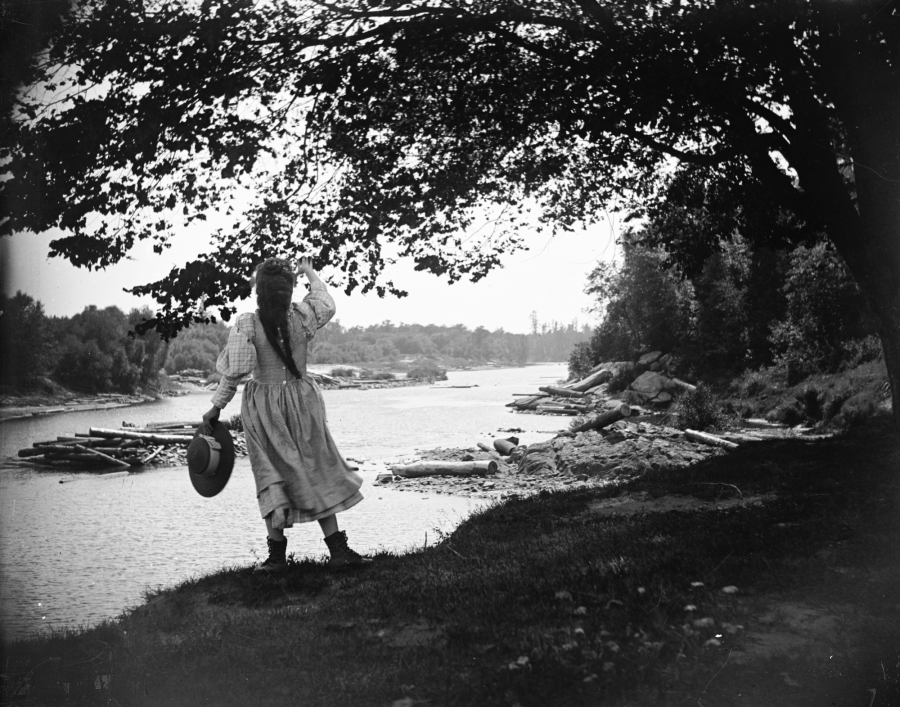
A native of Ohio, Michael Lesy moved to Madison in the late 1960s for an M.A. in American history at the University of Wisconsin. He and his friends from New York City, where he’d gone for undergrad, were not so sure where in America Wisconsin was, exactly. “To the best of my knowledge, it was near Wyoming,” he recalled later, “since, as everyone knew, the states were arranged alphabetically, east to west, from A to Z.” Lake Mendota was beautiful and its women were gorgeous, but the New York Times came two days late and Lesy became bored. Breaking from his studies, he wandered idly into the Wisconsin Historical Society, where the photography director — a “twinkling magician” — introduced him to a trove of images made around the end of the 19th century by a man named Charles Van Schaick, the town photographer of a Wisconsin county seat called Black River Falls.
It was the eyes that got him, staring intensely from what seemed like long ago and far away, though it was neither, removed by six or seven decades and a two-hour drive. Silently they spoke to Lesy, the people of Black River Falls: solemn old women with faces like skeletons, drunken men playing fiddles or posing with fish, families arranged stiffly in front of barren fields or wooden shacks, loggers glaring murderously out from snowy pines. Now and then there appeared a Native American dressed in white man’s clothes, a woman laughing as she wrapped live garter snakes around her neck, a man of no distinction until you noticed his two prosthetic legs. More photos than you might expect showed tiny, horrible coffins, inside of which were infants, eyes shut in what looked like sleep. From this cache of glass-plate negatives taken between 1890 and 1910 and left to sit for decades after the artist died, Lesy culled the images of Wisconsin Death Trip. Arranged just so, the faces — unsmiling, wild-eyed, Scandinavian, touched by some obvious madness — convey a collective psychic crisis of the sort I witness regularly on public buses and trains and in the eyes of those who record front-facing videos on their phones.
Lesy began to investigate the town where Van Schaick took his photos, disappearing into the cold, dark reading room where old newspapers were reduced to stamps and wound around the spools of microfilm machines. Alongside standard local-news fare — births, betrothals, church suppers — accumulated tales of murder, suicide, arson, insanity, epidemic diseases, starvation, poisoning, and infanticide, interspersed with stories of ghosts and lake monsters, pyromaniac women and grisly men in the woods, elderly people with religious mania, and people mistakenly buried alive. Men set fires for business and pleasure or freeze to death in their sleep. Women throw themselves in front of trains or into wells or slash their own throats with sheep shears. Entire families are killed by diseases: diphtheria, cholera, smallpox, or croup. People drink arsenic, carbolic acid, or an emerald insecticide called Paris green — or they eat match heads or swallow cigar stubs, or hit themselves to death with hammers, or explode themselves with dynamite. All this in a small town in Middle America at the end of an era called the Gay Nineties. All this in Black River Falls.
A curious effect of the late-19th-century photographic process is the way that people who presumably love each other might appear as if they’ve never met before. There is a loneliness trapped in Wisconsin Death Trip’s photos, the rigid poses and stern expressions emphasizing the distance between family members, man and wife, or the members of a band. What intimacies there once were between these people have been lost to time, and what remains is the appearance of a society of strangers who brush against one another as they drift through life alone. Through their various estrangements, their mysteries endure. Who is the girl in the family portrait who appears to have been struck by lightning? Who is the man obscured by shadows standing beside a coffin that carries a five-year-old girl?
Lesy believed that he had stumbled upon a nucleus of chaos, but that wasn’t exactly true. State statistics showed Black River Falls was not extraordinary, with mostly normal rates for mental health, mortality, crop production, and crime. The psychedelic drama of the rural Wisconsin community proved to be surprisingly consistent across the region. One out of every 472 inhabitants of Jackson County was certified as insane in 1900, slightly less than the state average. Suicide rates around that time echoed the state average too. Records from the Mendota State Hospital for the Insane described similar paranoias shared across the region: nervous fantasies that neighbors, relatives, and governments were conspiring to make the patients poor and miserable.
What happened at the end of that century in the heartland to have inspired this concentration of terror and estrangement? One of the most extreme financial crises in American history, to start with. Concurrent with the pageantry of the Chicago World’s Fair, the crash that hit the country in 1893 set off a chain of bank closures, bankruptcies, and farm failures, causing unemployment rates to soar and poverty to spread throughout desperate rural communities and the slum districts of cities. Paired with the threat of epidemic diseases and the long, cold Wisconsin winters, Black River Falls’ catastrophe comes more clearly into view. Its residents, who’d mostly settled there from Norway, Germany, and Sweden, had come searching for the American dream and woke to find themselves inside the American nightmare.
And still these pilgrims held faith in the idea of America, where yellow-brick roads lead to emerald cities. For those unswayed by what remained of the frontier myth, or daunted by the responsibilities of living off the land, there were the cities — “symbols, occasions, and places of choice,” as Lesy wrote in the book’s conclusion, where people could escape the tragedies of 19th-century country living for the spectacle of urban perma-adolescence. (Never mind that the cities were filled with immigrants poorer than the poorest farmers, discounted at will from the dream.) Those fleeing the crowded, degenerative cities, where progress bred exhaustion and crippled the nerves, could strike out for the inherent virtues of the countryside.
But more and more, it seemed that there were fewer places one could go to postpone the realization that they had been told a lie. Perhaps, as Lesy offered, the paranoia of those committed to the Mendota state asylum was not misplaced. Maybe they understood a truth that had escaped their neighbors — that what they had been promised was not what they got, that what had happened to them had not happened by mistake. “Those farmers in poor circumstances first went crazy because they were ashamed,” wrote Lesy. “Then they went even crazier because of the shock of understanding that the intricate webwork of friends, neighbors, officials, purchasing agents, rivals, relatives, creditors, and dealers didn’t exist to help, sustain, and encourage them, didn’t even exist to give them a good run for their money, but actually conspired to rob them blind, strip them naked, and steal the pennies off a dead man’s eyes.”
Spend enough time in the pages of Wisconsin Death Trip and you may start to feel affection for these Midwestern madmen and madwomen, these forebears of the indigenous American berserk. I myself have grown fond of the snake-handling woman, the beautifully stupid men in saloons, the tough-looking dwarf in his smart little jacket, the kids with their thousand-yard stares. There was the man who swallowed his false teeth while chewing a tough steak, the woman bitten by a dog who claimed she spoke to angels, the man driven to insanity over his obsession with building a perpetual-motion machine. Lest I forget Mary Sweeny, a frequently recurring character, who wandered the Upper Midwest habitually breaking windows, often under the influence of alcohol and cocaine. Some stories alleged that Sweeny simply wanted to see the country and broke windows for the free train rides offered by authorities so that she might leave their town and vandalize another.
But then I’m always falling for the people I find in the dark corners of the Midwest, a whole universe of strangers beneath what presents as a region of small-town familiarity. I meet the people of Black River Falls the same way I meet men in bars — as an interloper, someone just passing through. I like to hear their stories, to get lost in their lives, which are almost always crazier than they seem on the surface. They remind me that our lives are far more interesting than modernity has led us to believe.
Years ago, I bought Wisconsin Death Trip strictly for the title, imagining it as an ideal living-room prop for a melancholy woman of the Great Lakes such as I. What drew me to it then — a juvenile overinvestment in the morose and macabre — is not what captivates me now. These days, I marvel at the mix of terror and humor and folly that constitutes the spectacle of our shared American catastrophe. Between the photos and found text and Lesy’s own words, the cumulative effect is powerfully bleak. But just past the darkness is an idea: that even the most modest lives, like those of the people of Black River Falls, are suffused with psychedelic mystery, like when an old man tricks his undertaker by leaping from the coffin in which he was supposed to be dead.
As for the title, it bears mentioning that the hallucinations of death and rebirth to which Lesy referred were not bad trips exactly. Often psychic death can inspire a new acceptance of man’s fate and a sense of continuity through all earthly creations. Listen closely and you can hear the whispers of the madmen of Black River Falls that echo through the country as it dies slowly, like a star. No shock. No explosion. No tearing asunder. What you thought was the end is just the beginning.
I grew up thinking of the Midwest as void of drama and intrigue, dull as dirt compared to California or Manhattan or other exotic places I’d seen on TV. Nothing much happened in the suburb of Chicago where I lived: baseball games, church parties, the weekend farmers’ market, all known to me abstractly, ever the indoor child. On banners all through town were pictures of a ruggedly handsome man born there a hundred years before who had gone on to become the country’s best-known literary icon. But Ernest Hemingway never set a story in Oak Park, Illinois, and almost never returned there after leaving at 18 to witness wars and bullfights, romance beautiful women, and seek out other swashbuckling pursuits with which a man might fill his life. His 1933 short story “Fathers and Sons” took place in northern Michigan. Through the character Nick Adams, his autofictional stand-in, Hemingway addressed his own father who’d died five years before “in a trap that he had helped only a little to set.” Dr. Clarence Hemingway shot himself in the head with a .32-caliber Smith & Wesson revolver in 1928 in the family’s Oak Park home, just as Ernest would with a double-barreled shotgun in Idaho in 1961.
“Why do we never go to pray at the tomb of my grandfather?” asked Nick’s son in the story.
“We live in a different part of the country,” Nick answered. “It’s a long way from here.”
I was in my 20s and living on the North Side of Chicago — a short drive from my hometown but many lifetimes away — the night my father told the story of what happened when I was born. Given the difficulty of adopting infants in the ’80s, my adoptive parents (that is, my mother and father) brokered a handshake deal with a nameless Chicago woman who was pregnant but did not wish to be. Born on the last day of 1986, I turned up at my parents’ house a week later, where I spent the next few months as a “remarkably happy and content baby” who rarely cried and enjoyed the Beatles album Rubber Soul, as per my mother’s diary. My first word was “mailman.” This much I already knew.
The trouble arrived in the form of a letter written by the stranger half responsible for my genetic makeup — a Chicago police officer, as I understand it. The nature of the correspondence was to demand a transfer of $50,000, otherwise the man would file for paternity and my new parents would never see me again. Whether this had always been the plan, my father couldn’t say. Anyway, they went to court. Meanwhile, my mother hatched a plan to abscond with me to Canada should they lose, leaving my father behind to start a new life on a feminist commune. All this excitement in the first year of my suburban life! Happily, they won the case, which means I’m a citizen of the American Midwest. Later I would gain two sisters, my closest friends today despite the many efforts of Catholic busybodies to remind me that I did not share their fair Irish features as we loitered on the church steps after Sunday Mass.
By the time I heard the story, I had squandered most of my remaining good luck fashioning myself into a wannabe bohemian, a self-involved young hedonist clinging to the dream that “artist” was a career that still existed in post-2008-financial-crisis America. It was the dawn of a revolutionary era that promised salvation through endless self-expression accentuated by digital technology, the perfect front for young “creatives” to inflict their various personality disorders upon the world. I liked talking late at night on the internet to strangers I encountered through various dabblings in the hipster arts. Sometimes I’d even fly across the country just to meet them, or they would fly to Chicago just to visit me. But the quick and addled intimacies we’d established in our messages would usually evaporate when we came face-to-face, and I would part ways wishing we had never met at all.
I became a writer passively, practically by accident, the same way I did anything back then. Funded by my real job as a small-time drug dealer, I typed into the void for long enough that it became my job. Now and then, I wondered if my mother would be proud, having spared no effort to mold me into an erudite and bookish child, reading aloud each night and feeding my voracious appetite for the works of Gary Paulsen, Beverly Cleary, and R.L. Stine. But mostly I tried not to think about it. I’d been a 21-year-old loser when she died at 52 of stage-four inflammatory breast cancer, and being paid the occasional $200 to broadcast my opinions did not exactly salvage me from being one still.
I spent my nights, and sometimes days, in the kinds of local bars where pool cues were frequently brandished as weapons, jukebox wars descended into bloodlust, and bikers with recent stab wounds danced cheek to cheek with intoxicated grandmothers. The regulars of such places always seemed as if they turned to smoke the minute they left the bar; most of them presumably had homes and jobs and families, but their real lives unfolded in the tavern every night. All these years later, I can still remember Maria, whom I must have seen inside the bar 200 times but never once encountered outside — a 50-something woman with the spirit of a deviant prom queen and hair the color of sunlight filtered through tinted windows. Each time we met, she’d skim her phone to show me pictures of her daughter, who she swore looked just like me, though I could not see the resemblance. I mostly recall her as fantastically boy crazy, cozying up to whichever Polish guido or haggard Latin King she deemed most temporarily eligible, tousling their hair or waltzing across the sticky linoleum to Daddy Yankee’s “Gasolina” or the Doors’ “People Are Strange.”
As for me, I fell in love at first sight or not at all. The men I liked were sad bastards and charismatic psychopaths — junkie musicians, wet-brained poets, guys with broken noses or missing bicuspids who cried during sad movies. Sometimes I fell in love pre-sight, planning my wedding vows with the middle-aged biker who’d emailed me a mixtape or swooning at the typewritten letter from the novelist with whom I’d start a life just as soon as he was released from federal prison. Once, I moved across the country with a long-haired piano player I’d met a couple days beforehand in a late-night bar. Things were so romantic when the two of us were strangers. It’s once you get to know each other that the trouble starts.
I became a regular at a tavern on the far North Side of the city, a nautical dive with carpeted floors on a side street on the edge of Lake Michigan. I came to love the characters who spent their days and nights there with me — fellow gregarious Midwesterners with an air of tragedy, for whom the notion of sitting alone with their thoughts for 15 minutes registered as some kind of Promethean punishment. The regulars told better stories than the young novelists and critics whose works were sold as urgent, necessary reflections of our time. As if “our time” wasn’t precisely what I had been avoiding, whiling away the days and weeks not answering my emails, drinking Old Styles with divorced boomers who were losing their teeth.
A pandemic came and pushed us deeper into isolation, and when it ended, there was not a resurgence of joy and adventure, or a new sense of awe at the world that we shared, but more fear and misanthropy and self-pity and inertia. In the eyes of my neighbors was a new paranoia, a new mania sizzling the strands of the collective consciousness. People on the internet got meaner. People outside were lost in their phones. Bleeding men in hospital bracelets sat beside me on the train. I listened on repeat to a song by Lana Del Rey about driving fast on the highway at night. “I believe in the country America used to be / I believe in the person I want to become / I believe in the freedom of the open road.”
Through various means of abstention and evasion, I had arranged my life in such a way that it ran smoothly despite the fact that I was not, in the administrative sense, a capable woman. So when it came to cars — machines requiring arcane maintenance and incomprehensible paperwork — it seemed better just to walk. But over time, this refusal of responsibility became outlandish, a shameful imposition upon those around me. The more I entertained the thought of driving, the more the claustrophobia of the past couple years lifted, the more it seemed the only thing in life that mattered at all. And so I found myself, closer to 40 than 30, at the Elston DMV on a rainy day in late December, where a surly Czech man well into his 70s lowered himself angrily into my sister’s passenger seat. “Take a right outta this lot,” he grumbled. “This driving shit is for the birds. Why do you even want your license anyway?” I rambled some spiel about freedom, rock and roll, living fast and dying young, though that ship had sailed. “You’re not the worst driver I’ve ever seen,” the man allowed. “Keep your nose clean and you’ll be alright.”
Like magic, one month later, I found a post on Craigslist: a man selling his grandfather’s 1993 Cadillac Coupe DeVille — with a blood-red paint job, dashboard, and leather seats. The old man barely drove it, leaving the mileage at 14,000. In an instant I fell crazily in love and arrived at the Northwest suburban home of a disheveled Polish felon with enough cash to have alarmed the bank teller. I drove off with the feeling that I’d gotten away with something; truthfully, I probably overpaid. But for the first time in my life, I had a sickeningly cool car. As the first order of business, I drove my sisters to Racine, Wisconsin, for stuffed pork chops, shrimp cocktail, and brandy Alexanders at the Hobnob supper club, where a good time was had by all.
These days, I might drive three hours to Indianapolis for a pork-tenderloin sandwich or seven hours to a bar in northwestern Wisconsin with no running water, minimal electricity, and plywood walls. There is no better feeling than driving down a lonely two-lane highway past endless rolling farmlands or through the deep Northwoods. Sometimes I go out on a whim, looking for I don’t know what, but usually I find it anyway. I pull up a barstool, nod to my neighbor. Hello, stranger.
Before I retired the Caddy for the winter last October, I made a visit to the Apostle Islands, watching the foliage of the mainland blur red and green and gold as the ferry made its passage across Chequamegon Bay. The group of islands in Lake Superior off the northern tip of Wisconsin is protected as a national lakeshore: land stripped of copper and timber in the early 20th century, now returning to its wild, primitive state. All but one of the 22 islands are presently uninhabited, home instead to the white-tailed deer, black bears, and bald eagles that live among the sandstone caves and old-growth forests. Only the largest, Madeline Island, is the exception, with a winter population that hovers around 300, expanding in the summer tenfold. Upon the bay’s annual freeze-over, island visitors are whisked over the lake by windsled until the ice is thick enough to drive a car across.
The island was the spiritual center of the Lake Superior Chippewa, who called it Mooningwanekaaning (“home of the yellow-breasted flicker”). Centuries before the Europeans arrived, the Ojibwe were guided by Kitchi-Manitou (“Great Spirit,” “Creator of all Things,” or my own favorite translation, the Great Mystery) to migrate to the place where food grew upon the water, a journey that brought them to present-day Bayfield, where wild rice grew in the marshes along Chequamegon Bay. Today, the island runs on summer tourism, though it remains the one place in Wisconsin aside from reservations with signage in both English and Ojibwe. “Gidanamikaagoo Mooningwanekaaning,” read a sign at the dock. “Welcome to Madeline Island.”
The visitor’s brochure I’d picked up at the Bayfield terminal advertised the island’s many art galleries, beach cafés, and kayak rentals. But it was halfway to November, the end of shoulder season, and what remained open for business were two restaurants, a grocery store, and Tom’s Burned Down Cafe.
The name of Madeline Island’s only bar is slightly misleading: There is no food at Tom’s Burned Down Cafe other than peanuts, although there is a Tom, whose place did indeed burn down. After his former bar was set ablaze in 1992, the owner — a notorious thorn in the side of the local chamber of commerce — built a new bar from its ashes. Well, perhaps “built” is a stretch. You might describe Tom’s Burned Down as a vast open-air junkyard partially covered by a tent from Big Top Chautauqua. The mismatched chairs were excavated from the island dump, the marble bar reclaimed from Bayfield’s Pureair Sanatorium. All other surfaces not embellished with birch branches were painted with one-liners ranging from alcoholic to anarchic, with quotes from Hunter S. Thompson (“I never advocated drugs, alcohol, violence, or insanity, but they have worked out well for me”) to Alexis de Tocqueville (“All those who seek to destroy the liberties of a Democratic nation ought to know that war is the surest and shortest means to accomplish it”). Flying from a mast at the center of the compound rose a painting of a phoenix bursting from the flames.
The gray sky threatened rain at any moment as I entered the island’s postapocalyptic Margaritaville, past signs that read “SORRY WE’RE OPEN” and “FOR SALE BY NEIGHBOR.” Immediately it was clear who were the tourists and the locals: The former huddled in hiking gear beneath palm-frond umbrellas, while the latter gathered at the bar in greasy workwear, dogs napping at their feet. A few had just finished their shifts at the marina, shrink-wrapping sailboats for winter storage. Others, with their beaded dreads and wind-burned faces, had more of a chronically unemployed vibe. “Dude, you gotta see this video,” a stoned 30-something in coveralls drawled to his friends. “This dog saves a baby from getting snatched up by an eagle.” “That’s totally AI, dude,” said his leathery companion. The crestfallen stoner took a swig of Spotted Cow, one of the few bottles left of the year’s dwindling supply. “Man, for real?” he said, sighing. “You could’ve fooled me.”
One could be tempted to make assumptions about the ideological spirit of a remote island dive bar in the far north of Wisconsin, but people and places surprise you more often than you think. Outside the bar, an F-150 had a decal on its rear windshield representing the driver’s family as two parent-size assault rifles and three child-size Glock 17s. Inside, a rainbow flag flapped in the breeze as a shaggy gentleman climbed atop the bar to gyrate to the music of SWV beneath a sign that read “LET’S MAKE GETTING IN TROUBLE FUN AGAIN!” The bartender’s earrings jingled as he poured the bar a round of shots — equal parts blanco, reposado, and pickle juice, which wasn’t nearly as repulsive as it seemed. No one noticed that it had begun to rain as the tourists and the regulars danced to “Brandy (You’re a Fine Girl).”
“I bet you guys don’t even know what this song’s about,” hiccupped the stoner.
“It’s about… Well, it’s about Brandy,” said the old fisherman beside him.
“No way, dude,” the stoner insisted. “It’s about way more than that.”
“Isn’t it always?” the fisherman replied.
Meaghan Garvey’s first book, Midwestern Death Trip, a memoir, will be available from Panamerica on May 12th, 2026.