The Golden Pineapple
The holy grail of the pineapple growers and how it destroyed Maui
A modern-day tale of the Garden of Eden
Man’s expulsion is followed by wildfires
There are many American dreams, of which the Golden Pineapple is one. As its name suggests, the Golden Pineapple — known upon its market debut as the Del Monte Gold — was distinguished by its Technicolor golden hue, as well as by its sweetness, the product of an ideal brix-to-acid ratio, and an unusually long shelf life that allowed it to be sold as fresh fruit even in the continental United States, where a pineapple, especially one grown in Maui, might take two or more weeks to reach a supermarket shelf.
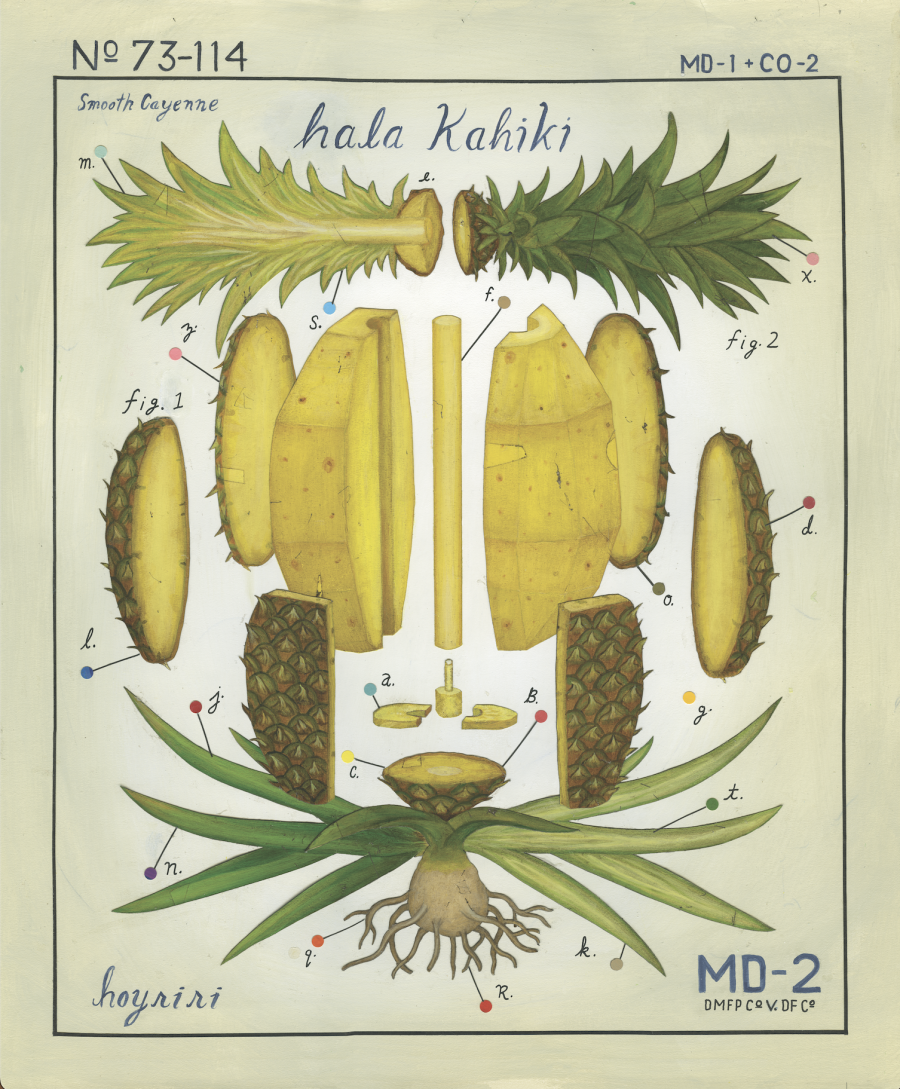
The Golden Pineapple was created by a methodical, decades-long breeding program sponsored by Hawaii’s three leading pineapple growers to create the perfect fruit. In the records of the Pineapple Research Institute (PRI), the Golden Pineapple was known as “the 73-114” — the identifying number which represented the year and the number of the pot in which it was grown. This end-product of over two million genetic crosses accomplished over forty years with the goal of creating the perfect pineapple became one of the most lucrative super-fruits since the apple.
The history of the creation and distribution of the Golden Pineapple has been told in part before, both in newspapers and courtrooms. It has only been told in part thanks to the fact that the records of the trials which adjudicated ownership of the pineapple were sealed by a judge in Miami, a venue that is not generally sympathetic to the idea that court records are public information. The first of these cases, which eventually numbered three in total, was a lawsuit filed by the fruit giant Dole — which originated the commercial cultivation of pineapple in Hawaii during 1909 and ruled the market into the 1990s — against Del Monte — which launched their Golden Pineapple into the marketplace while discouraging competitors from selling the fruit through a variety of methods that its attorneys have charitably described as “playing hardball,” and which others have disparaged as fraud.
What follows is an account of the discovery and propagation of the Golden Pineapple, backed by years of interviewing and personal research, and by the records of the Dole-Del Monte case which I now have in my possession after a New York judge agreed to unseal them for the benefit of my report (how this happened is its own story). What emerges from those records is an account of ambition, pride, greed, painstaking scientific research, and high-level corporate maneuverings. It is a story as old as time, rendered in the dry legalese of depositions and courtroom transcripts.
While these legal records explain, in remarkable and occasionally exciting detail, the how and the what of the Golden Pineapple’s development and propagation, they do little to explain the why any of it might interest a reader who is not already fascinated by pineapples. For that, one has to go back to the mystery of the apple with which Eve tempted Adam in the Garden of Eden, or to the somewhat analogous discovery of the piña de Indes — or “pine of the Indians” — by Christopher Columbus and his crew when they arrived in 1493 on the south Caribbean island of Guadeloupe. The moral of the story is the same in both cases: The belief that fruit has been placed on Earth for our enjoyment, without requiring us to think too much about the consequences of our appetites, is something to be wary of. The difference being that in the story of the Golden Pineapple, we invented it.
The end of the dream of the Golden Pineapple, that is to say, the idea of a consequence-free universe of human choices, can be dated with some precision, to July 1, 2025. On that date, Del Monte Foods, the 139-year-old company known for its canned fruits and vegetables, and now based in Walnut Creek, California, filed for bankruptcy, after securing $912.5 million in debtor-in-possession financing. “After a thorough evaluation of all available options, we determined a court-supervised sale process is the most effective way to accelerate our turnaround and create a stronger and enduring Del Monte Foods,” the company’s CEO, Greg Longstreet, said in a statement.
Del Monte’s bankruptcy, impelled in part by President Donald Trump’s 50 percent tariff on imported steel and aluminum, which pushed up the prices that the company paid for its cans, was part of a larger shift in the tastes of American consumers, who increasingly prefer cheap fresh fruit to canned alternatives — canned fruit being the product upon which the Hawaiian pineapple industry had built its fortunes. “Canning was the height of modern food preservation, and that height has grown stale,” explained Steve Zagor, a veteran food-industry consultant. (Del Monte Fresh, now a separate company specializing in the sale of fresh fruit, was unaffected by the bankruptcy.)
As for Maui, the Garden of Eden where the Golden Pineapple was born, the end of the dream had already arrived. Two years earlier, on August 8, 2023, a combination of high winds and dry weather led to one of the deadliest wildfires on American soil in over a century, since the Cloquet wildfire of 1918, which killed an estimated 453 people. At 12:22 AM in the town of Kula, a fire erupted, most likely caused by a power line that was downed by a felled tree. At 3:43 AM, evacuations of nearby residents began. By the next day, the fire had consumed over 1,000 acres. That same morning, a fire broke out in Lahaina, where a three-acre brush fire was reported at 6:37 AM, accompanied by winds gusting to upwards of eighty miles per hour. Evacuations were immediately ordered, and the fire was thought to be contained. By 3:30 PM, the fire had flared up again, forcing the closure of Route 30.
What followed was a scene of horror that will be seared into the memory of Hawaiians for generations. Gusting winds pushed the roaring brushfires through densely populated areas of the town, as residents, who had been told to shelter in place, tried to flee through the flames. As the fire moved towards the Pacific coast, firefighters found themselves without water to combat the blaze, which jumped the Honoapi’ilani Highway and entered the main residential neighborhoods of Lahaina. By 5:45 PM, the fire had reached the shoreline, forcing residents and drivers stuck in bumper-to-bumper traffic on the highway to jump into the ocean — to save themselves, as their cars burst into flames.
Burning off and on, for over three months, the Maui wildfires destroyed over 17,000 acres, killing at least 102 people, destroying 2,207 structures, and causing an estimated $6 billion in damage. They also surfaced the underlying tensions caused by the island’s development into a seemingly safe and neighborly paradise. Ordinary islanders — squeezed by the relentless increase of the cost of living and shortages of water — now had to reckon with the future of an island where large tracts of land are owned by billionaires like Oprah Winfrey, and where the price for a basic home is more than $1 million.
The wildfires, it turned out, were the entirely predictable result of the end of agriculture on Maui — a change directly brought about, in almost Biblical fashion, by the discovery of the Golden Pineapple. By creating a perfect fruit, with an alluring color, great taste, and a long shelf-life that was resistant to bugs and could be grown more profitably elsewhere, Maui had unknowingly written the end to the culture of pineapple growing and canning that had dominated the island’s economy and land-use patterns since the beginning of the twentieth century. As a result, tens of thousands of acres that had formerly been devoted to cultivating pineapples now lay fallow and untended. In place of pineapples, whose rough, alligator-like skin functions as a natural fire-retardant, the empty pineapple fields were filled with dry grass and brush, which fed the flames.
That the end of pineapple cultivation was turning Maui into a giant tinder-box waiting for a spark had been noted for a decade or more by botanists and scientists who studied fire, and who warned time and again of the devastation that a wildfire could wreak on the island. Clay Trauernicht of the University of Hawaiʻi at Mānoa had particularly warned of the risk posed by the rapid spread of nonnative invasive species like guinea grass. The absence of agricultural workers also meant the reduction of fire-fighting capacity and expertise, and of the early-warning systems that once stopped wildfires in their tracks. When Trauernicht suggested that Hawaii subsidize agriculture as a way of reducing the risk of wildfires, his suggestions were ignored by the State Legislature, which chose to do nothing to address the threat.

Maui is a place with a long history, only part of which has anything to do with pineapples. An even smaller part of the island’s history has to do with me. That said, I have long been fascinated by the marriage of Maui and pineapples — and the resulting worlds of pineapple growers, pineapple scientists, thieves, and smugglers. I have also long been interested in the sons and daughters of New England missionaries who made pineapples a symbol of the Hawaiian islands, as well as the sons of CIA agents and the daughters of music producers who were big here in the 1970s, all of whom are among the galaxy of odd characters whose trajectories have variously intersected with mine on the island. I also love pineapples. So be forewarned: If you are in any way allergic to pineapples, you are probably better off jumping to some other section of this newspaper, starting with the classifieds.
Islands exist as much in the imagination as they do in real life. That’s true of everywhere, of course, but the imaginative nature of islands is distinctly inspiring to the human spirit, particularly the islands of the tropics. It’s easier to dream when you are surrounded by palm trees, colorful butterflies, and an ocean that takes up the entire horizon with the nearest continent over a thousand miles away. They also make it easy to do nothing — dreaming big while doing nothing being one of the characteristic pleasures of island life. A drunk can easily be king of an island, or at least believe that he is king. Meanwhile, the dreamers who surround him are probably too busy warming their toes in the sand and drinking piña coladas to tell him or her otherwise. Artists, starting with Paul Gauguin, love islands for exactly this reason. So do businessmen, rock stars, hotel developers, sailors, the captains of cruise ships, wealthy drug addicts, pretty girls, and nearly every other type of person on Earth. At some point or another, most of us have dreamed of cutting loose from the moorings of a civilization that we can all agree is somewhat rotten.
What makes me different from the usual run of people who fantasize of running away to an island, is that every decade or so I acquire the courage, plus some share of the capital required, to pull it off. I spend my money this way, in part, to spite my father, who grew up destitute — and as a result never quite managed to escape the demands of the many people, including his children, who all manifestly depended on him, and who in his mind required him to be responsible. I recall at one point a brief business trip to San Diego that became a serious bone of contention which nearly destroyed his marriage to my mother, whose pretense of tolerance apparently did not extend to allowing her husband to check into a hotel for a weekend without her. Whatever my mother imagined him doing in the course of his busman’s vacation, their dispute cemented my own ideas that slavery in the guise of marriage was bad, and that a man who worked as hard as my father did deserved at least a long weekend away from his family at least every few years, whether he chose to spend that time sailing, or spear-fishing, or consorting with native women, or eating hamburgers. I experienced my father’s renunciation of his manhood in the face of my mother’s pleas as a betrayal of his own manly independence, for which I never entirely forgave him.
My father was a convenient symbol of male responsibility to rebel against. It is therefore fair to say that I owe to him many of my subsequent rebellions, which have included covering wars, taking drugs, engaging in illegal activities and serial promiscuity, marrying and then divorcing my first wife, forgetting to come home for Thanksgiving, pissing on the grave of John Calvin in Geneva (I told my father that I did this; it wasn’t true), racing German sports cars on the country roads near my farm (his father’s entire family died in the Holocaust), as well as inventing the occasional harmless fiction. In other words, I made a point of leading the adult life he was too responsible to lead, both as a gift to him, and as a way of banishing his shadow.
The islands were mine. I went there to smoke dope, do mushrooms, and oogle the natives. Of all the islands I have visited, Maui is by far my favorite. The most memorable affair I had there, long ago, was with a half-Japanese girl whose father was a music producer who had worked with both Graham Nash and Willie Nelson. His father was the scion of a New England missionary family who lived out his destiny as a spy in Southeast Asia at the same time that my father was doing similar work for the British government in Berlin.
Neither myself nor the girl, who I will call Jenny (I’d estimate that half my more serious paramours have carried that honest but unbeguiling name), had anything to do with the Cold War spy games. I liked her because she was pretty, and enjoyed hallucinogenic drugs. One night, we hiked to a park inside a giant crater and ate some mushrooms and looked up at the night sky. I recall being intensely aware of the scent of the dark foliage, and the weight and intensity of so much life in one place. The night sky was alive with the brilliance of the constellations, and with what appeared to both of us as a form of bioluminescence, of the type one might see while deep-sea diving, that was itself alive. Above us was the living light, furling and unfurling itself in the form of giant algae-like forms, which were clearly having thoughts of their own. At daybreak, we climbed back down the mountain and returned to her car, which she drove to her house in the town of Haiku — a one-bedroom shack with a long covered porch overlooking the ocean, where we spent the day alternately dozing and making love. It was paradise.
That was thirty years ago, when most of what is now prime real estate on Maui was still cane and pineapple fields. If you were lucky, you could still catch Willie Nelson playing in town at a bar he owned in Pāʻia, which doubled as a breakfast joint that served the best banana pancakes in town. Twenty minutes up into the mountains, locals grew the world’s most famous dope — which was flown off the island from private airstrips or packed it onto yachts owned by rich hippies who threw it into the ocean off Malibu to be recovered by local lobster divers and other enterprising fellows with fast motorboats.
Maui has a particular energy of its own. There were energy vortexes here, or so Jenny believed. Her father believed it, too. Most of the people he knew here, like Willie, felt tapped into a particular frequency on Maui, which led them to pick up from wherever they were and move here. Before the shadow fell, and experience robbed me of the capacity to feel in isolation from my knowledge of the habits of deceit that are common to all mankind, Maui was a kind of sacred garden. That some part of that enchantment still remains — despite the Oprah Winfreys and Mark Zuckerburgs of the world buying into the place and closing the roads to local residents during times of disaster — is no small consolation. Unfortunately, though inevitably, walking the line between overpowering natural beauty and the force of the illusions it engenders is a balancing act that often ends badly both for the residents of the island and for the people who visit here.
In the late afternoon, Jenny and I might drive into Pāʻia for a shaved ice, served in a paper cone. Flavored with syrups, the magic is purely in the ice, whose very existence here in Hawaii appears to contravene the laws of nature — gorgeous, crystalline, and cold to the touch. You can add as many flavors as you want, at fifty cents each, until you transform what should be a light and refreshing confection into a puddle of syrupy sludge, at which point there is no recovering the magic.
Like pineapples, the question of where ice comes from is frankly a lot less interesting than the simple fact that it exists at all. Science tells us that at temperatures below zero, water molecules abruptly rearrange themselves in a specific configuration that looks, feels and behaves according to an entirely different logic than water does. You could spend your entire life around water and never even remotely imagine that it could turn into ice. Scientists call this kind of transformation a “phase-shift.” Ice is a property of water, or rather a potentiality that is inherent in water, one that is invisible to the naked eye. But it’s still there, even though in large parts of the world there is plenty of water that will never become ice, naturally formed.
In Hawaii, until very recently, if someone wanted to actually see or feel ice, they would have to find someone else who was fortunate enough to know someone who had access to a block of ice that came from some far-away missionary place like Boston, packed in sawdust and then shipped by railroad across the country to San Francisco, and then shipped to Hawaii. By the time it arrived, the layer of sawdust on top of the ice had turned black, which was the color that the dock-workers who hosed off the ice would probably associate with this bizarre new substance and tell their children about. The chopping of the ice would take place in a hurry, with consignments packed up into insulated containers to be sent out by rail and/or horse. By trading on connections and friendships, some of them no doubt going back to one’s childhood, a fortunate boy, with trembling hands and liquid brown eyes, dressed in clothing decorated with bright-colored thread by the hand of his mother, might gaze upon a wee fragment of ice, and even hold it in his hand, then watch it melt away into nothingness.
A phase-shift. That’s one explanation for what happened. The other explanation is that there were never any such places as Maui or America to begin with. Both were products of the human imagination. Today, only traces of Mauiness or Americanness can be plausibly detected in either place, even by the most advanced machinery of our time, despite the fact that both remain clearly labeled on maps. Such is the result whenever we take something from the crystalline realm of imagination and make it manifest on a planet inhabited by human beings. Very little of what we do on Earth can be redeemed, at least not by the hand of other human beings, who are not so different from ourselves. When you think about this basic truth for a moment, you realize why the idea of God has proved itself to be essential at so many different points of time, both here on Maui and also everyplace else. Such is my preface.
Escape can fuel the imagination. Yet it is also, generally speaking, a fraud. That’s because we are inherently social beings, thrown into states of deep enmeshment with other beings, and with the communities and places where we are born and raised, and whose deeper reverberations and echoes in our psyches we are unlikely to ever out-run. That’s why the promise of self-invention, upon which so much of America’s optimism is premised, so often turns tragic. Our lives are simply too short, while the chain of consequences that binds us to the past and to each other stretches much further back than we are aware of, and continues on into a future that none of us can see. It matters very little whether we wake up one morning and declare that we are free. We are all merely links in a chain that keeps on changing.
Simple and unadorned, the Po’okela Church is a place of clean Puritan lines with a vaguely nautical feel, a reminder of the people who came here on boats from New England. The Church’s name, which means “striving for excellence,” is a reference to the Hawaiian saying Ahuwale ka poʻokela i kāu hana iā haʻi — as in, “It is through the way you serve others that your greatness will be felt.” Built in 1843, it overlooks the cowboy town of Makawao and the open fields beneath, which extend down nearly to the bay in Pāʻia. The church’s clean, simple outline on a hill serves as a point of intersection between two powerful and opposing fields of energy, connecting the Puritans who came here to the land of plenty and desire, which they hoped to tame.
As its Hawaiian name indicates, the church was built to instruct the natives in the Christian faith. Later, it served the Japanese and Filipino laborers who worked the sugar cane fields and picked pineapples, whose descendants still make up the majority of its congregants today. The higher-ups in the local fruit and land companies, including the descendants of the New England missionaries who gave Hawaiians back their language in written form, and taught them to read the gospels, worshipped down the hill, in the posh chapel of the Union Church, with its wooden pews and gorgeous pipe organ. The Union Church was removed from its original spot higher up the hill after Perrine Baldwin, one of the two Baldwin brothers who owned nearly all the land here, got his arm chewed off by a sugar-cane crushing machine. After he recovered, he tore down the sugar shed where he suffered his injury and endowed a new church atop its ruins.
Both Po’okela Church and the Union Church below claim the same founder, the Reverend Jonathan Green. A New England missionary, he was born in Lebanon, Connecticut, in 1796 — a mere six years after Rhode Island, the New England colony founded by the great Roger Williams, who originated the idea of “soul liberty” that resulted in the American separation of church and state, became the thirteenth and final state to ratify the US Constitution. Arriving in Honolulu in 1823, the Reverend Green, an ardent abolitionist, spent nearly twenty years in missionary work, during which he caught the eye of Chief Kiha of Makawao, who asked him to minister to the people of his district. Green founded Po’okela in 1843 before accepting a commission as a land agent from King Kamehameha III to sell 2,000 acres of government land to Hawaiians, in the hope that they might better their lives through agriculture.
The plain, whitewashed interior of Po’okela Church boasts nothing so grand as the pipe organ in the Union Church. Two couples sitting next to each other in a rear pew are conspicuous in their relative youth and vigor; they are in their late thirties. Everyone else here appears to be above the age of 70, with the exception of the minister, Dr. Kimberly Fong, who holds a Doctor of Ministry degree from the San Francisco Theological Seminary. Dr. Fong encourages a lively personal relationship with the Holy Spirit, which serves to fill up the God-sized space that is inside each and every one of us. Even if your circumstances don’t change, she preaches, you change. The congregation reads from the New Century Hymnal, which is published by the Pilgrim Press of Cleveland, Ohio. We read together from Hebrews 13:8: “Jesus Christ is the same yesterday and today and forever.”
I am not a particular fan of the obnoxious tone of the Book of Hebrews, which argues that Jesus is greater than angels, Moses, the Jewish high priesthood, and God’s Covenant with Israel — much of which contradicts both the spirit and the letter of the rest of the Gospels. Without the Jews and their covenant, there is no God of Israel and no Christ. To be a Christian is to embrace the humility of being a guest in someone else’s house. The gentiles who were called out from among the nations to become a New Israel were given a unique license to participate in a story authored by someone else. That is the meaning of God’s grace.
That said, I believe that the gist of the sentence that the congregation reads aloud together to be true. God is unchanging and eternal. We are the ones who embody flux. Today, only six percent of Hawaiians are the pureblooded descendants of the peoples who lived here before European settlers arrived. Perhaps eighty percent of Hawaiians lack any Polynesian blood. Former US President Barack Obama, whose direct ancestors came from Kenya, England, Ireland, Wales, Germany, and Switzerland, and whose step-father was Indonesian, is a far more typical Hawaiian than Moana, who is a fictional cartoon character. Of the colorful flowers that are commonly used to make the fragrant decorative leis beloved by tourists, only jasmine and hibiscus are native to the island: Orchids, plumeria, and carnations were all brought here by missionaries.
Pineapples, the fruit most commonly associated with the Hawaiian Garden of Eden, were brought from South America to Europe before arriving here by way of the grandchildren of the New England missionaries, whose original mission was to save the souls of the natives. Pineapples are both products and symbols of the far less selfless second wave of American imperial ambition that emerged out of the American Civil War. By firmly subordinating southern planters, midwestern farmers, and western ranchers to the superior force of industrial capital, the North’s decisive victory over the South gave America the world’s first modern economy, rooted in war-time methods of mass production, which helped bring about the giant industrial fortunes of the Rockefellers, Carnegies, and Fricks, which in turn rested on the great combinations for raising capital captained by the Drexels, Morgans, and Mellons. Uniting the fortunes of these arrivistes with the old social hierarchies of the victorious North, a new governing class was proclaimed, the so-called WASPs (White, Anglo-Saxon Protestants) who carved pineapples in marble on the entrances to their lavish Newport mansions, stuffed full of the treasures of the Old World and which Americans now bought at a relative pittance, as the global balance of wealth and power — which in the minds of the WASPs was proof of God’s favor — tilted towards the United States.
Today, three months after the fires were supposedly doused, the empty pineapple fields of Maui continue to smolder. The smell of burning foliage gets stronger as you drive towards Makawao, a cowboy hill-town that became a refuge for hippies, artisans, and glassblowers. It was here that I first tasted the pineapple that would take over the world.
“A fruit like this comes along only once in a lifetime,” C.J. Ingles, executive vice president of Texas-based Le Best Banana Company, a competitive producer, told the Wall Street Journal when the story of the Golden Pineapple’s birth on this island first became public. “It’s even more rare that one company would control it. Del Monte had a beautiful ride.”
The story of the Golden Pineapple, the fruit that would lead to the greatest explosion of pineapple wealth that the world has ever seen, and to the end — or nearly the end — of pineapple cultivation on the island, which would lead in turn to the emptying out of tens thousands of acres of agricultural land to be consumed by fire, began nearby, at the Pineapple Research Institute — a joint research project run by a combination of Dole, Fresh Del Monte, and the Maui Land & Pineapple Company. In 1973, the director of research at the PRI was an eccentric English botanist named David Williams who spent the better part of his working life on Maui in pursuit of the holy grail of pineapple growing — a sweet, low-acid fruit with a long-enough shelf life to still be sold fresh on the mainland. The fruit of the pineapple growers’ dreams would close the gap between the pineapple of American movies and songs — the luscious, symbolic apple of the Hawaiian islands, imperial America’s Eden — and the disenchanted brown fruit available to mainland consumers.
In 1973, David Williams was experimenting with a series of genetic crosses intended to improve the standard pineapple grown on Maui, known as the Champaka. The third of five children, Williams grew up in Watford, north of London, and attended Reading University, where he earned a degree in horticulture. After falling in love with a girl from Norway named Elsa, Williams taught himself to speak Norwegian. The young couple married in Bergen. Williams then found a job on a fruit-breeding research farm in Manitoba, where Elsa would follow him with their three young children. He then earned a doctorate as a plant breeder in Madison, Wisconsin, writing his doctoral project on green beans. After returning to Norway to work on the docks, Williams was offered a job running an experimental breeding station in Maui. There, Williams introduced Protea to the island from South Africa. The Williams would have their sixth child Kristin on the island. Williams was planning to move on to Christ Church, New Zealand, when he was offered a position at PRI, developing pineapples.
As it happened, relatively few Americans outside of Hawaii and some growing areas in Latin America had actually eaten fresh pineapple. Those who had usually encountered a fruit whose withered brown exterior and bitter, often-half-rotten interior made them wish that they had stuck to eating the fruit from a can. The PRI’s job was to make the experience of eating a fresh pineapple live up to its place in the American imagination.
Genetic cross 73-114 caught everyone’s attention, beginning with the golden hue of its skin, compared to the Champaka’s pale yellow. It was also sweeter, less acidic and highly resistant to parasites and internal rotting. In this new fruit, the 73-114, known for our purposes here as the Golden Pineapple, David Williams achieved the impossible — a pineapple that was nearly twice as sweet as its predecessors, and lasted twice as long on the shelf, with a golden flesh that appeared to be lit from within, like the fruit in an Esther Williams movie. “We knew we had a remarkable pineapple,” Williams later recalled in a deposition. However, the big fruit companies took little interest in Williams’ innovation in the 1970s — an oversight that can be attributed to the large expense (to say nothing of the risk) of growing an entirely new pineapple variety from scratch and then devoting thousands of acres over a period of three or four years to its cultivation before obtaining a marketable crop.
In 1987, Dole withdrew from the PRI and the institute dissolved. The seedlings from Williams’ experiments were turned over to the group’s other two members: Fresh Del Monte, and the Maui Land & Pineapple Company — a Hawaii-based real-estate and agricultural company. Del Monte shipped its 73-114 genetics to Costa Rica, where they soon took over 15,000 acres of former coffee plantations and virgin forest located between the Pacific Ocean and the Cordillera central mountains. In the late 1980s, Del Monte started selling small amounts of Williams’ Golden Pineapples that were grown in Costa Rica under the product name “Gold Extra Sweet.” Some were shipped to Publix stores in Florida and some to Stop & Shops in Boston, where the fruit quickly sold out via word of mouth. In 1996, Williams left Hawaii for Fort Collins, Colorado.
That year, Fresh Del Monte rolled out the Golden Pineapple (73-114) nationwide, raising the price as high as $20 for a 25-pound box of five to seven pineapples, and using demand for pineapple to sell more crates of bananas and melons. However, when Del Monte tried to patent their 73-114 in 1992, the company ran into two problems: First, Maui Land & Pineapple, which co-owned the rights, refused Fresh Del Monte’s terms for a joint patent; second, Del Monte had already been selling the fruit for years, violating the patent rule against prior sales.
So, in 1994, Fresh Del Monte quietly secured a patent from the US government on a different pineapple bred by Williams during 1973 — the 73-50. The 73-50 and 73-114 are genetic siblings, both created at the Pineapple Research Institute. Like the 73-114, the 73-50 had a “sweeter, more vitamin-C rich fruit,” and a “uniform yellow color,” according to the patent description. The 73-50 was also well-suited to the climate of Hawaii, which is where Dole has historically grown many of its pineapples. Meanwhile, Fresh Del Monte continued to sell the 73-114. In a July 1993 internal memo, Mike Pereira, then Del Monte’s vice president for North America, explained that the company had secured a patent for 73-50 that would “confuse our competition” into thinking the 73-114 was also a “proprietary variety” that belonged to Del Monte.
Despite these efforts, Dole succeeded in building its own plantation in Honduras to grow the 73-114. In 1999, the company started selling its pineapples in the US under the brand-name “Dole Premium Select.” Fresh Del Monte fired back with a lawsuit, claiming Dole “misappropriated the most commercially valuable pineapple in the world.” Notably, Del Monte carefully avoided accusing Dole of violating its patent. Instead, they accused their competitor of having stolen the physical seeds from which its rival then grew its crop.
Dole countered that its seeds were obtained through legal channels — including at a public function where Fresh Del Monte employees served up 73-114’s fruit to guests, among them Del Monte’s competitors, who later retrieved the crowns of the fruit by going through the trash. Dole also raised questions about the scope of Fresh Del Monte’s patent, and said the threatening letters the company had been sending to growers of the 73-114 pineapple that mentioned the patent amounted to fraud — since the patent in question only applied to the 73-50.
A major point of contention between the two companies during the trial was the origin of what came to be known as “the seven seeds” from which Dole had supposedly grown its crop. According to Fresh Del Monte, Dole got its first 73-114 seeds from a plantation in northern Costa Rica called Cabo Marzo. According to testimony from growers, the Cabo Marzo plantation got its seeds from a mysterious “stranger,” who came to the farm with only seven seeds, from which the thousands of acres of 73-114 being planted in the country today originated.
Dole claimed that the means by which they had obtained their 73-114 seeds — including their retrieval of crowns from the trash at a Del Monte function — were entirely legal. Del Monte dismissed Dole’s account of how they obtained the seeds as a fiction, and accused their competitor of having stolen the fruit from Del Monte’s plantations. Ultimately, neither pineapple titan was able to prove anything about the origins of Dole’s seeds, and in a response to a motion by Dole, a federal magistrate in Miami ruled that in “sending threatening letters, Del Monte intentionally committed a fraudulent act.” The letters, the judge said, contained the “implication” that the 73-114 pineapple “was covered by the [73-50] patent, which Del Monte knew was false.”
If this seems mind-bendingly Pynchonesque, or like a particularly complicated plot-point from a William Gaddis novel, that’s because it is — proving that many of the greatest stories in American life are written by large corporations, which after all have the same standing before the law as people.
Fresh Del Monte and Dole settled the case, putting the records of their legal shenanigans under seal. When David Williams died, in 2019, the records of the case remained under seal, making it impossible for his six children, 14 grandchildren, and 12 great grandchildren to gain any recompense for Williams’ development of the fruit.
The man generally credited with bringing pineapples to Hawaii is Don Francisco de Paula Marin, a trusted advisor to King Kamehameha the Great. On January 21, 1813, Marin noted in his diary that he planted pineapples and an orange tree, which gives us at least an approximate date for when the fruit was introduced to the islands.
The idea of commercial pineapple plantations was brought to the island nearly a century later by James Dole, the father of the multinational fruit company that still bears his name. The scion of a Massachusetts Puritan family, Dole was a descendent of Wigglesworth Dole, who took his first name from his relative Michael Wigglesworth, the Puritan minister, physician, and poet whose memorable tracts against masturbation and nocturnal emissions culminated in “The Day of Doom” — an early New England best-seller. James Dole also happened to be the cousin of Sanford Dole, who became governor of Hawaii after the overthrow of Queen Liliʻuokalani in 1893.
Arriving in Honolulu on November 16, 1899, at the age of 22, with a suitable bankroll in his pocket, James Dole purchased a 64-acre government-owned plantation on Oahu, where he decided to grow pineapples. As the popularity of his product grew, he constructed a cannery and packing plant near Honolulu Harbor and took out advertisements in prominent American magazines to promote his pineapples. It became one of the first successful nationwide consumer ad campaigns in United States history, so to keep up with demand, Dole invested in a machine invented by Henry Gabriel Ginaca that could core 35 pineapples per minute. By the end of World War I, Dole put together a capital investment fund that he used to buy the Hawaiian island of Lāna‘i, which he turned into the world’s largest pineapple plantation. With over 20,000 acres of pineapples picked by imported foreign workers and canned by machines, Dole’s juggernaut drove noncooperating producers on the islands out of business, leaving his company with control of over 75 percent of the world’s pineapple crop — a near-monopoly position that it maintained until the arrival of the Del Monte Gold pineapple.
Dole also purchased land on the island of Maui, where he faced competition from Henry Perrine Baldwin, son of the missionary and physician Dwight Baldwin and cofounder of the land company of Alexander & Baldwin. Like the Doles, the Baldwins were Puritan missionaries from New England, who were originally drawn to the islands by the opportunity to convert the natives. A graduate of the Punahou School in Honolulu, founded by the island’s Puritan aristocracy and later to graduate Barack Obama, Baldwin returned to Maui and went to work for his brother David running a small sugarcane farm.
Dwight Baldwin, the boys’ father, was a legendary figure on the island, respected for his personal rectitude and skill as a physician, and for his personal attention to public health, for which he repeatedly risked his own personal well-being. Baldwin was especially close to the ruling Hawaiian family of King Kamehameha III, which would be replaced at the end of the century by the regency of Sanford Dole.
Baldwin arrived in Hawaii on June 21, 1831 from New Bedford, Massachusetts, and opened a seaman’s chapel at Lahaina, where he preached temperance and assisted in the translation of the Gospels into the native tongue. King Kamehameha III, Maui island governor Hoapili, and his wife Queen Kalākua Kaheiheimālie regularly attended his church. The missionary period of American settlement in Hawaii, of which Baldwin was a part, lasted from approximately 1820 to the outbreak of the American Civil War, and was directed by the American Board of Commissioners for Foreign Missions (ABCFM) — America’s first independent Christian missionary organization. Founded in 1810, the Board made Hawaii a particular focus of its early efforts, sending about 184 men and women divided into 12 companies to the island to carry out its goals, which included creating an alphabet for a written version of the Hawaiian language and establishing schools where Hawaiian children could learn to read.
When a series of deadly epidemics, including whooping cough and measles, swept through the islands in October of 1848, Baldwin followed the royal court to Honolulu, where he took charge of public health. As he later recalled, “I can compare to nothing but a raging battle, with all its turmoil & its sad scenes of death & carnage. Never was I driven so to distraction, week after week, & month after month, with no respite.”
Unleashed by the arrival of the clipper ships — which could make the Pacific crossing in a fraction of the time and thus enabled the transport of live bacillus — the wave of epidemics continued for another decade, during which Baldwin traveled throughout the islands of Maui, Molokaʻi and Lānaʻi, establishing quarantines and vaccinating as many residents as he could in the hope of saving them from otherwise certain death. Thanks to Baldwin’s efforts, only a few hundred native Hawaiians died on Maui, compared to the many thousands of souls that were lost on Oahu.
Turn off Baldwin Drive, the long road that connects Pāʻia to the hills above Makawao, and you will quickly find yourself on curving dirt roads sunk beneath tall grass and earthen berms. Discarded washer-driers and black plastic bags swollen with rotting garbage sit by the roadside, beyond the stretch of which are empty fields as far as the eyes can see. These were mostly sugar cane fields, cultivated by Henry Perrine Baldwin and his brother David Dwight Baldwin. The remains of the Baldwin brothers’ operation sit a little bit further down the road, in the form of a decayed warehouse complex with long thin strips of corrugated metal peeling from its face. A gray concrete retaining wall hosts a colorful mural, proclaiming: “We have better things to do than drugs and alcohol.”
Those who are familiar with the lore of the New England Puritans who settled these islands will tell you that not all of the great ships that brought the missionaries to Hawaii came back empty. It is said that a group of Hawaiians came back on the early missionary boats and settled in Nantucket, where they married into the local African American and Native American populations. If you meet a person of native descent on Nantucket or Martha’s Vineyard, or in the old former whaling towns of Cape Cod, it is possible that person may have Hawaiian blood. Tashtego, the formidable harpooner in Herman Melville’s Moby-Dick, who comes from the town of Gay Head on Martha’s Vineyard, might have traced some part of his ancestry to Hawaii. The sponsors of the Pequod’s expedition, along with Captain Ahab himself, most likely had relatives who ventured there.
The fields above Pāʻia mostly grew sugar cane. First owned by the Baldwin brothers, they became the property of Alexander & Baldwin land company, then a sugar company, before passing into the hands of a Canadian hedge fund that merged with a California egg company which bought up all the land and water in the area on a ten-year agricultural plan. The hedge fund operates under the name “Mahi Pono,” which means “Do the right thing” — and no doubt they will. Until then, their holdings lie fallow, while the average home price in the area hovers around $1.9 million. The artificially enforced scarcity of developable land in Maui would be a sizable boon to the local descendants of the cane-cutters and the fruit-pickers if they generationally owned any sizable plots of land here, or had anywhere else to go. Alas, the future of the area can be seen in the drive up the hill, where rows of solar-roofed McVillas are already being built in cane field plots, turning this former agricultural landscape into Maui’s own version of Tuscany, by way of Malibu.
At the bottom of the hill is Pāʻia, a charming hippie town where the likes of Graham Nash escaped to record music and smoke Maui Wowie and frolic with the large green sea turtles who make the beaches their home. Effie Baldwin, heir to the Baldwin family name and a part of its fortune, grew up here in the 1960s. A slender blonde who looks a good twenty years younger than her actual age, Baldwin is at once elegant and down-to-earth — the perfect representative of an aristocracy that few outsiders here can recognize. Even though she is a direct descendent of Henry Perrine Baldwin, known within the family as H.P. — and despite also marrying into the Cameron family, which cofounded the Maui Land & Pineapple Company with the Baldwins and later grew the 73-50 as their “Maui Gold” variety — she rarely tasted pineapple growing up. “My dad fell in love with my mother, who is from Hilo,” she explains with a laugh. “And they had four children. And we all inherited from her a sensitivity to fresh pineapple. The bromine in it, the tenderizer tenderizes our mouth. The Maui Gold is different, because it is less acidic,” she adds. “But back then, it hadn’t been developed yet.”
Baldwin remembers Pāʻia of her childhood as a town with three stoplights and a few ethnic grocery stores. Before the era of condos and luxury hotels, only the most intrepid hippies and surfers came out here, which was hardly enough to provide an economic alternative to pineapple cultivation — even when they started growing dope. “They weren’t getting really rich on it,” she remembers, of the beginnings of Maui’s dope-growing period. “Then the quality improved, the strength improved, and they started to make more money, which changed the nature of the business, and attracted different kinds of people, more aggressive.”
“I lived on Molokai for a while, when my husband was alive,” she recalls. “The big shift there happened with crystal meth. That changed some things radically. And you found people who had thought marijuana was terrible, wishing, pining for the days when that’s all the kids were doing. I once teased my dad… ‘What about Maui Land & Hemp?’ And he looked at me, and he raised his eyebrows.”
“In my dad’s case, the decision to do the resort came through a series of acquisitions and mergers that he took on in order to regain control of the pineapple part of the company,” Baldwin remembers. “While our family had stock in Alexander & Baldwin, we didn’t have any control of the company. My dad, he went to Harvard Business School, he was working in the company, and then all the sudden it was like, ‘Dad’s home.’ He’s growing a beard. My mom says, ‘Well build me a fish-pond.’ My dad was a thinker, a philosopher, a darn-good writer, actually. But he was not a fish-pond builder. We’d go off and collect rocks and he’d build a fish-pond, and it would leak, and then he’d have to bring someone in to fix it.”
It was during these endeavors that her father, the last great Baldwin land-owner on the island, came up with a new strategy: He would leverage all the capital at his disposal to buy enough shares of Maui Land & Pineapple to gain a seat on the board, where he voted “no” on every proposal on which the board was asked to weigh in, bringing the company’s business to a stand-still. His price was simple: He would exchange his stock for two pineapple plantations, which he then took public in 1969, in order to raise working capital for two projects: An upscale resort in Wailea, and a pineapple plantation.
None of the Baldwin kids or their friends particularly liked going to church. Effie’s father didn’t go either. But Effie didn’t mind going with her mother. “I kind of liked reading the Bible, I thought it was really fascinating,” she remembers. “But the inconsistencies in the Bible were an issue for me. And that made the ability to give my heart, my soul, my life to an institution like the church completely impossible.”
Still, she inherited a regard for the Congregationalists and their mission, especially for Dwight — the missionary who taught Hawaiians how to read — and his son H.P., who was Effie’s great-great-grandfather. Henry Alexander Baldwin, H.P.’s son and Effie’s great-grandfather, also inherited significant regard for their mission, as well as his family’s land holdings upon which he added significant deeds.
“When Henry becomes an adult, it’s time for him to decide what to do,” she says, offering the version of history that was passed on through her paternal line. “His family are church people, which means they’re broke. He’s in Hawaii at a time when you know, it’s all horseback. Food comes on a boat, letters take forever to get anywhere. His friend, Samuel Alexander, was a little older than him, and he gets his first job in sugar cane in Wailuku, in a managerial position. My aunt did come up with a letter from Samuel to his brother, where he wrote, you know, ‘Poor Henry. He wants to be a man of letters. What a waste of time.’”
Instead, Henry Alexander Baldwin partnered with Samuel Alexander and began acquiring Hawaiian land with their company Alexander & Baldwin. The impetus for their activity was the Great Māhele, which was intended to provide secure title to indigenous Hawaiians. In practice, by opening a market in land, it allowed large tracts of land to pass into the control of the descendants of the New Englanders.
The 1839 Hawaiian Bill of Rights, also known as the 1840 Constitution of the Kingdom of Hawaii or the Great Māhele, was drafted by a missionary school alumnus named Boaz Mahune. It established a constitutional monarchy with executive, legislative, and judicial branches of government, along with a free enterprise system that included individual property rights. The Māhele supplanted the previous land system under which the kuleana (responsibility and obligation) to maintain the land was granted to an aliʻi nui (high chief), who received tribute from villagers who collectively worked the land. The Māhele, which came into effect on March 7, 1848, allocated one-third of the land in Hawaii to the Crown, another third to the traditional chiefs, and another third to commoners.
Under the Kuleana Act of 1850, commoners had two years to file their claims, which required a formal survey as well as two witnesses to confirm that the claimant had worked the land. On July 10, 1850 — while Kamehameha IV, Kamehameha V, and their missionary advisors were conveniently off the island — the legislature passed the Alien Land Ownership Act, written by Chief Justice William Little Lee, which allowed foreigners to hold title to land. Unclaimed lands were then sold by the Hawaiian Republic to settlers from the continental US, or auctioned to the largest corporations on the island that were run by descendants of the New England missionaries. Since ownership of land was a previously unknown concept on the islands, many Hawaiians made no claim.
The overthrow of Queen Liliʻuokalani on January 17, 1893, which can best be classified as a coup d’etat, was led by the so-called Committee of Safety, which was composed of seven foreign residents and six subjects of the Kingdom, all of whom were of mainland US descent. The insurgents called for the annexation of the islands to the United States as the Republic of Hawaii, which occurred in 1898. Between 1889 and 1923, the Baldwin family made an estimated 225 separate land acquisitions. By 1933, the Baldwins owned more than 22,600 acres on Maui, which became known as Honolua Ranch, where they raised cattle while farming an assortment of mango, aloe, taro, and coffee beans.
Effie Baldwin recalls her distinguished ancestor H.P. as having been of two minds about the change in the island’s status: “He liked living in the Kingdom of Hawaii. He liked Hawaii. He liked Hawaiian people. He spoke Hawaiian,” she recalls. However, tales of the fiscal profligacy of the Hawaiian royals made the preservation of self-rule appear threatening to the landowners’ ability to do business. A 1993 resolution by the US Congress later conceded that “the overthrow of the Kingdom of Hawaii occurred with the active participation of agents and citizens of the United States and [...] the Native Hawaiian people never directly relinquished to the United States their claims to their inherent sovereignty as a people over their national lands, either through the Hawaiian Kingdom or through a plebiscite or referendum.”
In the wake of the coup, the Baldwin family continued to enjoy good relations with the Hawaiians to whom they had ministered and attended. “Everywhere you’d go on this island, somebody would stop my mother or my father to speak to them. Either they needed something, or they just wanted to be recognized,” Effie recalls. Her parents served on nonprofit boards. “Up the road, which is now Lumaria,” she says, referring to a fancy yoga resort on the hill, “was the old folks’ home that they named for their son who had died. Henry, you know, built an orphanage at Kalaupapa. Henry and Ethel helped build the sanitarium for tuberculosis. So if something needed done, they did it.” At the end of the year, she says that her grandfather — Francis Baldwin, son of Henry Alexander Baldwin — would take the accounts at the company store, and he would look for the workers with the most kids and he would just write off their debt. “There was a lot of that,” she says. “Because what’s the purpose of business if it's not to make your world and the people around you better?”
As lords of the arable lands of the island for the better part of the past 200 years, the Baldwins are as responsible as anyone for what Maui has become. Maui is in far better shape, development-wise, than Oahu — let alone American Samoa and other American holdings in the Pacific that never gained the benefits of statehood. At the same time, the island plainly lacks the water, sewage capacity, and other infrastructure required for the kind of development that the big land companies and real-estate developers would like to see. And if left unattended, the land will burn.
“Alexander & Baldwin has some challenges ahead of them,” Effie Baldwin agrees, speaking of the giant land company that her great-grandfather founded, which remains a central figure in Hawaiian real estate to this day. “Their tracts are large, they’re all in units that are hundreds of acres. They’re booked at prices dating back to before 1900. So you know the price per acre is minimal. So should they sell even the larger tracts at ag rates and with a discount for the larger tracts, there’s still going to be massive capital gains involved. In order to retain agricultural status for property taxes, they need to be doing something.”
So far, the best solution that the island has come up with is selling vast tracts of agricultural land to billionaires, like Oprah Winfrey. “People who have been raised here hate the traffic, they hate the change. They are not always fond of the tourists,” Baldwin adds. “Their pressure is to just say no. ‘No, don’t let large landowners do anything with their land.’ And they’re going to be very, very successful at that. In order to get a 300-acre parcel zoned, and divided up, the process is truly decades long. Despite the fact that the people who work here can barely pay their rent because rents are incredibly high. So at some point, I’m hoping there’ll be some combination of intelligence that says, ‘Yes. It’s okay to have people here. It’s a good thing. And we should be able to provide them with livable housing.’”
It takes about five minutes of traffic driving back up the hill to Makawao at 2:30 in the afternoon to demonstrate the truth of Baldwin’s account of how the coastal valley is caught between two worlds. PAIA KUAU MALIKO proclaims the graffiti on the shack of an old cane worker. In smaller letters below, “be mo’ better, not bitter.” Next door, the million-dollar renovated storefronts advertise IV Therapy, Longevity RX, and the Maui Dharma Center. I stop to do my grocery shopping at the Pa’ia supermarket, which has been a scene for as long as I can remember. Walking through the doors, I realize its mania has scaled heights once reserved for certain juice places and health food stores in Santa Monica and Malibu.
The selfishness of Maui hippies presents itself as a higher state of awareness, but that’s hardly what makes them unique, though. What is unique is their conviction that they personally represent not only the perfection of all prior forms of human civilization but also are likely to be the last people born on Earth, the beginning and end of all the things, the alpha and the omega. Their dialogue when speaking amongst themselves has a unique texture to it, of early Sixties pulp science fiction after being put through the blender of EST and however many decades of one perfect afternoon following another, while jetting occasionally from here to there.
“I know I’m not at my best in Germany. I hate it there. It’s where our childhood trauma happened,” one of these creatures, in its late sixties, confides to a minion, who is at least thirty years younger, both blonde. Where the younger one is painfully thin, the older one is at least thirty pounds overweight. The job of the skinny one is to hold the fat one’s wallet, including its credit card, so that it may move through space and time unburned by the burden of obscene wealth. It’s all as plain as day, says the fat one. Don’t you see? “So there’s no way that I’m getting on a plane to help out,” she concludes. “I can be just as supportive over WhatsApp.”
In the hills above Pāʻia, on a plot of land he owns and will pass on to his children, Wes Homura grows taro. “It used to be pineapple at one time,” he tells me. The first time he saw a pineapple, he was five years old. Wes’ granddad started working pineapples with the Baldwins around 1921. His granddad’s parents immigrated from Japan to Maui to work for the sugar company in Lahaina.
The past and the present are always intertwined. To tell a story, you have to go back in time before you can go forwards. That’s what history means. It’s the part of the past that exists in the present. Not understanding your history means that you wander around partially lobotomized, missing the half of your brain that explains who you are and how you wound up here. Making up new history, this time with the natives as the good guys and us as the bad guys, as well-intentioned Americans are wont to do, is therefore almost always a bad idea. It explains nothing, while leaving people even more confused than they were before about where they came from and why things are the way that they are.
Comparatively few people living in Hawaii are native Hawaiians, meaning descendants of the peoples who once lived here exclusively — after arriving here from whatever other islands. By this point, the Baldwins certainly qualify as Hawaiians. So do Wes and his family, who have been here since the beginning of the past century, and in the pineapple fields for long enough to know the land as well as anyone. The history of the Baldwins is Wes’ history, too.
“After the Great Māhele, you know there was land ownership, land division,” Wes explains. “Western power, so to speak, acquired large tracts of land and they wanted to farm. And in doing so, they needed workers,” he says, nodding at the reality that has defined agricultural work in this bountiful landscape since the land barons conquered the Garden of Eden.
Workers were needed. But where would they come from? This is the piece that was missing from Effie Baldwin’s story of missionaries and islanders. “Well, the Hawaiian population was decimated with disease, for one,” Wes explains. “And the Hawaiian people, their culture isn’t so much to work every day. You know they work hard, but they also rest hard,” he says with a laugh. The answer, as Wes knows, having run gangs of day laborers on this island for decades, would be found in every part of the Pacific that the promise of the new imperial America could reach.
“What the western landowners wanted was people who could work ten-hour days, six, seven days a week, really hard-driving. So the King of Hawaii went to Japan to talk with the Emperor,” Wes continues. Ending the feudal system in Japan meant ending the traditional system by which villagers were owned as a form of chattel, and entering a new world of cash payments for seasonal work. It also meant that millions of peasants were thrown off the land and were starving. First the Chinese came, then the Japanese, then the Filipinos.
“The original village that I grew up in here was the Japanese camp,” Wes remembers. Though his grandmother spoke to him only in Japanese, today his Japanese vocabulary is minimal. “There were a lot of Filipinos in Japanese camp, there were Hawaiians in Japanese camp, you know there’s Japanese in Hawaiian camp. The Caucasians were isolated in a more remote area, in higher-class houses. I don’t know how else to put it. If you were a Caucasian, you were a manager, even if you had no skills. The Caucasians were not field workers.”
The plantation system was rooted in racial segregation, but it also offered opportunities to rise. Wes’ grandfather was born in a village called Ka’uahua, on the mountainside of Lahaina, where he attended school until the eighth grade. In the fields, he learned how to blow dynamite. Wes’ father followed him into the business, where he worked as a department supervisor, harvesting supervisor, and irrigation supervisor — all good middle-management jobs. He is the third of four generations of his family who worked pineapple fields on Maui. “I worked my way through high school, went to college, earned my money working every summer,” he says. “Went to college, graduated, came back. Got offered a management position. All working pineapple.”
The man who hired him, he recalls, was Doug McClure, a legend in Maui’s pineapple business. At the time, Wes was graduating from the University of Hawaii with a degree in urban planning. His girlfriend was from Honolulu, which was the only urban place in Hawaii. None of it made much of an impression on McClure, who had known him since he was a child.
“I don’t think you want to work for the government,” McClure told him, after jumping into the cab of the truck he was driving, the bed laden with boxes of freshly picked pineapples. “You want to work for an up and coming innovative company that will give you a great chance for advancement. You know you want to work for us.”
In 1979, Wes started working for McClure as a management trainee, assigned to the Pineapple Research Institute, where his first boss was David Williams. “Williams is an interesting guy,” he recalled. “He's really smart but he didn’t want to make you feel dumb. He was very personable. He’s British.”
Williams first tasked Wes with controlling Soren beetles — a black bug that loves the smell of vinegar, alcohol, and sugar, and is attracted to pineapple fields. They are also a concern at the Baldwin-owned resorts, where their attraction to suntan lotion made them a nuisance for tourists. The trap that worked the best, Wes found, was made out of newspaper containing a wedge of fermented pineapple. By replacing the newspaper with burlap, they could get five to ten times as many bugs in each trap.
Just under six feet, Williams wore a standard uniform of shirt and slacks in the Hawaiian heat. With five children at home, he made sure not to waste money. Each genetic cross of pineapple that Williams developed for the PRI research program had its own plot. “They had planted them in beds and they would put stakes with numbers on it, like 73-50,” he says. “They looked like they were about 15, 20 feet long by about four rows or like two beds. And so I would say, maybe 200 plants, or something like that, per plot. And they had a map to go with it, so we always had to keep track of it.” The 73-50 was from plot pot 50, during 1973. Eventually, the PRI grew over two million unique pineapple strains in its pursuit of the perfect fruit.
The process of cross-breeding and cloning an individual pineapple took years, beginning with an individual fruitlet. Each fruitlet had its own flower. Workers would take the pollen from one of the flowers with a paintbrush, put it into the other flower, and you seal it off. A seed would then develop inside, “like a tiny little apple seed,” Wes explains. PRI workers then extracted the seed and put it in a pot, where it would grow a small little pineapple plant. Each plant germinated differently from its brothers and sisters of the same fruit. “You’re talking about genetics,” Wes usefully reminds me, when I ask him why. “Why am I taller than my brother? You can do the same parents a hundred times and every single one will come out slightly different.”
Growing each new variety was a long, painstaking process that took an average of four years to obtain one fruit, whose qualities could in turn be sampled and then isolated. Since the acid content of pineapples remains fairly constant, the main variable to monitor in the brix-to-acid ratio is the brix (or sugar content) — which determines the relative sweetness or tartness of the fruit as they ripen. “I’ve seen it get up to like 50 something brix-to-acid, and it tastes like syrup. It’s too sweet,” Wes says. “And I’ve tasted it like 15 brix, it’s pretty tart. I think most people like it in the upper twenties, to the low thirties.” The bricks-to-acid ratio also determines shelf life, which is another key variable considered by PRI, along with fiber content, size, shape, and flesh color.
The magic of pineapple reproduction made all of this painstaking work worthwhile. Once the perfect fruit was identified, it could be reproduced ad infinitum by taking its slips and cuttings and planting them in the ground. “The reason they developed all these varieties was they were looking for the perfect pineapple,” Wes explains. In the old days, the perfect pineapple meant perfect for canning. The closest the PRI came, he says, to breeding the perfect canning pineapple, was a variety called 53-116 — developed in 1953 — nicknamed “Red.” Red was particularly distinguished by its high fiber content. “They would swear that you could drop it on a concrete floor and it would bounce and it wouldn’t bruise,” he recalls. With a squat shape, Wes says the pineapple itself resembled a can, which allowed it to run through a canning machine and get maximum slices, with the least amount of waste.
The question of color was particularly important to the fresh fruit market. “They came up with the Champaka variety back in ’72, which came out of the island of Kauai,” Wes recalls. The Champaka was a derivative of Smooth Cayenne, which was the original pineapple that was developed in Hawaii by James Dole. “When Champaka came out, it was low maintenance,” Wes says. “You didn’t have to do that much work. The fruit was square shouldered, and it produces a huge fruit. And so you can squeeze your density, and get fruit size to be a little bit smaller, but still big, so your tons-per-acre were outrageous,” he explains. “I mean, it was almost the perfect pineapple.”
There were other competitors for the title of perfect pineapple. Dole on Lāna‘i had developed another variant of the Smooth Cayenne called the F100, another square shouldered fruit but one with a better brix-to-acid ratio than the Champaka. It also had more translucency. The problems with the F100 was that the Lāna‘i plantation where it grew was far from the Dole cannery in Honolulu, and it didn’t have enough workers. So Dole allowed the workers to palm fruit, a technique by which field laborers grabbed the pineapple by the crown and hit it on the edge of the bin. “Whereas in Maui Pineapple, you could not do that,” Wes says. “You had to twist it off, treat it real gently. But we had an advantage because we’re close to a cannery.”
Williams’ research showed that for every day spent transporting fruit from the field to the cannery, growers would lose one case per ton. “Which is huge,” Wes explains. Where Maui pineapple averaged around 17 cases a ton, Lāna‘i was getting around 12 cases per ton. “I think it was taking them over two to three days to get them from Lāna‘i to (Evalay) Cannery,” he recalls. “And they were pounding the fruit.”
Wes was the harvest supervisor for PRI during the 1980s when David Williams’ 73-114 fruit first became a candidate for the perfect pineapple. “It was like ’84, ’85, right around there,” he recalls. “I was working with the fresh fruit supervisor in Honolulu at the time, Les O’Connell. And I was going in there and I was cutting fruit, tasting it. And I narrowed it down to what I thought was the best two or three. And my choice was 73-50, and another one we called 970. And 970 I thought was actually a better eating fruit. But it had better problems with it. It was susceptible to pythium rot, core rot, and fruit lip — which is a deformation of the fruit.”
Wes pauses for a moment, reaches down into a box at his feet, and twists the crown off a golden, sweet-smelling fruit. He takes out a folding knife from his pocket, and begins cutting it up into pieces, which he offers to me to eat as he speaks.
“Pineapple is a multiple, or we call it a composite fruit. It’s made up of multiple fruitlets, or flowers,” he explains, pointing to the hexagonal eyes on the glowing golden skin of a ripe Maui Gold. “Each one of these is its own complete fruit. It takes one hundred fruitlets to make one composite pineapple.” The 970, he recalls, tasted even sweeter than the 73-50, but it had a brown spot in the eye, which marred its appearance.
Wes takes personal credit for naming the fruit. “I was working with the sales people and they wondered why he kept marking it 73-50,” he recalls. With two million crosses, names were obviously impractical. But the 73-50 was special. “They came up with like Paradise Gold or whatever,” he recalls. “And I told them, you know, ‘I chose Maui Gold.’ So they ended up taking Maui Gold.” The Maui Pineapple Company — the pineapple-specific subsidiary of the Baldwin family’s Maui Land & Pineapple Company — was the first to call the 73-50 a “Maui Gold.”
Del Monte also grew the 73-50, which they called the “Del Monte Gold,” in addition to another finalist on the PRI grid — the 73-114, our Golden Pineapple. “We all had rights to all of it,” Wes says. But he doubts that Del Monte retained the cuttings of the 73-114, or bothered to taste or cultivate the fruit on Maui. “I think they got rid of it,” he recalls.
It is the opinion of the ex-PRI man that Del Monte tasted the 73-114 on Maui, realized what it was, and took the clippings to Costa Rica — a chain of possession that made obtaining a patent for the 73-114 impossible. It would also kill the pineapple industry in Maui, while turning out an inferior version of the island’s magic pineapple.
Smuggling the 73-114 to Costa Rica didn’t take much imagination, Wes suggests. “You could take a crown like this or a stump, a sliplet,” he demonstrates, holding up the crown and the stump of the pineapple we just ate. “You just keep a little bit of the bottom portion and you dry it up somewhat, so it doesn’t rot. You can grow pineapple from that.”
Maui Pineapple Company formally closed in 2009, though its ghost lived on in the form of the Hali‘imaile Pineapple Company — which was owned and operated locally, growing pineapples on Haleakalā’s volcanic slopes — before being purchased in 2018 by the California-based LeVecke family, which rebranded the enterprise as the Maui Gold Pineapple Company, which sells fresh fruit to tourists and hotels on the island. It is also a living repository of the island’s memory of itself as a working agricultural community. The cool agricultural sheds, with their vaulting 20-foot high roofs, continue to house long rows of worn metal lockers, which stand ready to receive hundreds or thousands of workers who no longer show up to work the fields. Corrugated metal dividers separate each section of the warehouse floor from the others, as sunlight shines through the missing slats in the walls. The high notes of an invisible transistor radio play over the steady back-beat of someone hammering on a sheet of metal, as the overhead fans in the ceiling whir the late morning air, which carries the faint but pervasive smell of over-ripe pineapple. When I ask for permission to check something in the company’s archives, the answer is a swift no. “We are a publicly-traded company,” I am told. “We can’t just let someone go rooting around in our archives.”
Instead, I take a ride with Doug McClure, a gruff pineapple veteran who has run this plantation in one form or another for the past fifty years — for the Williams family, the PRI, the Maui Pineapple Company, the Hali‘imaile Pineapple Company, and now the Maui Gold Pineapple Company. He drives me out to the middle of the field, where we come upon a long ditch, where he parks his truck and we get out. True to his name, which he shares with the star of the 1960s television series The Virginian, McClure looks and talks like a tough guy movie star with a touch of California shag — Clint Eastwood, plus a touch of Tom Selleck in the cab of a pick-up.
“Yeah, this is the ditch,” he says, when I ask about the provenance of this feature and its role in the island’s history. “It irrigates all the pineapple and sugar cane and the ag park and irrigates a lot of farms. and supplies 12-million gallons of water,” he informs me. “In the old days, we used to drink water directly out of this ditch. And the Honolulu ditch,” he adds. It’s the same ditch created by Henry Perrine Baldwin, and his successors, like Sam Baldwin, and Peter Baldwin, Effie’s brother, who is now 78 years old and lives up on the hill, closer to God than either one of us is likely to come.
David Williams worked for McClure. “He was a crop breeder and a brilliant guy,” he recalls. “A chemist and a plant breeder and a physiologist. All of those put together. And he was kind of an eccentric guy.” Williams had five kids, MacClure remembers. He himself has seven — four from his marriage to his first wife, who died, and three children belonging to his second wife. “So I’m eccentric too,” he adds.
The field we are standing in now is fallow, filled with little spiky pineapple plants that are maybe three months old. An Israeli irrigation system drips 450 gallons per acre per day onto the land, which is covered beneath sheets of plastic mulch.
McClure came out here after graduating from college in Los Angeles, where he was recruited by a man named Duncan Carter. Duncan’s father, Walter, was then the head of the PRI. When he arrived in Maui in January of 1964, there were maybe 160 people living in Lahaina, McClure recalls. Now the population is 40,000.
Maui Land & Pineapple once owned 26,000 acres, and they’ve since sold much of it off. The main controlling interests in the company were held by the Cameron family, Harry Weinberg, and the Baldwins. The cannery had 2,000 employees, he remembers, and the plantation had about the same. “It was 7,000 acres that I planted at one time,” McClure recalls.
His job is to control the fields for mealy bugs, symphylids, two kinds of nematodes, and root knot. “They’re a bitch,” he says of the bugs. “And there’s invasive species like fire weed,” he says, walking down the rows and pointing out the invaders to me. “It’s an island and there’s invasive species every place. This is a Japanese plant, a bloomed plant from Japan,” he says, spotting an invader on the ground.
Continuing on foot through the fields, we arrive at rows of plants that are about 16-months old. “They were first forced when they were about 12 months, too early,” MacClure explains. “That means we give them ethrel, that’s a gas that’s pregnant with charcoal. It’s been used for bananas and pineapple for years. It’s a natural product. They usually use ethrel for ripening bananas. We’d spray it, about 500 gallons an acre from a supply truck.”
Near a 1,600-gallon spray tanker, a group of men is sitting and having lunch. Their day starts at 6 AM, MacClure says. Lunchtime is usually around 10. A single man can pick about ten tons of pineapple a day.
In the old days, MacClure recalls, every kid in the area had a job with the company. “My girls worked on the farm and my youngest daughter was a grease mechanic,” he remembers. “And my other one worked as a harvester and she supervised a multitude of kids. And we had a farm over here, and we lived over there. And it was good.”
At night, the pineapple farmers would socialize with the real estate developers and sugar cane people. Everyone went to church on Sunday. During the week, he learned to speak pidgin with the workers. His children lived between the two worlds of the field and the mansions up on the hill, walking barefoot to school in Makawao and bicycling in the Cameron’s yard. “Frannie Cameron and J. Walter Cameron were my friends,” he recalls with pride.
Arriving at a likely plant, McClure gestures for me to twist the pineapple off the plant. With very little effort of my wrist, I am standing with a ripe pineapple in my hand. “That came off easy,” I remark. This pineapple, McClure explains, is from the ratoon crop — ratoon being the Japanese word for second harvest, which is usually sweeter but also less bountiful than the first. One row over is the second ratoon, meaning the third crop. It’s impossibly sweet.
“That’s what Dave Williams came and told me about,” he says. “After he made two million crosses.” He points out the eyes on the pineapple, just like Wes did. “Dave Williams did the paint brush routine for every eye on the pineapple. And it’s sequential flowering, from the bottom,” McClure explained. “He put male pollen on the female anthers and combined two million crosses.” It was certainly a lot of work, I observe.
MacClure nods. “He was a patient man, and he was also eccentric. He used to beat the heat by laying down beneath his desk and sleeping at lunch. And he made a swimming pool by hand. With a shovel. And then he fell off the roof.”
“He was from England,” I observe. “They’re famous for that. “
“I put a stick of deodorant out for him once, and he was insulted,” MacClure recalls. The English, I respond, have different standards of personal hygiene and grooming, especially in the tropics. MacClure nods again.
“I went with Dave to the sales office in San Francisco,” he recalls. “And he had a guy that was from Europe and he talked German to him. And he got drunk. First time I’d seen Dave drunk. And he said he was going to go out and buy a suit for our meeting the next day. He went and took a cab and went to Neiman Marcus and got his suit and did his speech the next day looking fine.”
Looking down, I admire the flower on one of the plants and attempt to sniff it. “Doesn’t smell. But it’s a pretty flower,” MacClure explains. He bends over to show me the base of the plant. “This is the slips. They would grow up to be planting material. And that’s where we failed in our patenting Maui Gold. Because you sell the fruit and the top can be planted, so we failed in our patent for that.”
I ask him if Del Monte physically took planting materials from PRI. MacClure shakes his head. “I took it to Costa Rica and started the plantation there,” he says. “We sent it by container and Rudy Waspin took a suitcase to Australia.” The problem, he explains, was when Del Monte tried to patent it, “or pretended that they had patented it,” he adds. We face the street together.
“This used to be Francis Cameron’s house,” he says, pointing to a large mansion across the street from the field. “Ada lived up here. And my kids used to come down this road and ride bicycles. When Francis died, they sold the property.”
“Were the people who lived on this road happy?” I ask.
“They were extremely happy,” he answers.
In 1992, Fresh Del Monte realized it was unable to patent the 73-114 pineapple, which they called the “Gold Extra Sweet." First, because the Maui Pineapple Company co-owned the rights as a partner in the PRI and had refused the company’s offer of a joint patent. Second, because by test-marketing the fruit, Fresh Del Monte had demonstrably violated the patent rule against prior sales. The company’s response to this seeming impasse was ingenious, and to some, troubling.
By 1994, the company had secured a patent on 73-50 — a genetic sibling of the 73-114, which it nicknamed the CO-2 after its research chief Calvin Oda who had formerly worked for David Williams at the PRI. Del Monte then sent out a series of letters to growers and competitors that could plausibly be read as suggesting that it intended to enforce its patent on the 73-50 against the cultivation of 73-114. Oscar Arias, an agribiologist in Costa Rica, received one such letter from Fresh Del Monte’s then-vice president for research and development, Dan Funk, who wrote that Fresh Del Monte “is aware your company has acquired pineapple plant material,” cited the company’s patent number, and warned Dr. Arias to “please govern yourself accordingly.” Several lawsuits would turn on the intent of these letters.
In 2001, Fresh Del Monte sent a letter to Maui Pineapple Company demanding that it stop selling a pineapple it was calling the “Maui Gold.” Maui Pineapple Company countered that the Maui Gold was the same variety that Fresh Del Monte had patented as the 73-50 — which was the property of the PRI, and therefore co-owned by their company. Again, like Del Monte’s lawsuit against Dole in 1999, the case was settled out of court, on terms that were apparently favorable to Maui Pineapple Company — allowing them to continue selling the 73-50 as Maui Gold. Fresh Del Monte then withdrew its patent on the 73-50.
None of this corporate legal skullduggery would have come to the attention of the wider public if not for an attorney named Michael Buchman. His sense of fair play being offended by Del Monte’s representations of its patent on the 73-50 pineapple as encompassing the 73-114 variety, Buchman filed a class-action lawsuit on behalf of store owners and consumers against Del Monte. The attorney submitted that Fresh Del Monte’s actions amounted to a knowing and deliberate fraud whose purpose was to prevent other companies from entering the market, resulting in a de facto decade-long monopoly that drove up Golden Pineapple prices worldwide at the expense of consumers and to the benefit of Fresh Del Monte.
There are those, of course, who see class-action lawsuits themselves as a species of fraud, designed to enrich patent attorneys and other legal opportunists who collect tens of millions in fees in the name of consumers who typically receive checks for dollar sums that are typically in the low double-digits. There are others who see such lawsuits as a way to use the power of the law to keep markets honest. Buchman, who played on the hockey team at the Kent School in Connecticut, and has an almost autistic sense of fair play, belonged decisively to the latter camp — a characteristic that exposed both his personal life and his law career to what by this point in our story might fairly be described as the curse of the Golden Pineapple.
While lawyers who have opposed Buchman in court seem to typically regard him as a hopelessly annoying naif, his sincerity is undeniable. Though a lawyer, he is the opposite of a sharpie. Rather, he appears to be the type of person who spent his formative years watching Hollywood movies about heroic attorneys who stand up for the little guy, and believing that those stories represent the actuality of his profession. When we meet semi-coincidentally in Maui to review the case, he tells me that the last time he was here on the island he brought back a souvenir: a painted terra-cotta pineapple, which now sits on the wall near the back-door of his house. “Just because it was a part of my life,” he explains. “All of these cases are a part of my life.”
Having spent many hours talking to Michael Buchman about his case against Fresh Del Monte, and how it ended, I can see why opposing lawyers found him viscerally annoying — like being stuck behind a driver who insists on staying five miles under the speed limit, regardless of the flow of traffic around him. At the same time, it is hard to see his lack of cynicism as a defect. One result of the time we spent together is that I now make a point of signing up for every class-action lawsuit for which I qualify, and cashing the checks for $24.67, or $31.56, which I receive months or years later, in the conviction that I am doing my part to make the world a better place.
“What we’re talking about in both the pineapples case and the generic drugs case is a genuine belief that there should be competition on the merits in marketplaces. And that when potential entrants actually seek to enter the market on a legal basis, they should be able to do so,” Buchman told me.
Buchman’s firm, Milberg Weiss, with over 200 lawyers, specialized in class action cases, particularly in the securities industry. Unknown to Buchman at the time, however, was that Milberg Weiss itself colluded with lawyers and plaintiffs in the cases it brought to court — collusion that involved cash payments to parties in the case. While Buchman was suing Del Monte for restraint of trade, his own firm would be found guilty of much the same crime, on a grander scale — an irony that did little to help the attorney to advance his case against the pineapple giant. “I was told repeatedly that this was all nothing, this was all going to blow over, they didn’t do these things, they were totally innocent, and they would prevail at trial, and this was really the Bush administration going after a Jewish New York class-action law firm,” Buchman says, of the behavior of his own firm. “And I believed it.”
In the middle of the trial, in which the records of Del Monte’s past cases were duly entered into the record, Milberg Weiss was dissolved after the firm and two named partners became subject to a Grand Jury indictment on numerous counts, including mail fraud, bribery, and racketeering. “I was naïve,” he admits. Buchman’s naïveté came at a high personal cost. He not only lost ten years of work equity he had invested in the firm, along with his share of the accumulated profits, he also found himself repeatedly trying to explain to friends and family members that it was impossible for him to have had any knowledge of the fraud being committed by the firm whose letterhead bore his name. That was because the books of Milberg Weiss were closed to all but a handful of the firm’s named partners, who essentially used the rest of the firm’s attorneys as human shields against the Justice Department’s investigation. “It’s hard enough fighting the bad guy,” he says, “but to have to keep explaining and justifying what you’re doing and why you’re staying, it was a lot of things coming at me from different angles at the same time.” Buchman then broke his leg playing hockey. And his wife asked him for a divorce. “It was a growing period,” he admits.
For guidance, he says, Buchman thought about the headmaster of his old prep school, George Barker, a decorated fighter pilot in the Korean War. “Everybody loved and respected him,” he recalls fondly. “Every time I had stress in my life, I would ask myself, ‘What would Mr. B. do?’ And I did exactly what Mr. B. would do, and it always kept me on the straight and narrow. Whether he knows it or not, he’s been my touchstone throughout my life.”
Buchman first heard about the Golden Pineapple case through a 2003 article in the Wall Street Journal. He connected the article with the new pineapple coring machines that he had seen in his local supermarket. “There was a change in my daily life that I witnessed firsthand, but I didn’t understand why,” he remembers. “And then as I started to do more research, I realized these were pineapples with a greater shelf life, they were more yellow in color, with a sweeter, richer taste, and they were superior to the old Champaka pineapples. So, it was a combination of work and real life coming together for me.”
In the pursuit of his case, Buchman deposed Calvin Oda, the Fresh Del Monte scientist who lent his initials to the CO-2 nickname for the 73-50 pineapple that Del Monte had patented, and who had worked with David Williams at the PRI. “We allege in the complaint that Del Monte decided to get a patent on a sister pineapple, the CO-2, and to represent to competitors that the patent that they received on the CO-2 pineapple actually covered the Golden Pineapple [73-114],” he said. “And we allege in the complaint that after they received the patent on the CO-2 pineapple, that they sent threatening letters to competitors essentially telling them that if they tried to grow this pineapple that there was a patent,” he explained. “They threatened them with litigation.”
Buchman’s opponents, representing Fresh Del Monte, included Carlos Sires of Boies Schiller Flexner — one of the best law firms in the world, who had also represented Fresh Del Monte in the Dole case. The judge selected by the judicial panel was Judge Berman of the Southern District of New York, and the case was assigned to a magistrate, Michael Dollinger. All the while, Milberg Weiss was imploding. By May of 2006, the firm was formally indicted. With his co-counsel Doug Richards, Buchman was then in the middle of another class-action lawsuit against Canadian car manufacturers. “The lawyers representing the defendants made a motion to disqualify Doug and I,” he recalls, “saying that at the end of the day the firm was going to be indicted and that there was going to be no law firm left and that we should be kicked out of the case. And we vigorously fought that motion. And we lost.” Similar motions to remove the two attorneys were filed in other cases, at which point Buchman and Richards left the firm.
I can appreciate what Buchman went through, I tell him. My own employers in the newspaper and magazine business gave away their entire ad market to Google in the late 1990s — destroying the professional capital I had accumulated and leaving me professionally homeless. Foolishly, my colleagues and I had trusted that the people who ran our industry knew what they were doing. Instead, they burned down the little island of commercially viable literacy, upon which I happily worked and played.
Buchman had to sell his apartment in the city, and return his Porsche Turbo convertible to the leasing company, while reassuring his remaining clients that he was still on the case. What he’s left with is an unexpected wealth of knowledge about pineapples, and a love for Maui. “You look at the mountains and you see the kite-surfers off in the water, it’s paradise,” he says.
There’s a fruit that grows in a place that seems magical. Some people succeed in making that fruit even more delicious — until they destroy the place. I ask Buchman what the moral of that story might be. “I think that human beings can… corrupt things,” Buchman wonders. “They take something pure and turn it into something less pure than it was.”
When I was a kid, I suggest, pineapples were brown, and cost like 17 bucks. So maybe Del Monte did some good. “Well, what we alleged in the complaint,” Buchman answers, “was that Del Monte’s threatening letters to competitors created what we called fear, uncertainty, or doubt. We called it ‘FUD.’ F-U-D. And during the two-year — I believe it was a two-year period — of fear, uncertainty, and doubt, the competitors were paralyzed. They didn’t know what was going on. And we alleged they stayed out of the market, out of fear that they’d be sued, because there was allegedly a patent on this pineapple.”
Carlos Sires, Buchman’s opposing counsel on the case, could not be more different than Michael Buchman — a statement that both men would probably take as a complement. If I had to hire one of them as my personal attorney, it would be Sires, in a heartbeat. Handsome, composed, intelligent, caring, and just a little bit predatory, Sires is clearly a man who is used to winning — because life is a serious business, which means that losing is simply not an option. Born in Cuba, where he lived for the first six years of his life, he grew up in Coral Gables, and now lives in Pinecrest. In America, his father worked as a bartender to help put Sires through college and law school.
As a lawyer, Sires tells me, there are cases in which one has to represent people or products that one might personally dislike or disapprove of. Pineapples were not an example of this phenomenon. “They were my favorite fruit,” he recalls. “I will tell you though, David,” he adds, “that pineapples are one fruit, the public persona of which, if that’s the right term, were totally at odds with the real thing, until Del Monte brought out the Del Monte Gold.” Where the pineapples of his imagination as a child were golden-colored, the pineapples his father would bring home were brown. The fruit inside was white, and not particularly juicy or sweet. “It makes you wonder how the hell pineapples got to be popular to begin with,” he concludes.
Sires’ work on the Del Monte Golden Pineapple cases for Boies Schiller Flexner began in 2000. “At one end of the spectrum, there is the fact that the pineapple is theirs because they were on their plantation, had been grown by them, using their seed, and somebody came over the fence and took them and used them to grow more pineapples,” Sires says, explaining Del Monte’s version of the case. “And that’s a proprietary right that exists apart from any intellectual property right. I mean we’re sitting here in the bar having a drink, and you can’t walk out of this bar with that glass. Doesn’t mean that this bar invented the glass or patented the glass. It owns the damn glass, and you can’t take it. And that’s what was happening in Costa Rica.”
Sires’ focus on Del Monte’s ownership rights to their own Golden Pineapples was arguably a clever diversion from the legality of Del Monte’s representations about its patent rights to whatever variant of the Golden Pineapple that may be grown by parties other than themselves. “They took all the risk, and then people start physically stealing the thing,” Sires explains. Del Monte, he points out, was the only company with access to David Williams’ work that bothered to plant and cultivate any variant of the Golden Pineapple. And by the time they did, the only two remaining members of the Pineapple Research Institute were Maui Pineapple Company and Del Monte — Dole having given up its rights to any future products when it left the PRI. As for Maui Pineapple Company, he continues, “it’s unclear whether it ever really retained it in its sample garden. I think the more convincing evidence is that they just got rid of it.”
There is no question, we agree over drinks, that the Golden Pineapple is the best pineapple in the world. “I can still tell a Del Monte Gold,” Sires claims, “and irrespective of whatever a Golden Pineapple is, and whoever grows it, and I will say, ‘This yellow, juicy, unbelievably sweet fruit is the best frickin’ pineapple I’ve ever tasted.’”
When it comes to the question of Maui Pineapple Company’s rights to the Golden Pineapple, and the resulting collapse of the pineapple industry in Maui, Sires focuses on the company’s decision not to pursue commercialization of the fruit. “Had they kept it and commercialized that fruit, they would have been fine. But they didn’t,” he says, correctly. “When you want to ship to the eastern half of the US, you really have to be in Costa Rica. So what Maui did is it started operations in Costa Rica. And when it started those operations, it did not start those operations by taking pineapple plants that it had owned and planting them in Costa Rica. It started to buy from the same kind of growers that were propagating stolen pineapple.”
What Sires alleges, in so many words, is that Del Monte did not engage in a fraudulent attempt to game a patent in order to drive competitors out of the fresh pineapple business. In practice, nearly the opposite occurred: its competitors, Dole and Maui Pineapple, stole its pineapples — to which it theoretically owned rights through its participation in the PRI — from Del Monte. “In fact, there are letters from Del Monte to Maui saying, the [73-114] is not patented, if you acquire it legally you can grow it,” Sires adds.
In this moment, I realize that I am in the hands of a truly masterful attorney. If I stay here much longer, I’ll be giving Carlos Sires the keys to my car, in the belief that it is in fact his car. Sires smiles.
Given Del Monte’s weak positioning in the market, he continues, it made sense for the company to pursue a moon-shot with a new pineapple variety, a decision that he credits in particular to Calvin Oda. “And in Costa Rica you had the guy who was in charge of pineapple operations, by the name of Rodrigo Jimenez. And he was a believer in the pineapple.” When Fresh Del Monte was sold in 1995, the new owners understood the promise of the new pineapple, and sunk considerable resources into the fruit in a risky gamble that its competitors were simply unwilling to chance — until the Golden Pineapple proved itself in the marketplace.
“I mean, just keep this in mind,” Sires adds. “When Del Monte first started growing this, it grew them in a very deep, removed parcel on the property, far from the main road. It had guards.” But, Sires adds, the need to plant thousands of acres of pineapples meant that security measures could only go so far. “You know, who hasn’t ever hopped a fence,” Sires says. “So, that’s how they acquired it,” he claims.
Which brings us to Michael Buchman. Sires sighs. “The only thing I can really tell you is that, after doing this for 33 or 34 years, and often having good relations with opposing counsel, he is the opposing counsel that I would say I had the most trouble dealing with,” he says flatly. “I would just say that as a factual matter, without getting into why or how, it was the least pleasant relationship I’ve ever had with an opposing counsel.”
At the same time, Sires allows, Buchman was clearly in a tough spot, given the implosion of Milberg Weiss. “I felt bad for him,” he admits. “Do I want to win a lawsuit against you? Yes, of course. But do I want something on top of that to befall you? No. I felt bad for Michael, that he was having to go through that, because it never occurred to me that he or his partner would in any way be involved in that, and of course they never were.”
As for the question of Del Monte’s patent, Sires waves his hands. “You can’t patent a fruit,” he asserts. “You can’t. The issue was that we couldn’t patent [the 73-114] because of a lapse of time, and then we patented another one [the 73-50]. That was the scheme, and this was primarily Mr. Buchman, the theory that he advanced, and it made no sense. It was in many ways a ridiculous case.”
When I ask him about the Pereira letter, which appears to plainly state otherwise, supporting Buchman’s version of the case, Sires shakes his head emphatically from side to side. “Michael Pereira, who wrote this memorandum, which never was effectuated, he was like a marketing guy thinking marketing shit,” he explains. “You have this entire scheme that Michael Buchman alleged, riding on one single proposition, that the patent you have is susceptible to being passed off as the patent for [the 73-114]. Without that, nothing else is yours.” When he examined Jorge Gonzalez, the lead pineapple scientist for Dole, on whether he was able to look at the patent, the scientist affirmed to Sires that he did. “He goes ‘Oh yeah.’ I said, ‘Were you able to do that without complicated machinery or tests?’ And he goes, ‘Yeah, I was just able to look at it.’ So how can you say a patent is being passed off?”
Sires similarly dismisses the testimony of Dan Funk, a pineapple scientist who had worked for Del Monte. “Dan obviously didn’t have any fondness for Del Monte, in the sense that A) he left the company because he was unhappy, and B) the company sued him, and then C) he was working for the competitor,” he says, in rapid-fire courtroom style. “He said, ‘Look, these letters were intended to make people think that the [73-114] was patented.’ But what was important, as far as Del Monte’s intent, is that we asked him very clearly, ‘Why were those letters written?’ And he never once said, ‘Oh it was because we wanted to keep legitimate competitors out of the marketplace,’ or whatever. He wanted to stop the theft.”
What was properly at issue in all three cases, from his view, Sires explains, is the fact that Del Monte’s fruit was stolen — not that Del Monte purposefully patented the wrong pineapple. “I may not have invented the apple, but I literally can’t go into your backyard and take your goddamn apple,” he says. “Plus, you add to that Del Monte did have a very, what I think is very confidential still, methodology for growing this fruit. Because you can have the greatest fruit in the world, but if you can’t grow it and get it to be that way... That’s why I still think, David, that if you go to a store, and you see these pineapples that are sold as Golden Pineapples — well, as I tell my wife — they’re just not the same.”
In the late 18th century, when the Hawaiian Kingdom became a sovereign state, Maui’s natural wetlands nourished breadfruit trees, taro, and fishponds that sustained generations of islanders. Today, Hawaii spends $3 billion a year importing nearly 90 percent of its food. The effects of the 2023 wildfires meant that the island’s dependency on imports would only continue to increase.
Month after month, long after mainland news coverage ended, the 2023 wildfires on Maui continued to burn. And every day, the water trucks needed to extinguish fires in gullies by the main roads. Deeper into the wooded areas of the island are piles of charred logs and fence posts below electrical wires, hanging low to the ground and half-unstrung — one good 80 mph gust of wind away from igniting a new firestorm.
A friend of mine, a musician and glassblower who lives up in the hills above Makawao, was in his home recording studio when the fires swept down the mountain. The sound insulation in the room prevented him from hearing much of what was happening outside. All he knew was that the room he was in felt unusually hot. When he opened the door, smoke came billowing into the room, nearly choking him. He ran outside, jumped into his Jeep, and sped down Baldwin Drive to Pāʻia. He returned home three days later to find his garden reduced to ash. The roof on his garage was gone. Miraculously, his house itself was still standing. He is glad to see me, and to play me his music, and to talk, he says, when we meet there for some afternoon relaxation, just as long as I don’t use his name.
“People here are angry,” he explains. “They are angry at the tourists, they are angry at the developers who are making big fortunes off the land they see as theirs, they are angry at the government and the legislature who failed to look ahead and protect them from the fire, they are angry because they can’t rebuild their homes and provide for their families, and because they can’t see a future here for their children. And I’d rather not be a target for that.”
We discuss the irony of how the big land companies like Alexander & Baldwin reaped enormous fortunes from the land by extracting billions of gallons of water from the island’s streams and ponds to grow sugar cane and pineapple, two of the thirstiest crops on Earth. And yet, if the land companies had continued with their monoculture, he points out, there would have been plenty of water on the land — Haleakalā sees about 300 inches of rainfall annually — and plenty of workers to stop the fires. Yes, the land companies hoarded the island’s water, but at least they were responsible for keeping water on the land. It takes nearly 2,000 liters of water to produce a single kilogram of refined sugar from the sugar cane that grew here.
By the time that the last of the sugar companies stopped planting its crops in 2016, he adds, the plantation owners had been replaced by absentee land speculators and developers, who couldn’t care less about the land or what grows there. Instead, they are betting on a future in which climate change and social chaos in California drives at least some part of the population to the safety of an island with perfect temperatures and sunlit ocean views, golf courses, surfing and great sushi. They will be telecommuting to work and soaking up the rays of the sun, while the God of the Puritans does his worst to the continent they left behind. Today, according to a 2020 report from the local water supply board, 16 of the top 20 water users on Maui are resorts, time-shares, and short-term condominiums. The island’s largest water consumer, the Grand Wailea resort, consumes half a million gallons of water daily — the amount needed to supply more than 1,400 single-family homes, or to irrigate nearly half of all pineapples still grown on Maui.
We drive out together to one of the large empty fields overlooking the bay, park his truck, and walk around in the tall grasses, which in some places grow higher than our heads. Where the grass parts, you can see the ocean. Once the legal issues are ironed out, a single acre of this land, he says, just off Baldwin Drive, would easily sell for a million dollars or more, as a stand-alone villa, or as part of a luxury subdivision or resort with some of the most gorgeous ocean-front views in the world. Until then, he continues, it will continue to be a dangerous firetrap.
Hawaiians, my old friend says, are used to thinking that the island and the ocean will provide. However, it’s been a while since that was true. “We don’t provide for ourselves anymore,” he adds. It is that reality that perhaps stings the most, the sense that the island people no longer participate in shaping their own destiny. In the wake of the fires, he says, speculators are seeking to buy up even more land, removing control over the island’s future even further from the people who live here.
Maui hasn’t been a Hawaiian island for some time. The Great Māhele along with the deadly diseases that the Westerners brought with them on the clipper ships, plus the intervention of the US Marines, took care of that well over a century ago. Today’s Hawaii is a culture of immigrants from other places, absorbed into a cultural matrix created by the Puritan missionaries and their grandchildren — first for the native islanders, and then for the Pacific laborers from China, Japan, and the Philippines who were brought here and settled in work camps for the purpose of extractive agriculture. In their teachings, inspired by the uniquely dour brand of human-centered optimism that characterizes the thought of Old Testament New England, these islands were an earthly Eden, a place whose theological standing among the Puritans was predictably bifurcated. The Hawaiian name for the town of Lahaina, they knew, was Lahaina i ka malu ‘ulu o Lele, which translates to “Lahaina lies in the shade of the breadfruit trees of Lele” — a reference to the large breadfruit groves that fed thousands of people.
Maui’s Eden was a place of unlimited bounty, where breadfruit trees grew from the ground thanks to God’s earthly blessings. Yet, like the Biblical paradise, whose fate shadowed their imaginations of the place they had come to, it was also a place whose inhabitants, whether owing to the defects of their natures, or the imponderable cruelties of God’s plan, would inevitably be cast out. In the New Englanders’ cosmology, replacing native villages with vast pineapple plantations while preaching God’s word to imported workers in their churches on Sundays was a fair-enough compromise. Fair or not, it’s what the Puritans and their descendants built here.
Condescending and unequal as it was, their vision was not without possibilities for redemption. If the Baldwins lived up on the hill, and the workers lived together in camps, they were all — saints and sinners alike — united in the vocation of serving the Lord, while supporting themselves and their children by planting and harvesting pineapple. Now, that sense of common purpose, however unequally its fruits were in fact distributed, is gone, replaced by a landscape from which God has been banished, and no one is responsible.