
49 Winchester
The hillbilly highway runs both ways.
Isaac Gibson’s red beard is part-Walt Whitman and part-Billy Gibbons.
Good songs ask a question, great ones answer it.
It’s the Saturday before Christmas and I’m backstage, sitting on a plastic folding chair at the National in Richmond, Virginia. The “rec room,” as the black lettering on the frosted glass door calls it, reminds me of a student lounge or a band hall. There’s a pool table between two spinet pianos in opposite corners, and an arcade game against a far wall. I’ve found myself here for the second sold-out night of 49 Winchester, an alt-country band that’s soon to conclude their winter tour in Richmond, and this lounge isn’t a bad spot to beat out the pre-show jitters.
Isaac Gibson, the band’s lead singer and songwriter, walks in with his bassist, Chase Chafin, though neither of them sit until they make certain that I’m already comfortable. “You’re sure you’re good there?” Gibson asks for a second time before he makes his way over to the cognac leather sofa. “Yeah,” I reply, “I’m just restless.” Chafin takes the loveseat. Their mothers and sisters and lovers would be proud.
The three of us don’t really know each other, but because we grew up in the Clinch River Valley on the old soil of middle Appalachia, there’s a sense of familiarity. It’s roughly 350 miles from far southwestern Virginia to the state capital by car. When I left home, it was to hear some songs about getting back. The hillbilly highway runs both ways. They don’t tell you that when you’re growing up, but you find out soon enough.
As a 31-year-old small-town Virginian, Gibson has an expression that’s at once thoughtful and impenetrable. He’s wearing what he’ll wear on stage later tonight: blue jeans and a denim jacket with caramel cowboy boots and a camo-print Atlanta Braves ball cap. It’s his laid-back country boy charm — that and a voice that sounds like it came out of a Memphis studio in the 1960s — that draws in the crowds and keeps them coming back.
“I know it might be strange, since I’m an entertainer,” Gibson confesses, “but I’m sort of an introvert.” It doesn’t seem too strange, though now I’m curious how he distinguishes between his public and private selves. So I ask whether he remembers the band’s first show. He chuckles, “Yeah, I remember it because it was the first time I sang in front of anybody, except Bus and Chase.” Gibson, Chafin, and lead guitarist Bus Shelton round out the group’s original lineup. They were barely out of high school when they started 49 Winchester. The name is a nod to the house Gibson grew up in.
“The gig was over in St. Paul,” Gibson continues. “They set us up in the parking lot at the Assembly of God church on a flatbed trailer — the kind you haul round bales on — beneath this old rickety tent.” A dimpled smile shows up behind Gibson’s long red beard, one that’s equal parts Walt Whitman and Billy Gibbons. “And right as Bus was hitting the first guitar solo he’d ever taken in public, the tent collapsed. My dad jumped up there and jerry-rigged the thing so it would stay. It was sort of like, ‘Man, if this is what we’re starting with, it can only get better from here!’ We just took ahold of it and never stopped.”
From the other side of the room, Chafin nods along in agreement. These guys grew up in the same mountain town of Castlewood, Virginia, on a street that follows the river. They spent summers running around their old neighborhood together, getting into trouble. “Howl at the moon, shoot out the light,” as the song says. They’ve known each other longer than either of them can remember. They seem more like brothers than bandmates.
If Gibson is the preeminent creative force behind 49 Winchester — “the voice and the mind,” as Chafin puts it — and if Shelton drives their big ‘n’ bawdy Southern rock sound, then Chafin is the guy who keeps the wheels turning. He’s a multi-instrumentalist who has also pulled stints as the booker, manager, designer, and distribution guy. This weekend, he is my chaperone. For the last ten minutes, Chafin’s been apologetically fiddling with his phone. Something to do with dinner, I think. He says he likes it this way — being involved in the business of the band. “It’s like a garden,” he says. “You water it, and nourish it, and then it grows.”
Early on, these three friends worked weekdays at trade or service jobs and played weekends at anyplace that would have them. “We’d leave as early as we could on Friday,” Gibson says, “and go to Kentucky or Ohio or West Virginia, go anywhere, and make a three-show run and get back in time for work on Monday morning.” Then COVID shut down their circuit of beer joints and honky-tonks. When things started opening back up, they made a serious decision. “We knew we’d have to be really busy,” Gibson tells me, “but the question became, ‘Does everyone have enough faith in this project and this process to just quit your job and go?’ And everybody was like ‘Hell yeah.’ That’s when it really started to blossom.”
By any standard, the band has been on a heck of a tear during these last few years. They’ve supported artists like Dwight Yoakam, Luke Combs, Tyler Childers, and Whiskey Myers. Following the release of their critically acclaimed fourth studio album Leavin’ This Holler — their second with indie stalwart New West Records — they launched their first top-billed tour with dates across the United States and Europe, during which they made their headlining debut at Nashville’s Mother Church of Country Music, the Ryman Auditorium, with two nights of sold-out shows. Now, MCA has signed the group to its Lucille Records imprint and the guys are gearing up for the release of a genre-bending album called Change of Plans, produced by nine-time Grammy winner Dave Cobb (of Chris Stapleton, Sturgill Simpson, and Jason Isbell acclaim).
Despite their mounting success, or maybe because of it, Gibson and Chafin share a gift for looking at the past and present with equal mind. “It still strikes me almost every single night when I’m on stage,” Gibson says, “and I’m sure it does for Chase too… You see a crowd of several thousand people sometimes, screaming the words to a song you wrote in your bedroom when you were still really worried about a lot, when you were barely able to afford a car payment, or didn’t have a car… It’s humbling. It’s given us the energy to keep going.”
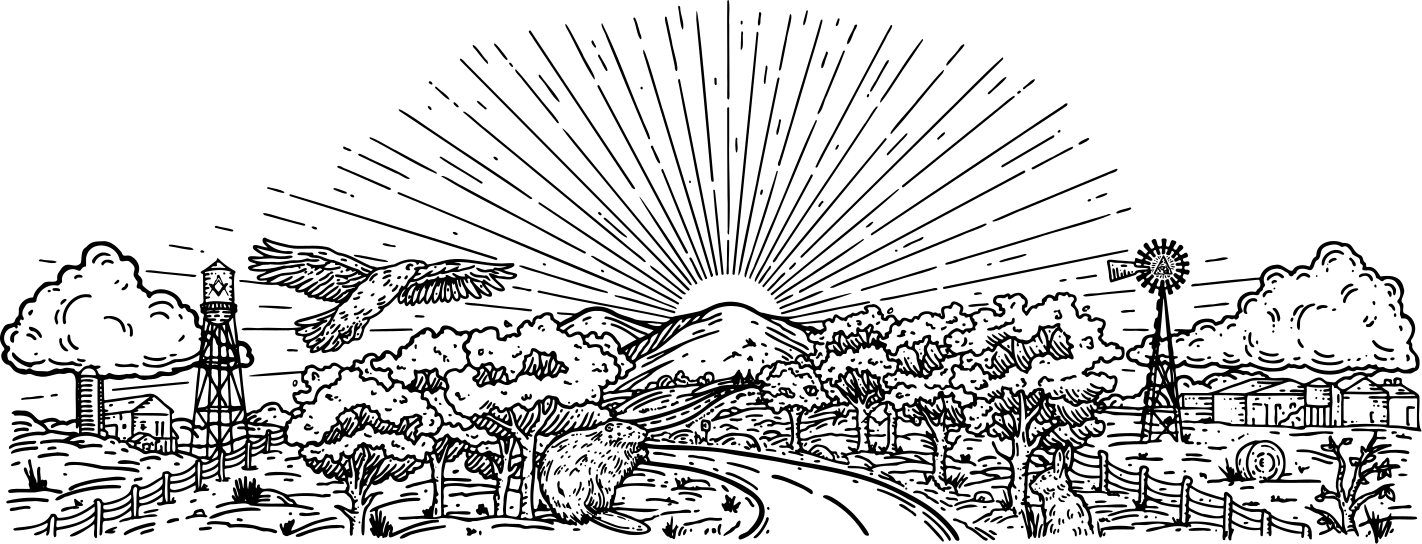
Their new record’s cover art features a gorgeous semi-psychedelic highway panorama that tracks the band’s pilgrimage to a celestial country-music Eden through Gibson’s childhood bedroom window. As the winding road goes, there’s Castlewood’s old Winchester Hotel, there’s US 58 that runs from southwest Virginia to East Tennessee, there’s Bristol’s gone-but-never-forgotten Grand Guitar shop, there’s the Ryman Auditorium and the Roundhouse (another sold-out show). There are tattoos and flowers and instruments and art from previous albums. There’s the sun and the moon and the railway and the river. And just within the periphery, there are those eternal yawning mountains. It doesn’t really matter whether you’re coming or going. They remain ever-ready to welcome you back home.

Before vintage boot-cut Wrangler jeans and grease-stained Carhartt chore coats became fashionable again among manicured twenty-something tastemakers, bands like 49 Winchester could still earn fans outside of the usual Top 40 country-radio set. Roots culture, which is the catch-all phrase for folkways that were born in or built upon in the United States, flourishes in moments of technological and political uncertainty. Tapping into the roots music scene is sort of like having a compass that takes you from “how will I get through this” to “I will get through this.” Good songs ask a question, great ones answer it.
49 Winchester — which now also includes Noah Patrick (pedal steel), Tim Hall (piano, organ, keyboard), and Justin Louthian (drums) — is among an emerging group of young artists who favor a sound that does not conform to industry standards, that does not rely on writers’ rooms and, now, algorithms. Instead, the band draws widely from the traditions of folk, soul, bluegrass, blues, Western swing, swamp rock, and early metal. They grew up on Merle Haggard and George Jones, but also Aretha Franklin, Bob Dylan, Joe Walsh, and Ozzy Osbourne. “We just… we really don’t see how you can take all these things that have informed what you love and never put them in your music,” Gibson says.
When Chafin talks about music and America, it’s as though they are the same thing. I ask him what gets him up in the morning, and he says, “All of it… the entire history of recorded music in this country.” He is baby-faced and his mouth turns up at the corners as though he’s smiling, even when he’s not. “Y’know, music has always been an outlet for people to share their frustrations. Frustrations with society, or with the government. Whatever it is, there’s a song that articulates that feeling.”
The thought that country music is a place for country people to express nonconformist and generally anti-establishment ideas comes up a couple of times. Gibson and Chafin share a fascination with the punk-to-country pipeline. “If you’re in a honky-tonk in Texas or a little beer joint in Kentucky somewhere,” Gibson says, “you’re going to go in there and see some old guy in a Waylon shirt. You can just clock him as soon as you walk in, and you think, ‘That guy was into… whatever… back in the day.’ Probably not Waylon. It was probably, like, Anti-Flag.”
Gibson likes to spin a good yarn, and he has a soft spot for oddballs and outsiders. The characters in his songs tend to be hardscrabble and matter-of-fact. They make ends meet by bending the law to the breaking point, and they aren’t tight-lipped about “Bringin’ Home the Bacon” while taking pride in a “Long Hard Life.” The “Hillbilly Daydream” is to leave the hourly wage job and spend that time cooking up moonshine instead (there’s a partial recipe in the chorus). Meanwhile, “It’s A Shame” is the refrain of a barstool philosopher whose tendency to shoot his mouth off puts him at odds with himself and everyone around him. “It’s just a shame to see a woman / Who’s white trash and pretty,” Gibson lilts, “It’s a shame to see a truck that don’t run / It’s a shame that I’m so rich / When I ain’t got no money / It’s a shame I ain’t havin’ no fun.” He punctuates the last line with a Jimmie Rodgers yodel.
The first writer Gibson knew was his mother, who, for the last 20 years or so, has published a popular column in a local weekly. Her influence, he tells me, has profoundly shaped the way he thinks about language. “She’s always had this way of painting an incredibly vivid picture with words, and I think that’s what you have to do as a songwriter.” He pauses for a moment to consider her. “She even does that when she speaks. I’ll ask her a question, and she’ll give me an answer that’s completely eye-opening.”
When Gibson writes about his internal life, his lyrics manage to be intimate — even confessional — without being self-conscious. “If I was a bluebird, I’d fly up to your window / And play for you the sweetest song that I could stand to sing,” he croons. “And if I was a wiseman, I’d muster up the courage / To leave behind these neon lights and finally clip my wings.”
To date, the band’s most culturally ambitious song is a narrative ballad called “The Window,” which is the first track on the new record. It describes the scene from Gibson’s childhood window as it truly is, with the railroad following the path of the Clinch River. The train becomes a symbol for the rapid rise and quick fall of the coal industry, and its diminishing haul becomes a metaphor for consequence. “It was real good for a little while / The company dollar kept us fed,” Gibson sings, falteringly, “Overtime and blood and sweat / Kept a roof over our head / That train is getting lighter now / Don’t whine like it used to do / Bills are piling up these days / Black lung never did come through.”
When I listen to it, I see the hands of the men who have loved me, stained black from the guts of the earth. “Another day, another dollar / Another trip down in the dark.”
It’s getting late now, and I can hear voices coming from the direction of the stage. Percussive vibrations ripple through the floor and walls. The opener, Maggie Antone, is up. Chafin walks me out so I can join the crowd. We part ways with a hug at the stage door. I make my way around the block to the main entrance.
In no time at all, I’m inside again, examining the elegant oval-shaped dome that is the central architectural feature of the auditorium’s interior. The National, with its neo-Renaissance facade, is the last of the three grand old theaters that once graced Broad Street. Designed by C.K. Howell, the place first opened its doors in 1923, treating Richmond audiences to big brass bands, vaudeville acts, and silent films. In the 1960s, it was transformed into a dedicated movie house, operating under the name Towne Theater. It closed its doors in 1983 and sat empty for decades before it was reinvigorated with the support of the Historic Richmond Foundation. It reopened as a live music venue in 2008.
Tonight, the floor is packed, but I manage to squeeze into a spot against the wall near the front with a clear view of the stage. I strike up a conversation with a middle-school teacher who works at the theater part-time. “After the place clears out later,” he says, “go and look at the floor on that upper tier back there. The marble is worn down from people leaning against it over the years.”
The crowd tonight is no less remarkable than any other. There are thrift-store cowboys from the local colleges, actual cowboys from out in the Shenandoah Valley, Gen Xers in Jerry Garcia T-shirts, blue bloods in khaki pants and V-neck sweaters, attractive women with big hair and jacked-up high heels, gingham-and-floral grandmothers chaperoning pre-teens on first dates, and a guy from Brooklyn who tells me he’s seen the band Flogging Molly nine or ten times… at least. Everyone is grooving and singing along with the band. Young couples are dancing and spinning each other wildly. They look like they’re playing dress up in their grandparents’ clothes.
Antone plays through most of the songs on her 2024 album Rhinestoned. Then, toward the end of her set, she launches into a cover of Jerry Reed’s “East Bound and Down.” She is a honky-tonk sweetheart in her white vintage Gunne Sax maxi dress. A Virginia native, she romances the hometown crowd with her big beautiful eyes: “Any Smokey and the Bandit fans out there?” The Flogging Molly guy asks what I think of her. I say I like her. “The way she sounds is the way it feels to be a woman in your 20s,” I tell him. He chuckles and says he thinks he gets what I’m saying. “A long way to go and a short time to get there.” Pretty much.
49 Winchester takes the stage around 9 PM, when Gibson proposes a toast with a half-finished beer: “Y’all ready to hear some hillbilly rock ‘n’ roll tonight?” The crowd erupts. The sound is immediate and expansive with Shelton’s guitar and Louthian’s drums filling the space and transforming it. “All Over Again” is first. “I took a dive and I’m still swimming up from the bottom,” Gibson belts. The song is a sappy one, but the hard-charging sound puts the crowd in the mood to party.
The band has become famous for its raw, sweaty, high-energy live shows that blend rock’s intensity with twangy country rhythms. It’s a style of performance they developed playing night after night in wood-paneled bars with sticky concrete floors. These guys didn’t get their big break from a social media clip. The point of discovery is now. And last night. And a thousand nights before. They’re a gig band. And they’re still out here, doing it loud.
“How many of you are having a great time tonight?” Gibson asks the crowd, to many cheers. “How many of you were here last night?” There is more cheering. “How many of you were there when we played our first show ever in Richmond?” More cheering. “There was just three people there, so some of y’all are liars,” he teases.
Every time 49 Winchester starts in on a new song, a guy next to me tells me it’s his favorite. He says he first learned about the band when he caught them at a festival a few years back, and he’s seen them a handful of times since. “What keeps you coming back?” I ask. He doesn’t hesitate. “In their music, they talk about the most intimate secrets of your heart,” he responds. “Except that they’re not secrets anymore, because they say them out loud.” Later on, he tells me he’s worried I haven’t opened myself up to the experience.
The band plays for a solid two hours, introducing tracks from the new album alongside old favorites, before walking off stage. They come back for a two-song encore. “Russell County Line” is first. It’s a soaring, melodic Appalachian lullaby — a love song to the place where these guys grew up. It’s also the band’s most popular song. “In that dirt was planted seeds of hope / And from them grew the flowers of our lives / And all our favorite little things that true love brings / And all the times we laughed and cried.” The voices in the crowd rise up like a chapel choir. Everyone knows what it feels like to want to go home.
But to close, they’ve chosen their cover of Black Sabbath’s “Changes.” It’s the first release from 49 Winchester’s new album. “This has been the best year of our lives,” Gibson tells the audience, “and we want to start the next one off right. Can we do one for Ozzy tonight?”
Backstage, Gibson told me that he’s fascinated by the way songs continue on and change over and over again, by the many, many lives they can live. With lyrics written by drummer Geezer Butler and released on Black Sabbath’s Vol. 4 album, “Changes” reflects the emotional turmoil the band was experiencing at the time, including drummer Bill Ward’s divorce. The ballad was later recorded by “The Screaming Eagle of Soul,” Charles Bradley, following the death of his mother. Gibson learned about that version of the song through the Netflix show Big Mouth. “We’ve always been into Ozzy and Sabbath and that early ’70s infancy-of-metal sound,” Gibson said, “but if you’re ever going to record a cover, and honestly even if you’re ever going to play one live, you owe it to the song and you owe it to yourself to try to make it your own.” The song sounds big inside the old auditorium, like you might be inside of it, swimming around. A woman in the balcony throws her head back and swings her arms open and sings along wildly. “I’m going through changes in my life.”
The song ends, and I make my way through the auditorium, up onto the marble floor with its grooves and curves, past Isaac’s dad selling records and T-shirts at the merch table, and back into the night. A guy asks his girl if they can wait for the band over by the bus. I don’t hear her answer. I look over at the thing and imagine its wheels turning, eating up the pavement. It’s about to make the same journey I’m making, back home. It’s a long drive, and when you get into Russell County, the air starts to smell rich and loamy, like the soil itself. It’s the scent of both hardship and abundance. The thing to do is to gather up what you can and take it with you when you head back out into the world again.