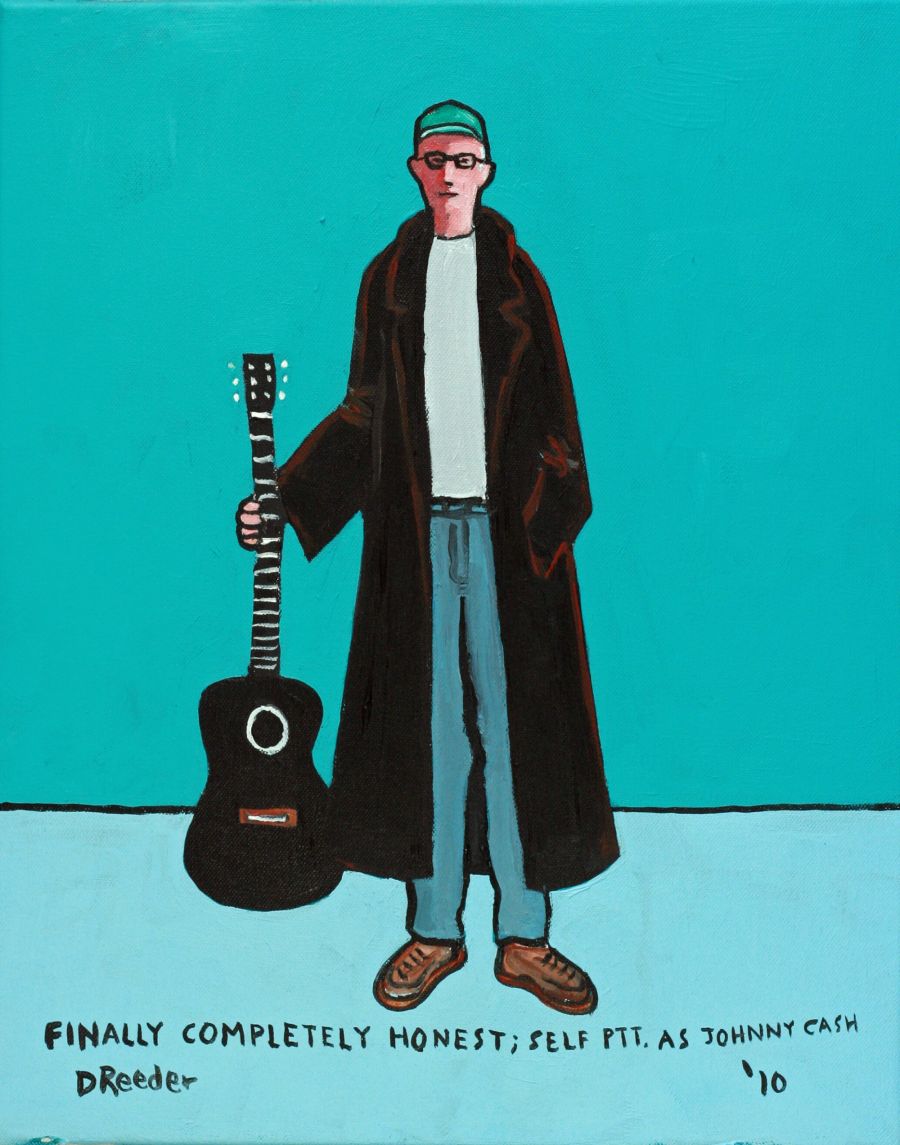

Dan Reeder
When being an outsider means being yourself.
A self-exiled maker of earworms appeals to the child and the grown-up in each of us.
All hail HJ Linderman!
In 1972, art critic Roger Cardinal introduced the term “outsider art” in his book of the same name. The label was his own version of French artist Jean Dubuffet’s earlier art brut — a label describing, in Cardinal’s words, “the only art which can truly be described as inventive, the art engendered outside the influence of society: by those certified insane; by those who claim inspiration from the spirit world; and by the innocent, upon whom the stamp of stereotyped culture has failed to make an impression.”
It’s a bit of a flex to be an outsider these days, with society being both intrusively omnipresent as well as something people feel increasingly guilty to be a part of. Everywhere we turn, media personas are peddling ideas, lifestyles, and aesthetics in a nonstop onslaught of suggestion. Our transformation into mirrored mosaics of impersonal impressions, with many (if not most) of us floating unconsciously down a stream of algorithmic slop, is nearly complete. So, in these trying times, some people are turning to outsider artists to be reminded of what it’s like to be “pure” — for me, this meant going to see one of the patron saints of outsider music, Dan Reeder, play alongside his daughter Peggy at Portland’s Mississippi Studios.
Dan Reeder is not unlike a meteor shower that comes around once in a lifetime. John Prine knew as much after hearing the demo tape that Reeder had sent over as an afterthought in 2003. After giving it a listen, Prine immediately signed Reeder onto his label, Oh Boy Records. At this point, Reeder was fifty-something years old and had spent the greater half of his life as a bastard of the art world. (An overview of his work can be found in Art Pussies Fear This Book, a title that tells you everything you need to know about his constitution.) At an age where many men are having their midlife crises, Reeder strummed a few chords and found himself playing his first-ever shows opening for John Prine.
“Touring with John Prine, we’re playing shows with 2,500 people and I’m going up there and I can’t sing and I can’t play guitar but I’m starting at the top,” he told me over the phone, some days after his Portland show. “It’s kind of weird.”
When he was six, Reeder moved from Louisiana to California, where he eventually studied art at Cal State Fullerton. At school, he fell in love with a German exchange student whose visa had expired a semester before graduation. She told him to come out for a little while, and so he followed her to Nuremburg. Six months turned into forty years, during which he continued to make his art and music in obscurity.
It had been fifteen years since Reeder toured on American soil. After being invited out to play the Healing Appalachia festival last year, his record company suggested booking shows in Nashville and Memphis. They didn’t expect them to sell out in the first few seconds of announcing tickets.
“We’re like, ‘Whoa, what the fuck is that about?’ And so the label put on a Dan Reeder tribute concert, where they had, oh, what’s the guy? HJ Linderman, or something?”
“MJ Lenderman.”
“There you go. And he sounded so much better than when we do it. But then we go up on stage, and the people go nuts for some reason.”
Most of the shows on Reeder’s first West Coast tour this winter and spring also sold out.

Mississippi Studios is an intimate and modestly elegant venue, chandeliers glowing dimly against deep red walls. It’s a local favorite, and everyone from your average Boomer to your Portland hipster are here tonight. As Reeder walks onto the stage, I’m struck by his fashionably casual Mac DeMarco swag, as if DeMarco were 71 but more bald and vulgar. He launches off with fan favorite “Clean elvis” — which is more or less a cover of Elvis’s “Can’t Help Falling in Love” but on paint thinner. Everyone sings along.
“I inject pure kryptonite / Into my brain / It improves my kung-fu / And it eases the pain during / Acceleration / When the pedal hits the floor / This thing burns nitroglycerin / And powdered C4 // And I will always love you.”
His voice sounds nearly the same as when he released his self-titled debut 22 years ago, a voice self-described as “weird and quiet.” It’s one of the reasons why he didn’t start writing music until he got a computer and had the ability to record and layer his voice, creating his signature self-harmonizing sound. Peggy’s voice lilts alongside her father’s like a bird carrying a bag of sand.
They sound profoundly tender together, even when they go into “angels may” — a song about angels feeding you ravioli out of the can because that’s what life’s all about. After a generous round of applause, he confesses to the cold consumption of canned ravioli. “You don’t eat ravioli cold out of the can for the flavor, you eat it for the feeling it gives you.” The audience agrees with their laughter.
Dan Reeder is the type of person you become when you don’t take yourself so seriously; when your impulse to create is as natural as the buzzing of a bee or a seagull shitting midair. I consider people like Bo Burnham, who try to make music that is listenable and funny but isn’t either because they’re not Dan Reeder. Listening to his music is like having a good-humored, potty-mouthed friend around who’s plucking away on the front porch or singing in the shower. “I make songs like I make paintings,” he told me. “Try to paint a picture, something really sweet and nice. It will be the nastiest shit you’ve ever painted in your life because you can’t leave it like a Hallmark card. You have to fuck it up. It’s that way with music too.” Which explains why all his songs consist of a few lovely chords, but are backed with lyrics like, “What do you want? / I want food and pussy! / How come? / It’s just the way God made me.”
I’ve been an audience to many singer-songwriters who’ve left me uncontrollably yawning no matter what I do to stay engaged, but Dan’s songwriting is interesting enough to keep you awake and provocative enough to make you think. They play “Beachball,” the rhythm of which floats up and down. Its lyrics point out the paradox that the harder you hit a beachball, the slower it seems to go. “Stay Down, Man” is a Southern California noir set amidst the swaying palms of a nightclub parking lot, and it has been covered by indie-rock supergroup boygenius.
The Reeders play an interesting assortment of covers themselves, like Procol Haram’s “A Whiter Shade of Pale” and Coldplay’s “Fix You,” appeasing the Boomers and Millennials alike. But he appeases all when he pays tribute to his late pal John Prine with a heartbreaking cover of “Angel from Montgomery.” The crowd is silently reverent afterwards. “I still miss him!” someone finally shouts. “Yeah. So do I,” Dan says. He pauses. “What’d you have to say that for?”
It’s the perfect inflection of playful mourning that comes with age, and the crowd laughs and he laughs and everyone copes. The show goes on like this, with his performance continually soliciting a few sentimental tears followed by many hearty laughs, which is all you can really ever ask of music. They follow with “Fuzzyfalafelosophy,” one of Dan’s songs whose wisdom grows on me with each listen: “Fuzzyfalafelosophy is my lifestyle / And I rock that shit like a movie star / People sometimes accuse me / Of just making it up as I go / But what they don’t know / Is that’s how it works.”
As I sing along, hoping to take some fuzzyfalafelosophy home for myself, I am struck by the gospel-like quality of the show. But it’s not until he plays “born a worm” that we truly find God. “Born a worm / Spins a cocoon / Goes to sleep / Wakes up a butterfly / Oh what the fuck is that about? / What the fuck is that about?”
Worm or caterpillar, cocoon or chrysalis, the mantra still drives me into an existential bout where I’m dizzied by the mystery. What the fuck is that all about though, really? I find myself in tears, again, his stupid little song reminding me of the miracle and the horror of being alive.
When we talk, I tell him how his show almost felt like being in church. I ask whether growing up in Louisiana had instilled in him some Southern gospel musicality. “My dad was a minister, and I grew up going to church every Sunday,” he answers. “So I learned to sing to the church hymns. That’s a thing that I’ll never get rid of.” His music is a sort of gospel of the absurd.
Reeder has been an expat for nearly forty years but still has a Southern sensibility about him. “There’s a part of me that’s always on the Mississippi River, not even a real one, but a mythical one from when I was six years old. It’s the idea that you can just escape from the world by building a raft and going down the river. That’s just in my DNA. No German would ever consider going down a river. That’s not going to happen.”
While he may not have built a raft and gone down the river quite yet, he’s built most of his own instruments, microphones, mixers, and computers, and he uses them to record his own music. Back in the early aughts he took the money he won from a painting prize to build his first guitar, the asymmetrical body of which looks extracted from a Picasso painting. It ended up being the guitar he played on his first album, dan reeder. The instruments used on his second album, Sweetheart, include “trash fiddle” and “paper banjo.” He also designs his own album covers. It’s all more or less a raft keeping him afloat on the currents of his big and wild imagination, and a testament to his stubborn self-reliance.
Outsider art is often compared to the work of children. Mental illness is also a common denominator across the genre, as in the case of Daniel Johnston: It inhibits the sort of socialization that breeds conformity. Dan Reeder isn’t mentally ill, but he’s crazy enough to not give a shit. I ask him what it’s like to be labeled an outsider artist, which is something of a backhanded compliment.
“What do you think is the appeal?” I prod.
“The music world, they’re looking for outsiders,” he answers. “In the art world, rich people decide what’s good and what’s going to be considered good. Rich people buy pictures. Poor people do not buy pictures. Poor people do listen to music, and if a lot of poor people listen to it, it’s super cool.”