
The Yankees Win!
A terrorist attack on New York City reverberates in the northern woods of Goshen
George Bush fired a perfect strike from the mound
The Yankees didn’t win
Every child loses his innocence, and I will tell you how I lost mine. My mother raised me on 14 acres in the woods outside Goshen, in upstate New York. We didn’t have cable television and she kept me from the Internet, encouraging me to read and explore the natural landscape.
My strongest link to the outside world was the New York Yankees. By seven, I was listening to nearly every game on the radio. On the rare occasions when the team played on one of the seven channels received by our television, I watched every moment. When the Yankees won, I ran through the fields behind our house, impersonating the iconic call of radio sportscaster John Sterling: “Theeeeeee Yankees win!” I repeated this refrain often, as the Yankees won the World Series the first three seasons I followed the team, 1998, 1999, and 2000.
My mother was not a sports fan, but she encouraged my love of the Yankees. She taught me to calculate batting averages and gave me biographies of the Yankee greats of yore. I recited the statistics and life stories not only of the Yankee stars — Jeter, Rivera, Pettitte, Posada — but also the utility man, Luis Sojo, and backup outfielder, Chad Curtis. I spent weekends organizing my baseball-card collection, deliberating over which players should be inaugurated into my vaunted Hall of Fame binder. My first published piece of writing was a letter to the local paper in which I predicted that the Yankees would win the 2000 World Series in four games; they won in five.
Every day after school I listened to the sports talk program Mike and the Mad Dog, eagerly awaiting the contest for tickets to Yankee Stadium. The announcement usually went something like this: “Two tickets to the game this Sunday to the eighth caller, if he can tell us the Yankee catcher with the second most World Series rings.” Dashing downstairs for the phone, I would repeat the answer to myself. (Everyone knew that was Bill Dickey.) When I dialed, the line was busy with the thousands of other people vying for the tickets. I called WFAN hundreds of times in my childhood, the busy signal all that stood between me and my heroes striding dreamlike across the diamond at Yankee Stadium.
One afternoon, in September of 2001, the radio host offered two tickets to the seventh caller if they knew the year Mickey Mantle won the Triple Crown. To my amazement, my call broke through the busy signal and was greeted by a human voice. “What year?” the voice said, as if I needed the question to be repeated. As if I was born yesterday. As if I had not read and reread Mickey Mantle’s The Quality of Courage. I shouted into the phone: “1956!”
The high pitch of my voice must have given me away. The man asked how old I was, and I said ten, and he told me that the contest was only open to adults. I rushed into my mother’s home office, handed her the phone, and shouted, “Say 1956!”
Reader, we were awarded the tickets.
That Sunday morning my stepfather and I drove to Yankee Stadium. We were seated like kings near first base. I stared in awe at the field across which my Yankees heroes had run: Ruth, Gehrig, DiMaggio, Mantle. There were no security barriers, and I walked to the perch near right field, where Clay Bellinger was having a warm-up catch. Bellinger was a utility player who hit .160 that season and lasted only three years in the major leagues; to me he was a God. “Clay!” I shouted, frantically waving my arms. “Clay! Clay!!”
Bellinger grinned at me, jogged over, signed the baseball I held breathlessly toward him, and returned to his warm-up catch. I will never, I vowed to myself, wash my hand!
Near the Red Sox dugout I spotted David Cone. He had been a Yankees star the last five seasons, and I’d listened on the radio as he threw a perfect game two summers before. Now he wore the uniform of the despised Boston Red Sox, a veritable Benedict Arnold. But I was a forgiving child, so I permitted him to sign the second baseball I had brought with me.
The Yankees triumphed that afternoon, September 9, 2001. Andy Pettitte pitched a masterful game, allowing one run in seven and two-thirds innings. Nick Johnson, a rookie expected to become the next Yankee star, hit his first career home run, the ball soaring past our seats on its way into the right field stands. On the drive home my stepfather and I lowered the car windows and shouted, “Theeeeeee Yankees win!!!!!”
That Tuesday morning the intercom in my fifth-grade classroom rang incessantly. The messages were all the same: Would so-and-so please gather her belongings and come to the front office? Her mother is here. At first I was envious that my classmates were leaving school early. But by the time half the class had been called away, there was an eerie sense in the emptying room.
Washingtonville, New York, where I attended elementary school, is 60 miles north of New York City. The village is a common residential choice for city police officers and firefighters.
By late morning, the homeroom teacher tensely addressed the remaining students. “There has been,” she said, “a terrorist attack in New York City.” My classmates nodded knowingly. Apparently a terrorist attack was one of those matters, like the birds and the bees, that other parents spoke about to their children, one my mother had yet to explain to me.
We were sent home. On the bus I sat behind my friend Sean. We often ran together through the woods, pretending to be Arthurian knights. “There’s going to be a war!” Sean said, bobbing up and down in his seat. Sean was a History Channel enthusiast and Risk strategist; he knew about such things. If we were lucky, Sean said excitedly, the war would last long enough for us to fight.
There was some confusion when the bus came to our driveway. The bus was too long to turn at the top of our drive, but it was unthinkable to leave me as usual at the foot of the hill. Terrorists had not hesitated to strike the Twin Towers, and would not hesitate to strike our remote field. The bus monitor had begun to walk me the quarter mile up the hilly drive when my mother hurried down toward us with a tight, concerned expression that I would see on her face perhaps four times in my life.
Only later would I understand that she had never worried for my safety, but rather my feelings. She must have feared that I had seen the Towers collapsing. Or she simply wanted to hold her son. That is the natural response to tragedy from people who have long ago lost their innocence. But I had not lost mine, so I asked my mother a more practical question: Did this terrorist business mean the Yankees were not playing their doubleheader that day against the Chicago White Sox?
The mood in town was mournful. Forty-four people from our county had been killed, including five FDNY firefighters from Washingtonville. The names and faces of the dead haunted the local paper. I stared for what felt like an entire afternoon at a photograph of a mother kneeling to the height of a son my age, explaining that his father was dead. My mother bought clothes to donate to a fundraiser “for families who lost—” she faltered, unable to finish the sentence. On the opening day of the Little League season, the town field was renamed in honor of Robert Hamilton, a 43-year-old local firefighter and father of two who died in the Towers.
My instinct was to retreat from the intensity of this public emotion. I didn’t want to look at the newspaper photographs of the dead or go with my mother to the local fundraiser or know if Robert was related to the girl surnamed Hamilton in my class. I wanted it all to have never happened. In the moments of silence at school I made bargains with myself: If I could have jumped from the Towers and died instead of all those strangers, I would have. Or would I? The moment of silence was over before I could decide.
More than anything I wanted all the talk of death and terror and war to dissolve into the comfort of Yankees baseball. But the season was immediately suspended. When I turned on the radio after school I was greeted not with conversation about baseball but rather somber discussion of September 11. I flinched at the wavering in the usually steady voices of the sports talk personalities, who sounded as uncertain as my stepbrothers discussing in hushed tones whether they would have jumped from the Tower windows or let themselves be burned alive.
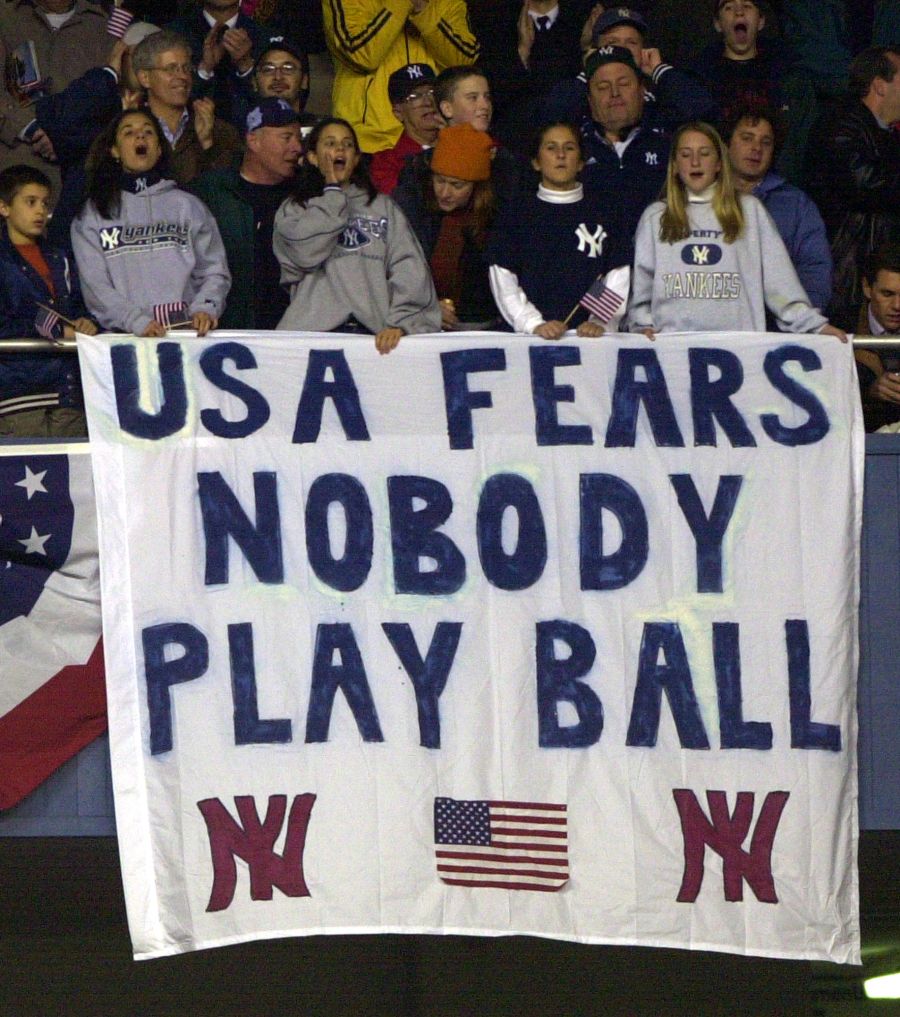
Finally, on September 18, the Yankees played their first game after the attacks. I listened on the radio in the living room as chants of “USA! USA!” broke through the static. “This is more than baseball,” said the Yankee broadcaster, Michael Kay. “We are hoping, the players are hoping, that this is some therapy for a nation that is hurting… America has to get back. The Yankees will do their part.”
In the days that followed, this narrative emerged on the talk shows I listened to and the newspapers I read: The Yankees would prove the toughness of New Yorkers by winning the World Series that autumn. “They can’t lose,” one FDNY firefighter told a reporter, “they got 3,000 angels watching over them.”
On the sofa in our den I watched every game televised on the public channels. A torn American flag found in the ruins of the Towers flew over Yankee Stadium. The ballpark was seen as a likely target for the next terrorist attack, which I took personally. At the seventh inning stretch of each game, the crowd of 60,000 sang “God Bless America,” night after night, the largest collective expression of grief in the country. Rescue workers were still digging through the rubble in downtown Manhattan. President Bush appeared on the massive screen at Yankee Stadium: “To fully defend America,” his enormous, pixelated face announced, “we must defeat the evildoers where they hide.” Every morning on the bus, Sean reported news of the impending American military invasion of Afghanistan. Grocery bags were printed with the American flag. Anthrax was mailed at random across the country and I was terrified to open our mailbox. But I needed the morning paper to know whether the Yankees had won the night before. If I didn’t open our mailbox I was letting the terrorists win. I closed my eyes and reached for the paper.
The playoffs began on Wednesday, October 10. I reported for duty on the sofa at game time each night. Supporting the Yankees was no longer a child’s passion. It was my duty as a New Yorker and an American. This meant bitter arguments with my mother, who did not think a ten-year-old should stay up past nine on school nights.
Our routine went like this: At seven, the game begins. The woods beyond the house are quiet, each tree straining to hear the first pitch. By eight-thirty, my stepfather says he has to sleep before his early morning commute to New Jersey. Watching the game alone, I can feel my love for the team seeping into the television and influencing the outcome. At nine comes the dreaded moment: My mother appears at the head of the stairs. She smiles as she descends toward me, announcing bedtime. Is she crazy? Grieving people are counting on the Yankees, and the Yankees are counting on me. I plead with her to let me watch even half an inning more. “Derek Jeter is batting after the commercials. Please, just ten more minutes!” Derek Jeter is not batting after the commercials. My mother returns ten minutes later. I tell her Jeter is up next inning, the very first batter, it was an honest mistake, can I please watch ten more minutes? My mother turns off the television.
In this protracted war, I had a secret weapon, my most cherished possession: a headset radio. When I could no longer convince my mother to let me watch “just five more minutes!” I would pretend to accept defeat and retreat to bed. Once my door was closed, I would tiptoe to the closet and retrieve my headset radio from its top-secret hiding place. Lying beneath the covers, pleased with the cleverness of my transgression, I would listen to the game through the static.
The only difficulty with this strategy was that I couldn’t stay awake. I would try desperately to keep my eyes open, pinching my arm, turning up the volume of my headset, terrified of what would happen to the Yankees if I fell asleep.
Luckily, the Yankees had not only me to count on but also Mariano Rivera, the greatest closing pitcher of all time. Rivera’s job was to pitch the ninth inning, preventing any final runs and ensuring the Yankees’ victory. This is called a “save,” and Rivera had more saves in the 2001 season than any other pitcher. Lying exhausted in bed, I told myself I needed to stay awake only until Mariano Rivera entered the game.
When I woke in the morning, I would run down the driveway, tear the newspaper from its plastic sleeve, and scan it urgently for the score. I could always tell the Yankees’ fate by the photograph on the front page. A raised arm meant victory, a hanging head meant defeat. This driveway sprint was a faster means of learning the score than our desktop computer, which required two minutes to start and another two minutes for the dial-up Internet to load MLB.com. I could run from my bed down the driveway in sixty seconds (arriving out of breath). Walking up the hill with the paper, I would find my mother and announce, “Theeeeeee Yankees win!”
But before the Yankees won that autumn, they lost. My early nights of sleep cost the Yankees the first two games of the playoffs against the Oakland A’s. This meant that if they lost any of the three following games, their playoff run would be over before it had begun.
The night of Game Three, the score was tied at zero when my mother asked me to go to sleep. In my bedroom, I made a few convincing snoring sounds, then whisked out my headset radio. Darkness lulled me to sleep. When I woke, it was to John Sterling going ballistic in my headset as he gushed over one of the greatest plays in baseball history: “What a play by Derek Jeter! That’s about as good a play as you’ll ever see!” It took me more than a minute to understand that Jeter had sprinted nearly two hundred feet out of position to catch an errant throw from right field and flip the ball to Posada just in time to tag out the A’s runner at home plate and preserve the Yankees 1-0 lead.
By falling asleep early, I had nearly cost the Yankees the series. There but for the grace of God go we.
With my backing, the Yankees won Games Four and Five and took the series. No team had ever lost the first two games at home and gone on to win a best-of-five series, further proof that the team’s march to World Series victory was a patriotic necessity. In the American League Championship Series, the Yankees easily dispatched the Seattle Mariners, who had won more games in 2001 than any team since 1905. Rivera closed out each victory.
All that stood between the Yankees and the World Series championship were the Arizona Diamondbacks.
My mother suggested that I host a viewing party for Game One of the World Series, which fell on a Saturday evening. I liked this idea: The more people who watched the game, the stronger chance the Yankees would win. My mother might have had another motivation. I’d struggled to make friends at school since transferring from a Waldorf school that spring, and she must have hoped that baseball might help me bond with classmates. The party was attended by Sean, my two stepbrothers, and three other boys from class (my mother suggested that I also invite girls, a terrifying idea). I was so excited by having classmates in my house that I jumped up and down on the sofa before the game began, shrieking, “Theeeeeee Yankees win!!!!!!”
The Yankees did not win. The Diamondbacks scored four runs in the third inning on their way to a 9-1 victory, and the other boys left early. The following night the Diamondbacks won Game Two, 4-0.
Not to worry: George W. Bush was waiting at Yankee Stadium for Game Three, which he began by throwing out the ceremonial first pitch to chants of “USA! USA!” Bush was dressed in an FDNY jacket and bullet-proof vest. I remember waiting in fear of a gunshot. Bush, who had once been a minority owner of the Texas Rangers, fired a perfect strike from the mound; this was the high point of our relationship. Fighter jets flew over the stadium, and a video honored the American soldiers who had landed in Afghanistan weeks before. Long after my mother told me to sleep I lay in bed with my headset, listening as the Yankees squeaked out a 2-1 victory.
The night of Game Four was Halloween. I told my mother that I wanted to dress up as Derek Jeter and Roger Clemens, a thin ruse to convince her to buy me each player’s jersey (usually, I could ask for one jersey each birthday). She agreed to let me have both jerseys and a Yankees jacket, a testament to her sense of how deeply the team mattered to me that autumn. I went trick-or-treating, repeating Derek Jeter statistics house to house. Then I took off my Jeter jersey, donned my Clemens jersey, and began repeating his statistics at each house.
By seven o’clock, I was through with the childish activity of collecting candy and ready to return home to perform my duties as the Yankees’ most devoted fan. I had watched one scoreless inning by the time my mother asked me to sleep. She had just given me the Yankees jerseys, so I knew this was no night to argue.
In bed I listened to the game on my headset radio. I couldn’t sleep with the score tied. I closed my eyes for just a moment and woke to morning sunlight. I sprinted down the hill, and nearly cried at the image of Derek Jeter pumping his fist after hitting a game-winning home run in the twelfth inning. I had let the Yankees down, but they had not let me down.
The Yankees won Games Five with similarly dramatic flair, tying the game in the ninth inning and winning in the twelfth. By then I was asleep, the game playing on the headset radio around my neck. Thankfully, Mariano Rivera was there for the Yankees when I could not be. He saved Game Three, won Game Four, and pitched two scoreless innings in Game Five.
The Yankees returned to Arizona needing only one win to clinch the World Series.
Game Six wasn’t even close. The Diamondbacks won, 15-2. That meant everything would come down to Game Seven, to be played at eighty-thirty on Sunday. I calculated that I would be able to watch two innings before my mother would tell me to sleep.
That night in the den I glared at 50,000 Diamondbacks fans waving white pom-poms and shouting against the Yankees, against New York, against America. All went silent for a trumpet rendition of “The Star-Spangled Banner.” Massive American flags waved overhead. A fighter jet flew over the stadium. I was too nervous to look at the television.
The game was a duel between two of baseball’s greatest living pitchers, Curt Schilling of the Diamondbacks and Roger Clemens of the Yankees. The score was tied at zero by the time my stepfather said he had to sleep. At nine o’clock I glanced anxiously to the stairs. My mother was nowhere to be seen. The house was silent, the silhouette of trees swaying in the darkness beyond the window.
The game was still tied at zero when my mother appeared on the stairs at nine forty-five. I had prepared arguments and promises. If my mother let me watch this game, I would never again have to be asked to unload the dishwasher. I would always brush my teeth. I would clean my room like no child had ever cleaned his room. I would say please and thank you…
I never had to make these promises. My mother sat beside me on the sofa and said, knowing each word was a gift, “Just for tonight, you can stay awake as long as you like.”
She could only have made me happier by marrying Derek Jeter.
Schilling and Clemens pitched scoreless fourth and fifth innings. I bit my lip and chewed my nails. In the sixth, the Diamondbacks went ahead 1-0. The Yankees most urgent problem was not that they were incapable of scoring, but rather that their most devoted fan, yours truly, was struggling to keep his eyes open. I paced the den to keep myself alert. I turned on every light in the room. I let myself doze for the two-minute commercial break, not a second more, just to rest before the final innings.
I woke alarmed in the seventh. My anxiety was quickly remedied: Jeter was on second, O’Neill on first. Bernie Williams hit a ground ball into a double play, but Jeter advanced to third. I leapt off the sofa as Tino Martinez singled and Jeter crossed the plate, tying the game.
My eyelids were heavy but I made one solemn promise: I will not sleep until the Yankees are winning.
Clemens pitched a scoreless seventh inning. Soriano was up first for the Yanks in the eighth. He was hitting a pitiful .208 in the series and went down 0-2 in the count. Schilling’s fifth pitch was a low slider that Soriano smoked over the left field stands. I ran through the living room, arms raised in imitation of Soriano as he rounded the bases. The Yankees were winning, 2-1. They needed only six outs to claim the World Series. Mariano Rivera, the greatest closer in baseball history, was coming in to finish the game. It was over. The Yankees had won. Weary from an autumn of late nights, I walked upstairs and fell into a joyful sleep.
How unreasonable was my feeling that by watching the Yankees I could help the team win? I was a child terrified by the killing of thousands of people. I wanted to feel safe and help restore normalcy. There was nothing I could do. But I could root for the Yankees and the Yankees could heal the country. Was my story stranger than the adult narrative that, by winning the World Series, the Yankees could restore to New Yorkers some aspect of the normalcy lost on September 11? Was my fantasy more fictitious than the stories told by adults after September 11 — that America was hated because we are free, that our wars were for democracy and could be easily fought and quickly won?
My bedroom faced east onto the mountains. One of the pleasures of my childhood was waking to the strong morning sun, and on that day in November of 2001 I woke to perfect light. The Yankees had won the World Series. I had done my duty and played my part. My mother came into the doorway. “I’m so sorry,” she said tryingly. “There’s always next year.”
I laughed happily. She had misunderstood. I felt no urgency to confirm the Yankees’ victory. I walked leisurely downstairs to our desktop computer. The home screen of MLB.com appeared one inch of bandwidth at a time. A photograph appeared of Mariano Rivera looking devastated on the mound. Then the score: Diamondbacks 3, Yankees 2. I checked SportsIllustrated.com. Then ESPN.com. There was something wrong with the Internet. I ran down the driveway, certain the local paper would have the right score. The newspaper showed the same dazed photograph of Mariano Rivera, and the same score.
Back at the computer, I watched the last minutes of the game in disbelief.
Rivera opens the inning by giving up a single. He fields a bunt and makes a wild throw, leaving runners on first and second. He hits a batter with a pitch, loading the bases. Luis Gonzalez, the Diamondbacks’ best hitter, comes to the plate. Rivera looks rattled, as if he knows what is about to happen. Gonzalez swings at the second pitch, floating the ball just beyond Derek Jeter’s outstretched glove. The Diamondbacks rush the field. “We Are The Champions” blares through the stadium, with its biting refrain: “No time for losers / ’Cause we are the champions.” The camera cuts to the stunned Yankees. Fifty thousand Arizona fans shout and cry. Fireworks erupt.
There are no handshakes, no congratulations, no consolations. A reporter chases after Gonzalez, who says, “You dream about this situation as a little kid, just to get up there and put the ball in play, and get a winning run.”
When I look back on my childhood, it is hard not to feel that a paradise of belief was lost that night I went to sleep unable to imagine the Yankees could be defeated and woke to discover they had been. Not long afterward, my mother and stepfather divorced. My mother’s first new boyfriend accidentally set fire to our house, and my binders of baseball cards and collection of Yankee memorabilia, including the baseballs signed by David Cone and Clay Bellinger, were lost. The Yankees launched their own television network, broadcast rights were revoked from the public channel, and I could no longer watch even a few games each year. I wrote a letter explaining this untenable situation to Joe Torre, the Yankees manager, but he never replied. I still listened on the radio, but it was never the same. The Yankees suffered devastating playoff losses in 2002, 2003, and 2004. Nick Johnson, whose first home run had flown past me in the last game played at Yankee Stadium before September 11, suffered debilitating injuries that prevented him from becoming the star he once promised to be. The Yankees teams of homegrown talent were overtaken by crudely cobbled-together rosters of high-priced players whose performance was juiced by steroids and human growth hormone.
Sean, my childhood friend, got the wish he expressed the morning of September 11: The wars went on long enough for him to fight as a platoon leader in the US Army. The wars had a different effect on me. Sixteen months after the World Series loss, I sat on the sofa in the den as the same television showed the first American bombs falling on Baghdad. Twelve years old, I knew I was leaving a childhood in which what mattered most was baseball, and in which I could convince myself that my own wishful thinking might control the world around me.
Soon my heroes were no longer Yankee players. I moved on from books about baseball to J.R.R. Tolkien, Daniel Pink, Kurt Vonnegut. I began to write stories myself and was pleased to discover the similarities between baseball and literature: the rhythm of narrative, the intricacy of character, the thrill of a plot twist. In a story, as in a baseball game, anyone can become the hero. Any sentence, like any pitch, can change the course of the story.
With time, my awe at the pitching and swinging of my Yankee idols gave way to greater awe at other people’s ability to conjure myth and character from language. I learned that looking at the name of an admired writer on the spine of a book gives me the same sense of majesty I once felt watching Clay Bellinger warm up in the outfield. This feeling is still with me. It does not matter if the writer is a utility player batting only .160 for the season. If she has written one sentence I could never have imagined, she is as immortal to me as the Yankee heroes of my childhood.
Today, I see my devotion to the Yankees as my first apprenticeship as a writer. My childhood belief that rooting for the Yankees could influence the outcome of the game was my first exercise in the imaginative thinking that every writer must possess.
If we are lucky, the children we once were live within the adults we become. The innocence of childhood lays dormant within us, always willing to be resurrected by memory.
One night at graduate school, in September of 2014, I set aside my writing for the evening to watch Derek Jeter play his final game at Yankee Stadium. I hadn’t followed the Yankees in a decade. The game was tied in the ninth inning when Jeter came to bat with a runner on second base. He singled to right field, ending his career with a game-winning hit. Waiting for him behind home plate were his retired teammates, my heroes of that 2001 team: Torre, Posada, Pettitte, Tino, Bernie, Rivera. I was there, too, ten years old, at Yankee Stadium on September 9, 2001, calling out to Clay Bellinger, holding my baseball and sharpie to David Cone, leaping from my seat as a home run soared off Nick Johnson’s bat. Dusk had fallen by the time my stepfather and I returned home that evening. My throat was hoarse from cheering. I ran through the house in search of my mother, eager to tell her about the game. She was kneeling in her garden, tending to peonies and rosebushes. She looked up as I ran toward her, exclaiming, “Mom! You won’t believe what happened! Nick Johnson hit a home run! Theeeeeee Yankees won!!”
We lose our innocence but not our memory. We fall from paradise but remember its light. I am older now than nearly every star on that Yankee team. My mother has been dead nine years. Yet I am still running toward her and she is still smiling at me. “There’s always next year,” she told me, on that morning in November 2001. And there are always the years that have passed.