
Hippie Hell Week
Welcoming the Great White Buffalo has been an American tradition since 1972.
I lose my ladylove to a mescaline-laced cake, but am kept calm by Orthodox Jews who serve me vegan pizza.
Masturbating in front of little kids is uncool.
As I do most mornings, I awoke to the sight of a girthy, well-proportioned member. But on this particular morning, July 3rd, 2026, it wasn’t mine. The appendage in question belonged to a long-haired, bald-crowned hippie in his thirties named David, who was squatting a few feet from my tent with a diabolical grin, entirely nude. He’d evidently been holding that position for a while, waiting for me to unzip my tent fly.
“Heard you stirring in there,” David said. “Mind doing a tick check?”
Considering the circumstances, a tick check wasn’t unreasonable. Last night, David, another hippie woman named Krystyna, and I had hauled our suitcases, tents, sleeping bags, and other camping gear through several miles of Pennsylvania’s tick-ridden swamps and thickets in total darkness. Eventually David and I, abandoning all hope of finding our destination, set down our bags in some horrid bog and declared we wouldn’t go another inch. Krystyna elected to press on, leaving David and me to camp alone. Now that it was morning, I was the only one there to inspect him for lyme-carrying creatures: I was obligated, that I could understand. Harder to understand, however, was the nudity. Or the grin. Why was he grinning at me like that?
“Make sure to get the ass. They like to get in the cracks.”
After thoroughly surveying David’s every crevice, I confidently stated that he was 100 percent tick-free. I couldn’t say the same for myself, since I passed on his offer to reciprocate.
In any case, tick-borne illnesses were the least of my worries at this event, a Burning Man-esque festival in the backcountry of the Allegheny National Forest called the National Rainbow Gathering. I’d learned of it a couple weeks prior, while catching up with a guy I’d known from a primitive skills gathering way back when, the sort of fellow some call homeless, but who personally prefers the phrase “on a quest.” He was cycling across the country on a $20 beater bike in the general direction of this Gathering. It’d be groovy, he assured me. Ten thousand hippies were determined to camp in Bureau of Land Management (BLM) forestlands during the first week of July, where they’d organize themselves around a gift economy in which all necessities (food, drugs) were free to share and consume. On the Fourth of July, they’d smoke pot and pray for world peace, as they’d done for the last fifty-some-odd years, with zero discernable effect on reality.
The National Rainbow Gathering’s Independence Day traditions — absolute silence until noon, followed by an all-Gathering om meditation for world peace — dated back to the inaugural Rainbow Gathering, held in 1972. It was the brainchild of the Rainbow Family of Love and Light (RFOLL), a self-styled white “tribe” living in the Oregon backwoods. The previous year, they’d stumbled across an old prophecy, allegedly from the Hopi people: “When the Earth is ravaged and the animals are dying, a new tribe of people shall come unto the Earth from many colors, classes, creeds, and who by their actions and deeds shall make the Earth green again. They will be known as the Warriors of the Rainbow.” The miraculous appearance of a Great White Buffalo would herald this new race of man. (The Hopi tribe has denied the existence of this prophecy and has issued public statements accusing the Rainbow Gathering of cultural appropriation.)
Somehow, the RFOLL determined the Great White Buffalo would appear precisely at noon the next year on July 4th, in the unsuspecting hamlet of Granby, Colorado. They spread the word far and wide among the hippie communes of the USA, and during the first week of July, about twenty thousand flower children overtook the Granby countryside. On the Fourth, they held an almighty Earth-shattering om meditation to welcome the buffalo. Colorado’s Lt. Governor and the FBI did their best to shield the helpless residents of Granby from these sacred intonations, but were outmanned and outzenned, and even though the only people who witnessed any buffaloes were likely on shrooms, these founding Gatherers deemed the Gathering a tremendous success — so much so that they resolved to om for world peace every Independence Day, buffalo or no buffalo.
Unlike the smaller regional Rainbow Gatherings, the National Rainbow Gathering only happens once a year, in a different part of the country each time — and by sheer cosmic coincidence, this year it was only a six-hour drive from where I was living. Well, why not?
It didn’t take more than a quick Google search to learn why not. First, since the National Rainbow Gatherings are held on BLM lands, every year the Forest Service, the FBI, and the DEA try to shut them down, sending hordes of attendees to court. Second, there are often hygiene issues, and I’m not talking body odor. I’m talking large-scale dysentery outbreaks. Third, the murders — a whole Wikipedia “Deaths” section’s worth of them, including such classics as the 2015 Florida Incident (a drug-fueled gang-bang) and the unsolved 1980 Rainbow Murders, which were so expertly done that they received a murder’s ultimate stamp of approval: a white supremacist tried to claim he was the killer, but later admitted he’d just read about them in the news.
Such inconveniences may have dissuaded a cosmopolitan pansy, but they weren’t going to put this old boy off so easily. I knew how to deal with hippies. Hell, I was one — having grown up the homeschooled babe of two bonafide bohemians in Topanga, California, where people are still peacefully protesting the Vietnam War. Primitive powwows and pagan solstice festivals constituted a critical part of my upbringing. I’ve admittedly softened a bit since, as I no longer protest or do drugs — in fact, the only drug I had ever tried was weed, which I smoked only once and with such poor form that I didn’t even get buzzed. Still, I do my morning yoga and try to use the recycling bin, and when I heard about the Rainbow Gathering, my roots beckoned.
After posting a ride request to the Gathering on one of those well-known dens of pedophiles, a Facebook rideshare group, I was contacted by Krystyna. She turned out to be not a pedophile but something even more formidable, judging by her handwoven seat covers and “Hot Girls Hit Curbs” rearview-mirror ornament: a flaming liberal. David, who Krystyna knew through a song-circle class, was the other passenger. The car ride, which ended with a tripometer-navigated stretch on dirt roads, was supposed to take six hours, but due to the copious curb-hitting and general chaos that resulted from Krystyna and David belting out song-circle ditties the entire way there, we arrived well after nightfall, which made the two-hour hike on unmarked trails about as straightforward as Homer’s Odyssey.
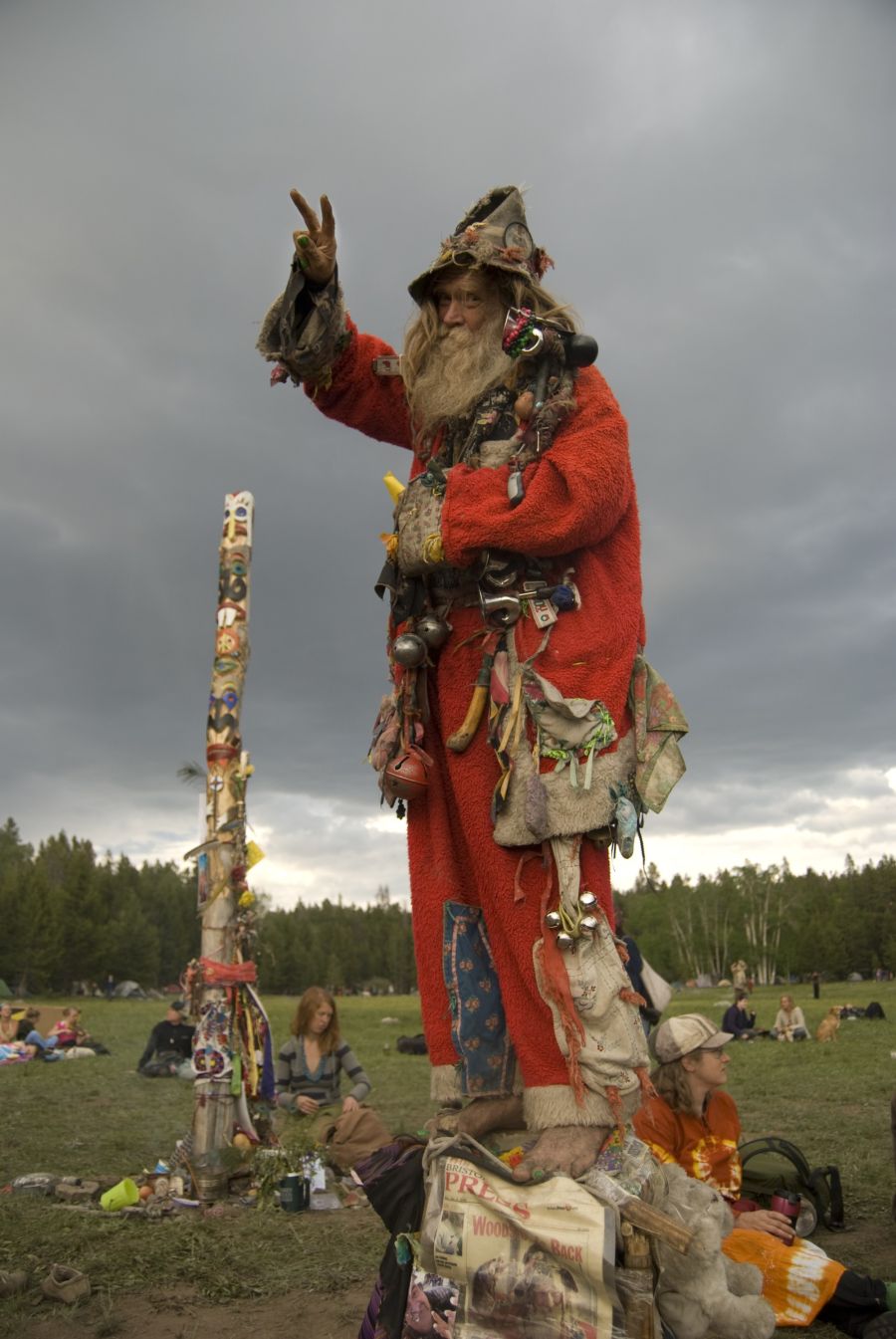
Leaving David to put on his undies, I walked down the main trail for a first look at the Gathering. It wasn’t long before I detected the unmistakable markers of hippiedom. A dreamcatcher on a tree branch. A woman wearing only a gunholster and a cowboy hat. A sign saying ENJOY THE RAINBOW WITH AN OPEN HEART AND YOU WILL SEE THE VISION. A sign with a 456-word land acknowledgement. Makeshift shelters cobbled together from tarps, filled with crystals and incense and tie-dye colors. Another sign: SEEKING DREADLOCK MAINTENANCE. The same two phrases, repeated over and over: “Welcome home” and “Lovin’ ya.” (The first was the default Rainbow greeting; the second, their goodbye.)
The National Rainbow Gathering was way bigger than I’d imagined. It took around an hour and a half to fully traverse the grounds, and that was if I didn’t get roped into a multi-hour discussion with a kabbalistic mystic tripping on acid. (I did.) In the thick, unmarked forest, I discovered that the Gathering was not a unified endeavor, but rather a composite of self-contained and -sufficient “camps” whose members shared a trait or identity. Out of the hundred or so camps that had erected their infrastructure in Allegheny National Forest, a few of the more well-known ones were Krishna Camp, which featured SoCal yogis singing Hari Krishna chants all day; Om Shalom, the rather unorthodox Orthodox Jewish camp; Faerie Camp, a giant polycule of young, gay, mostly unclothed men wearing tails; Shut Up and Smoke It, whose activities were self-evident; and the notorious A-Camp.
There is no official decision-making body that presides over the Gatherings, but one of Rainbow’s few unwritten rules is that it’s meant to be booze-free — alcohol, unlike weed, being an intoxicant not known for advancing world peace. But the alcoholics indulged their habits anyway at A-Camp (“A” for alcohol), and nobody did squat about it, since they also doubled as Rainbow’s vigilante law enforcement. They were brawny and tattooed, wore metal-spiked motorcycle vests, and contributed disproportionately to the aforementioned “Deaths.”
Most camps had a kitchen, and I learned that if I came by at the right time with my “blissware” — Rainbow parlance for tableware — they’d serve me some of whatever was cooking. Considering that the volunteers running the kitchens had to drag food and firewood out to the backcountry and install a gravity-powered water transportation system from a spring miles away in order to serve it, their doling out free food so liberally was extraordinarily generous. I’m not normally one to question good things, but something compelled me to investigate their economic model. After a bit of digging, I uncovered their secret: Most of the kitchens sourced food from local dumpsters. (I overheard a grungy-looking swinger deploy the following pickup line on a woman, with favorable results: “Did you come from a dumpster? Because you look like I could eat you.”) Needless to say, the food was unrefrigerated and perishable, and the weather was murderously hot. They could have just wheeled the dumpsters to the serving line, put the lid on, and eliminated the middleman.
This discovery explained my sudden — and soon-to-be-frequent — urge to use the bathroom. The shitters were enormous, all-gender open-air trenches around which the unwiped masses would drop trou and communally do their dirty work. They had two main flaws: 1) people would get scared of falling into the trench and thus squat too far away from it, meaning they’d miss the trench entirely and shit on the ground, meaning the next person — trying to avoid stepping in trenchside shit — would squat even further from the trench and do the same thing, and so forth; 2) there were frequent toilet-paper shortages, which were especially harrowing since all the shitters were nearly a mile away from the toilet paper stash back by the trailhead, meaning that by the time those with delicate constitutions such as I made it to the stash and back, it was too late.

As I walked around the Gathering that morning, several times I heard someone shout the phrase “Six-up!” Whenever Gatherers heard this, they’d stow away their drug paraphernalia and quickly disperse, because it meant Forest Service agents were approaching. Since 1972, the Forest Service has been an irksome seed in the Gatherers’ ganja. That very first year and throughout the early years of Rainbow, the Gatherers justified their activities under the First Amendment’s religion clauses. (Exactly which religion they were was anyone’s guess.) But after crime rates rose, ranchers complained about their grazing land being trampled, and residents litigated about the reek of sewage from open-air pits, the Forest Service passed a law requiring any noncommercial event of more than 75 people on BLM land to apply for a permit, which was cleverly designed so Rainbow wouldn’t qualify.
However, the law had one crucial flaw: Only the organizers of such an event could be prosecuted. Being clever themselves, the founding Gatherers styled Rainbow as a “non-organization.” The lack of a formal “organizer” not only helped them in court — where they could shrug and say they had no organizer to sign a permit in the first place — but also aligned with the foundational hippie philosophies of equality and anarchism.
The Forest Service, along with the FBI and DEA, has spent millions of dollars to clear the Rainbow Gatherings out over the years, using such methods as drug dogs, helicopters, and mounted cavalry. In practice, however, the cops are always outnumbered. It would take no less than the 1st Infantry Division to clear thousands of hippies from the rugged backcountry, especially when those hippies are far more organized than you’d think, and, in the case of A-Camp, well armed, too. The cops’ only hope became roadblocks and checkpoints, but the Gatherers quickly adapted to these tactics as well: Each year they changed the Gathering’s location and released it via prerecorded information phone lines called “Lightlines” only a few days before the Gathering began, by which point many of the Gatherers had already arrived, having determined the Gathering’s location by word of mouth. A couple of times the cops managed to collect intelligence and stake out the next location beforehand, but most years, including this one, they resigned themselves to the fringes of the Gathering, busting lone attendees for petty crimes like marijuana possession.
However, I didn’t learn much of this until later. That first morning, I tried to glean some basic information about Rainbow from the official information tent, located in a large meadow that served as the Gathering’s center. But the tent’s name, “Information and Rumor-Spreading,” seemed like a contradiction in terms, and it was staffed by a couple old-timers who were more interested in providing me with a spliff than either information or rumors. Accepting that they were uninterested in such banalities as proper shitter protocol, I asked about those deaths on Wikipedia, figuring if anyone knew anything about the unsolved Rainbow Murders of 1980 or the 2015 Florida Incident, it’d be them. But here too they prevaricated. I kept trying, but the more questions I asked about the darker side of Rainbow, the more evasive they became.
Finally one of them set down his doobie, blew an enormous stream of smoke through his nose, and said, “Look, man. Have fun at Rainbow before you learn about the bad stuff.”
My first taste of The Bad Stuff came while I was chopping carrots at a camp called Instant Soup. As implied, Instant Soup served one thing and one thing only: an extremely watery soup. (You’d be lucky to get anything solid in your ladleful.) The camp was something of a Rainbow institution, having been around since the ’80s, and everybody said it exemplified the old-timey Rainbow spirit of warmth and generosity. As far as I could tell, this was true: The kitchen was dishing out soup-broth with reckless abandon, and everyone was toking away and generally having a groovy time.
A guy in a threadbare black shirt walked into the camp, swaying a bit from side to side. His eyes had the look of someone who’d been messing with more than the usual hippie drugs. I later learned that his name was Linchpin — many Gatherers went by an alias, for reasons of anonymity as much as whimsicality — and that he was on the Rainbow Trail. If one timed it just right, one could attend a Rainbow Gathering somewhere in the world every day of the year and subsist indefinitely off nothing but Rainbow’s goodwill. Those who did so were said to be on the Rainbow Trail.
“The Forest Service impounded my car and I need someone to drive me to court to retrieve it!” he yelled.
This was a considerable ask, since it would take more than a day to hike out of the forest and drive to and from the courthouse. Moreover, he didn’t appear to be in the right state of mind to tackle such a logistical clusterfuck, so the Oldheads tried to talk him out of it.
“Come on, Linchpin. Let’s get you back to your camp,” one of them said.
“Fuck you all! Fuck you!” he screamed, as they dragged him off. “I’ve done so much for Rainbow, and this is how you repay me?”
The vibes at Instant Soup weren’t quite as groovy after that, so I took my dumpster rations and meandered off to a camp that appeared to be hosting some sort of chakra-aligning prayer circle. But after sitting down and flashing the participants a disarming grin, I soon realized I had bumbled into a “Shanti Sena” session (Shanti Sena meaning “Peace Army” in Sanskrit), Rainbow’s equivalent of a court of law, convening to adjudicate the case of an 84-year-old man accused of molesting children.
It being a fine afternoon for a refreshing dip, Defendant had been availing himself of the Gathering’s swimming hole — a shallow, muddy pool in a creek. Defendant had sat in the pool fully nude, which was not unusual. What was unusual, however, was the lecherous glint in Defendant’s eyes as he ogled a band of young children frolicking around the pool, also in various states of undress. After some time, Defendant slowly rose out of the pool, still leering at the innocent cherubs, and stood tall, allowing the many horrified families at the swimming hole to observe what he’d been doing underwater.
At least that was what the plaintiffs, comprising the families of those children, alleged. The defendant, for his part, claimed he had risen from the pool merely to adjust his scrotum, which had “gotten caught on a limb.”
But these assertions only became clear after several screaming tirades, understandably teary meltdowns, and several tension-defusing om meditations.
“He did it! He admitted to touching his genitals outside of the water in front of children!” yelled one father.
“Pedophile!” accused a mother.
“ We’re gonna fucking eighty-six you!” screamed the makeshift bailiff, which caused the judge to call an emergency om meditation.
The only proof for the defendant’s case, it seemed, was the purported lacerations on his scrotum, but he couldn’t provide visual evidence of those lacerations, since everyone had seen enough of his scrotum for the day. Yet he continued to argue, trying to depict his scrotum’s entanglement with the underwater limb verbally, until one parent pulled the nuclear option: They threatened to tell A-Camp he was a child molester.
The defendant came around pretty quickly after hearing that, since a man had been accused of child molestation last year and members of A-Camp tried to murder him with a machete. It was decided that for his safety, as well as that of the children, he would be overseen by a round-the-clock escort until the following morning, at which point he would be banished from the Gathering. For all practical purposes, the council was over — but not before everyone had their last words.
“The concessions you made are likely to end your life and will follow you home,” someone said.
The defendant tried to save face one last time. “As I said, my scrotum—”
“ You masturbated in front of children! You masturbated in front of children!” a woman screamed repeatedly while putting her hands over her ears.
The circle was closed with another om meditation.
The sun was setting on my first day at Rainbow as I stood in the main meadow, blissware in hand, trying to find a spot at Dinner Circle. Every evening began with Dinner Circle, when various kitchens walked around the main meadow and dished out food to the Gatherers. Everyone sat in several large concentric circles, partly for ease of service, partly for the spiritual benefits conferred by such a pattern.
On the meadow’s outskirts, a couple Forest Service rangers surveyed the scene. There was nothing unusual about this. To all appearances, this looked like just another routine two-man patrol, whose presence the hippies begrudgingly tolerated, even if they routinely called them Nazis.
What was unusual, however, was the sudden appearance of additional Forest Service rangers, until there were twelve in all, standing in a line. Several Gatherers approached the rangers and began to let loose. This didn’t do much, as the Forest Service had learned by now to simply disregard their usual vitriol. However, a bald, shirtless man sporting a dad-bod and a plastic lei, a self-proclaimed lawyer, took a more intellectual tack.
“A lot of times Rainbow’ll take the First Amendment argument about the right to assemble, right? But there’s another argument about religious freedom that applies to organized religious gatherings. When you consider that, sure, there’s a duty for you guys to protect and serve, but there’s also a religious aspect of peace and chillness that you’re disturbing, man.”
“We’re just checkin’ it out, that’s all,” said a tall, heavyset ranger.
“Well, I know, but specifically I’m talking about this brother over here, who seems a little grumpy,” said the lawyer, referring to a short, frowning ranger with a red beard.
Ranger Redbeard had good reason to be grumpy. Throughout the day a rumor had been going around that one of the hippies had fallen into a shitter. Apparently said hippie was unable to get out and couldn’t tread sewage much longer. This rumor may have been evidence that the Information and Rumor-Spreading folks were doing their job, but the Forest Service was obligated to Protect and Serve, so they had to check every shitter at the gathering. This task was already hard enough due to the shitters’ inconvenient, far-off locations, and it wasn’t made any easier by the 95-degree heat, the Forest Service’s skintight canvas uniforms, or the fact that whenever the patrols asked a Gatherer for directions, they’d get sent to Timbuktu.
Ranger Redbeard said, “These trails are going to be scarred for years. The meadow is completely destroyed.”
This was true. Nearly all plants in the several-acre meadow had been trampled.
“I don’t care if it’s an organized religious gathering,” he continued, “it’s illegal, you’re destroying the ecosystem… Hold on, are you in charge of the organization?”
“No, not at all,” the lawyer said quickly.
“You said it’s an organization. Who’s in charge of the organization?”
“I said it was an organized religious gathering—”
“Are you coming to us as a representative of this group?”
“No, no, no, I’m just a dude. And one of the more rewarding things I have in life is to be generous to people.”
“Well, you’re not being very generous to the environment. There’s also an archaeological site here, getting trashed by y’all. But you don’t know about that, because you don’t care. You dug your shitters on top of an Indian burial ground.”
“Look, man, all I’m saying is with a less aggressive, more communicative approach, maybe these issues could be resolved…”
Suddenly, in one coordinated motion, all the Forest Service agents and policemen broke into a sprint. They jumped over the concentric circles, ran across the meadow, tackled someone to the ground, and handcuffed him.
It was Linchpin.
I won’t go so far as to say the Gatherers were hoping something like this would happen, but there couldn’t have been a better opportunity to vent all their pent-up anger. The thousands of Gatherers at Dinner Circle formed a mob around the Forest Service rangers, yelling very ungroovy things while trapping them in a noxious cloud of pot smoke. This therapeutic release came to a swift end, however, when the rangers, who were probably also itching for some action — given that they chose to do their operation in the most public place possible — started unloading explosive pepper-spray projectiles upon the Dinner Circle. This calmed the Gatherers down enough for Ranger Redbeard to explain what was going on.
“We’re conducting a felony arrest on a drug distributor.”
“What kind of drug? The Love Drug?” a hippie asked.
“No.” Redbeard chuckled. “This is dark dope.”
The rangers began to hike to their home base, located at the main road, with Linchpin in tow. They were trailed by a smaller cadre of hardcore peace warriors, who viciously heckled the cops and kept shouting “Six-up,” which at this point wasn’t very helpful. I followed this motley parade, too scared of the weapons-grade capsaicin to do much heckling myself.
It was a long and arduous hike to the road, though. By the end, the quality of their heckling had begun to drop off:
“Why are you walking so slow? You’re going to make us late for dinner!”
“Make sure that pepper spray is organic next time!”
When the Forest Service reached the road, they began to shove Linchpin, still kicking and screaming, into the backseat of a Forest Service vehicle. The Gatherers, realizing this was their last chance to save him, or make a scene, or do something, amped their heckling back up and got in Ranger Redbeard’s face. He unholstered his pepper-projectile gun. For a moment, it looked like things were going to get ugly again.
But just before Ranger Redbeard pulled the trigger, an intervening voice of reason came from the mouth of a long-haired Lebowski-esque dude wearing nothing but a mankini. He stood on a hummock and delivered a sermon unto his quarrelsome congregation.
“Brothers, do you not see? We are mimicking their behavior. I believe we pray before the same crosses. But when we show them the same brokenness as theirs, how are they to learn what to model? We must show them the way, truly.”
“Amen,” a ranger said.
No! I could see the hippies thinking. To be hamstrung at the last minute by this inconvenient nonviolence philosophy of theirs! Lebowski started an om meditation, and like chickens falling under the hypnotic spell of a straight line, the rest of the Gatherers couldn’t help but follow suit. Some of the rangers even joined in.
“Namaste, y’all,” Ranger Redbeard said as the oms dwindled to silence. He then left with Linchpin.
The Fourth of July’s fabled noontime om was supposedly the apotheosis of an already-apotheotic week, so I arrived early. As I sat on a log and ate a lentil pancake that I’d gotten from a Hari Krishna devotee with a cornrowed beard, a woman sat next to me. She was around my age, with a pixieish face, a flowy dress, and henna tattoos, all of which gave her the look of some kind of sylvan sprite. Breaking the rule of silence, she told me her name was Robin. That was as far as our conversation got, since at that point a yellow-bearded geezer in an orange Sufi getup started looking at me funny, and I wasn’t about to mess with such a figure.
Although the om was supposed to start at noon, it couldn’t actually start until a critical mass of people had assembled in the meadow, a fact which the laggards took advantage of. So there I sat with Robin until about 2 PM, when enough people had finally arrived. Unfortunately, by then the more punctual types were already zonked out from waiting in the sun. The resulting om was lukewarm at best. But His Almighty Grooviness — or whomever in hell we were praying to — must have been listening, for it then began to rain.
I accompanied Robin to her camp to grab an umbrella. As we walked, she explained that she was a CALM nurse. CALM, short for Center for Alternative Living Medicine, was Rainbow’s first-aid service. It was run by an Ashkenazi hermit named 7Song, and the nurses were all part of his herbal school, which had come with him to Rainbow on a “field trip.”
Mostly, CALM focused on keeping their patients — which included drug overdosers, rabid-dog-bite victims, and at least one heart-attack survivor — calm. This was generally accomplished via the administration of good ole-fashioned dope or, in some of the more severe cases, opium. But not too much opium, because then there wouldn’t be any for the nurses. Robin explained that there was an “opium den” behind the first-aid tent, where the nurses could retreat to calm themselves down a little after seeing various horrific sights.
Despite the nurses’ best intentions, their methods were not always effective. Earlier that day, I’d been told by a Forest Service officer that five fatalities had occurred thus far at the gathering: three drug overdoses, one heart attack, and one rumored murder (though I could not confirm his report).
Robin and I spent the rest of the afternoon together. Even though our medical beliefs differed considerably, I found many of her qualities compelling. I admired her extraordinary charisma and confidence, qualities that seemed to earn her an extra ladleful at any kitchen she approached. (Not that she needed them, as she had unlimited access to the CALM kitchen, which had an emergency supply of non-rotten food that she shared liberally — another terrific quality of hers.) Most of all, I respected the way she treated her patients, which was more caring and empathetic than that of any hospital physician I’d ever seen. That afternoon, we ran into a twelve-year-old walking around with a catatonic face and zombie-like eyes, tripping on LSD his dad had given him, and she sat with him until he became lucid. Soon afterward, she applied an herbal tincture to a bleeding tumor on a cancer-riddled dog’s paw, to the relief of the distraught owner, a homeless man in a tie-dye Grateful Dead shirt and ragged red gym shorts, who said to her, “I know it doesn’t look like I take care of him, but I do.” She squeezed his hand.
Robin and I went to a talent show that evening, held at a camp called Granola Funk. The show took place at a “theater” consisting of a few plywood boards placed on logs to make a stage. We sat on a decomposing trunk at the back of the crowd as a man tried to balance a spoon on his nose. And on this trunk, I was seduced.
While most activities at Rainbow — drum circles, the big om meditation, the spoon-balancing act — moved extremely slowly, certain other activities moved quite fast.
“Why don’t we go somewhere else,” she suggested between kisses.
We set out for my camp as a man in a felted antenna-hat displayed his talent for making extraterrestrial noises with his mouth. Robin then had the sensible idea of undertaking a toilette, so we cleansed ourselves by skinny-dipping in a nearby stream, where several crayfish bit my bottom.
“I know what I want, and I usually get what I want,” she told me, as we retreated to my quarters.
I awoke at 7 AM to blinding sunlight, with hellacious stomach cramps from either dysentery or plain old hunger, probably both. We’d stayed up till dawn, so I’d caught an hour of sleep at most. Beside my pillow, Robin had left a note saying she’d gone to her CALM morning shift and would see me again that night.
I unzipped my rainfly to find David naked and eagerly in need of another full-body tick check, which I performed. Then, as I sat on a stump in a sleep-deprived miasma, the events of the evening returned to me. There hadn’t been any contraception at hand, and Robin wanted to use the pull-out method, which I didn’t exactly groove with… but had the deed been done? That was the crucial question. Then I recalled her attempt to assuage my concerns by saying CALM had “herbal” Plan B, which could only have meant one thing: marijuana.
I panicked. We’d have a child; her being an herbalist and me a writer, we’d have no money for food or shelter; before long I, too, would be hitting the Rainbow Trail.
Then I calmed down enough to be sensible. If nothing could get worse, I might as well spend the night with Robin again, and tonight we’d be prepared with nonherbal latex. The fact was — and this bewildered me, given my usual predilection for deodorized Type-A girlbosses — I’d developed some feelings for this hippie herbalist.
I went to CALM to find her, but they told me she’d just left. And if it was hard to find stationary things at Rainbow, it was downright impossible to find moving ones. The rest of my day was spent asking random longhairs if they’d seen a woman who looked… normal.
“She usually wears at least underwear in public,” I’d say. “And she doesn’t even have a tail.”
Nighttime came, and the odds of my finding her went from unlikely to astronomical. I knew the prudent course of action was to accept defeat and retreat to my camp. But as I solemnly walked by the CALM tent on my way home, I heard a big commotion — screaming and drumming and bluegrass music. (This couldn’t have been good for the moribund patients, unless the intent was to give them a right proper sendoff.) There, bopping her head to the bluegrass, was Robin. A smattering of cake crumbs dotted her cheeks. She explained that this was a going-away party for 7Song, who had decided that after forty years of Rainbow Gatherings, this would be his last. But it seemed the party had less to do with 7Song and more to do with CALM’s ample supply of herbal medicine.
CALM had tasked Robin with offering their guests some highly suspect Parmesan crisps from an unlabeled bag, so I left her to her duties and wandered around the party. Eventually I came across an extremely large, heart-shaped cake. It was 7Song’s going-away cake, baked by CALM’s nurses. Everyone was eating it, adults and toddlers alike. Feeling hungry, I cut myself a slice.
The cake had a bitter, metallic taste that I found odd, but in that regard it was no different than any other food at Rainbow. After scarfing it down, I went to find Robin, hoping to save her from this demented rave. But she was nowhere to be found. I returned to the music, feeling uneasy that the night had gone so far off script, when a CALM nurse named Peaches, who I happen to know has a red heart tattoo on her right buttcheek, announced with a maniacal cackle that the cake contained large amounts of unspecified drugs, including (but not limited to) hash, opium, and a large San Pedro cactus’s worth of mescaline.
The crumbs on Robin's cheeks, and now on mine, too… so much for plans. I left the party and wandered into the woods to take my first psychedelic trip alone, not caring where I was headed so long as it was away from all these depraved flower children dosing unsuspecting passersbys like me with Schedule 1 controlled substances.
And just when I was nice and deep in the Appalachian wilderness, off trail and in pitch-black darkness, an animal began stalking me. A large animal, judging from the snuffles and crackles… no doubt a bear. The bear came out of its lair and reared up on its hind legs, revealing itself in all its terrible glory. Sure enough, as I feared, a grizzly… and judging by those foot-long canines, an alpha.
Growling steadily, he approached. I tried to reason with him:
“Hey, man… that growling is bumming me out. See, I’m not doing too hot right now… I haven’t slept in two nights, I recently got dumped, and I just took large amounts of drugs. Also, I think I’m about to puke. So how about you go your way, I’ll go mine, and we call it square?”
He was in no mood to reason. This left me with two options: fight, or tear ass.
Considering the bear’s weight class, I prudently went with the second option. Due to the treacherous terrain, though, most of my ass-tearing was literal. I kept glancing back to see if the SOB was gaining on me, and on a particularly ill-timed glance I slipped on a rock and ate shit, tumbling ass-first into a thick bramble patch and reopening my crawfish wounds. Scrambling to my feet to keep running, the thunderous beast rapidly approaching, I suddenly began to hear the sound of many people chanting, a sacrificial incantation in some demonic tongue; and it became clear that the sacrificial offering was me, and the syllables got louder and louder, until—
“Shalom, brother. Are you all right? You look a little out of it,” said a man with payots and a yarmulke.
I’d stumbled into a late-night prayer session at the Orthodox Jewish camp.
As I tried to explain to the man that an alpha grizzly was stalking me, I realized I’d seen him before. In a pine-forest clearing, there’d been an Orthodox Jewish wedding the day after I arrived, and this gentleman had been one of the four holding the chuppah, a sort of sacred sun-canopy contraption, over the bride and groom during the ceremony. Notably, the bride and groom were not Jews but two “spiritual” hippies who had each gone through several divorces and “wanted to try something different.” (The rabbi touted this collaboration between Orthodox Jews and hippies as a step toward world peace.) That was all well and good, but it made the ceremony longer than usual, since the rabbi kept making the bride and groom redo their vows due to their flawed pronunciation of Hebrew. This poor chuppah-bearer had baked in the sun all afternoon, and with one of those black overcoats on too. So when I saw him having a groovesome time, drinking and smoking and partaking in other substances of questionable kosherness, I felt glad. He’d earned it.
The chuppah-bearer led me over to a log and offered me some vegan pizza. He told me he’d come to Rainbow to “find himself” after being stuck in an 18-year arranged marriage. She’d threatened divorce, and it was likely she’d take custody of the three kids.
I, too, had suffered heartbreak — only a few hours ago, in fact. Thus ensued a profound communion of souls, where the chuppah-bearer enlightened me as to the true nature of love, the inscrutable machinations of fate, what exactly a chuppah was, and many other cosmic truths.
Whatever happened after that must have been truly miraculous, because I awoke the next morning on my deflated sleeping pad. I unzipped my tent fly for the last time, steeling myself for an eyeful of raw ass. But when I looked outside, David was nowhere to be seen. All signs of his existence had disappeared: his tent, his jute hammock, even the soiled underwear he’d hung on a branch. Too bad, I thought. Just when I’d begun to enjoy our morning ritual.
I left my tent and sat on a nearby log next to a meadow, smacking my lips to eliminate the taste of mescaline-laced stomach acid from my mouth. I knew, in an abstract sense, that I was fucked. On the hike in, I’d made plans with Krystyna to depart early this morning, but I hadn’t seen her since. If she hadn’t left already, it’d take a Great White Buffalo-level miracle to find her: I had no idea where she’d camped, and the only person who might have, David, was long gone. Not that any of this mattered, because I’d first have to pack up my own camp — a Herculean task, given that I’d barely made it to the log without erupting from both ends.
I did not give those dour presentiments much thought, though. I’d survived till morning, and morning was beautiful. Dragonflies capered among the goldenrods and black-eyed Susans; a soft wind ruffled patches of switchgrass; the sharp vanilla scent of pine arose from the damp log; and behind all the other sounds, barely perceptible, was the murmur of thousands of people singing, laughing, beginning their days. No bears were in sight. Once again I was in the hands of the Gatherers, and as I watched the morning sun rise over the treetops, an inexplicable belief possessed me: Somehow, everything would turn out groovily.