
America’s Tour de Corn
Just a Girl on a Bike, peddling through Iowa.
Isn’t Iowa supposed to be flat?
RAGBRAI isn’t the least bit Scottish.
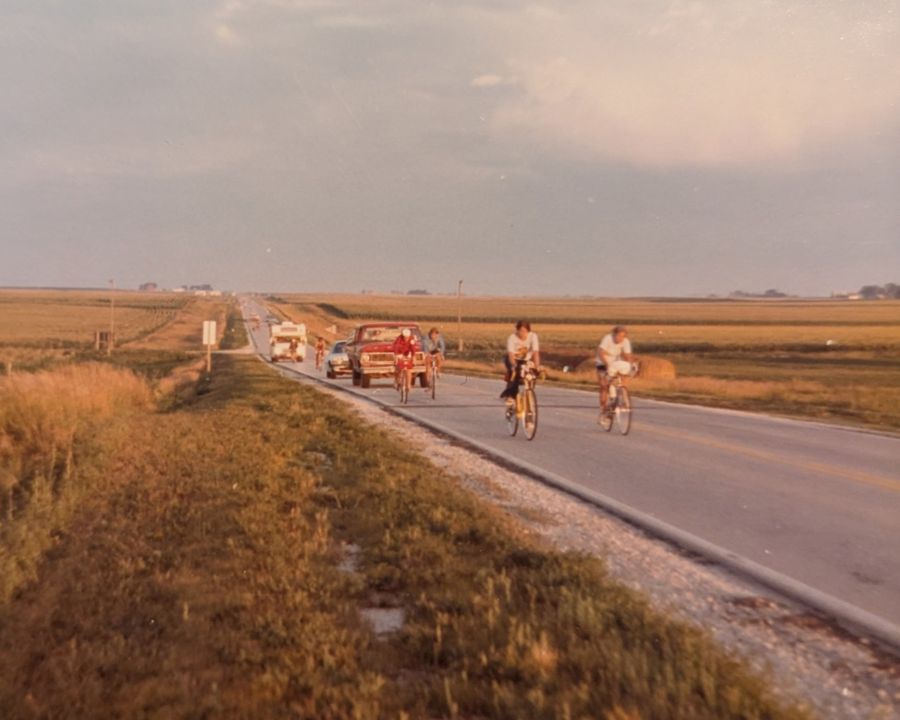
On days like this, they say “the air is close.” We had been biking since 5:30 AM. To begin riding any later would have been suicidal, as the midday heat bordered 100 degrees and headwinds blew air of 70 percent humidity from the sweating Iowa corn.
All day long, ambulances sirened by us in the passing lane as my fellow cyclists succumbed to the infernal afternoon, battling against 57 miles with 3,600 feet of elevation gain. But I found it hard to stop pedaling. Without the lick of breeze created by my pace, my own burning sweat would flood my eyes. When finally, at 2:30 PM, we got to the middle-school sports field that was to be our campground, we dumped our bags in the shadeless grass and deferred setting up our tents to a darker, cooler hour. Tomorrow promised much of the same.
Even with AC, the scene inside the middle school was alarmingly dismal. Bodies strewn about the hallways resembled an ill-prepared army that had lost a war with the elements. Adair-Casey & Guthrie Center Junior High had been converted into a refugee camp of sorts for the nearly 40,000 cyclists who call this week their vacation. A movie played in a crowded auditorium, but we were told we couldn’t take a seat until we showered in the locker room. I stumbled through a wicked murk of evaporated sweat on my way to the gym. “At least I’m not the only one suffering,” my friend Grace said after our rinse as we joined the scattered dozens of others laying supine on the cool hardwood. We stretched for a while, but something cracked.
“Where even are we?” I asked.
“We’re in Iowa,” she answered.

America may not have the Tour de France, but we do have the Register’s Annual Great Bicycle Ride Across Iowa (RAGBRAI) — the world’s longest, largest, and oldest “recreational bike event.” It’s more a weeklong bender on wheels than it is a race. Its origin exemplifies the life hack that is journalism. In 1973, cyclists and writers John Karras and Don Kaul of the Des Moines Register wanted to go on a bike tour across the state. So they convinced their editor to pay for it, on the premise that they’d catalog America’s vanishing rurality along the way. After some light advertising they garnered 200 participants to join the inaugural roll.
Over the course of its 53-year history, RAGBRAI has attracted half a million cyclists from all over the globe. The route changes each year, but, per tradition, it always begins with dipping one’s rear wheel in the Missouri River, and ends with one’s front wheel in the Mississippi. The small towns and locales that are chosen as pit stops or overnight hosts equate the selection to winning the lottery. RAGBRAI generates $25 million worth of revenue for the state of Iowa, and one afternoon of biking through a host town pumps hundreds of thousands of dollars into the local economy. Funded by the cyclist registration fees, RAGBRAI also pays out to the dozens of host towns, as well as the Iowa Department of Transportation and Iowa State Patrol, which shut down the roads and redirect traffic to accommodate riders.
As you may have been taught, the outlined perimeters of Minnesota, Iowa, Missouri, Arkansas, and Louisiana resemble the silhouette of a chef, and this year’s route begins in the nape of his neck in Onawa and ends at the tip of his nose in Dubuque. It’s the third hilliest ride in RAGBRAI’s 53 years, with 16,027 feet of elevation gain over at least 391.4 miles. Flat as a waffle.
Iowa hadn’t been in my lineup of desirable states to bike across. I’ve enjoyed solo bike tours around Washington, Montana, and California, but as far as my narrow West Coast mind could fathom, Iowa was dull as dirt. The passionate recollections of RAGBRAI that floated around my cyclist communities suggested that I might be wrong, so I invited my friend Grace to join me. It’s very easy to have fun with Grace — she is the bubbliest person I know. Her eyes are green and her short hair is dark and curly. I have at least four inches on her, height-wise, and our friendship is one of shared spontaneity that opens portals into the heart of time. While we checked our bikes at PDX, a man behind us in line asked where we were headed.
“Iowa!” we beamed.
“Well what the hell are you going there for?” he scoffed. “It’s just corn.”
I considered this a challenge. I had been listening to Arthur Russell for weeks in preparation, and if Iowa could produce one of our finest avant-garde musicians, then certainly there was more than just corn.
Nothing could have prepared me for the corn. Looking out the windows of our shuttle from the Omaha airport to Onawa, its oceanic ripples hypnotized me. What was hiding in there? One could get lost in it and die of loneliness. It’d be just like drowning.
When we got to Onawa, the true magnitude of RAGBRAI became clear. Thousands of tents filled the fields of golf courses, schools, parks, and neighborhood yards. There was so much grass, grass everywhere. If it wasn’t corn fields or soybeans or a road or a building it was grass, impeccably mowed. The golf carts of production staff zipped around, radios squawking, while trains of bikers headed into town. We outnumbered Onawa’s residents eight to one.
Settling the logistics of this trip required Grace and I to spend several hours at our favored Portland dive (Holman’s): where to fly in and out of, and how to transport our bikes and boxes as cheaply as possible. After untangling all the moving pieces post-arrival, it was a relief to finally assemble our bikes and set up camp on the golf course, which, in the grand scheme of things, felt kind of naughty. All this grass for a few balls to roll around on, and now we were defiling the sanctity of its purpose. It’s amazing what you can get away with as a biker. Tomorrow, Sunday, would be day one, 61 miles to Harlan. I heard it was going to be hot and hilly but I figured it couldn’t possibly compare to the geography of the West, in which I had trained for so many years. I fancied that I had an edge.
Around 4:30 AM I was awoken by tent zippers and the clop of clip-in bike shoes. I pushed my ear plugs in deeper and fell back asleep. When I awoke two hours later much of the campground had already packed up. Overachievers, we huffed. We followed suit and dropped our bags off at the luggage truck, where we were assisted by a polite, curly-haired bag boy named Brai.
“Wait, is your name…”
“Yeah, my parents met here and literally named me after RAGBRAI.”
“Your name is an acronym for Bike Ride Across Iowa?” I pressed.
“I guess so.”
On a bike tour, it is a supreme luxury to have your camping gear shuttled from town to town instead of having to schlep everything in panniers, a luxury I’d never before experienced. I started the day’s ride feeling rather naked.
The rest of town had woken up with us, to sit on their front porches with their coffee and wave as we passed. After being held up by a freight train for 15 minutes, we rode out of Onawa like the Mongol Horde. The rest of Iowa spilled out before us as vast golden farmland, the earthy scent of manure drifting in with the morning breeze. Down the road, as far as I could see, were cyclists pedaling in silence — the first mile dedicated to quiet remembrance of those we’ve lost on the road. Every few feet a hay barrel displayed the name of an Iowan biker whose life had been taken in an accident involving a motorist. Just last month, I had lost a friend who’d been struck by a garbage truck on his bike. The shock reframed the privilege that is my working body; anybody who’s lost someone knows that we continue on for the ones who cannot.
In William Least Heat-Moon’s travelog Blue Highways, he recognizes, after a few thousand miles of driving around our enormous country, that “Place names are clues to the soul of a region.” I considered the nominal determinism of local residents as I rode through the towns of Turin, Soldier, Dunlap, Earling, and Westphalia. Their names evoked visions of muskets and suspenders and burlap sacks and, of course, sacks of corn. None of these names really scream “exorcism,” but as it so happens, Earling, population 397, is home to one of our country’s most extensively documented cases of demonic possession.
Emma Schmidt had been exhibiting the typical symptoms of possession since age 14: violent behavior, blasphemous outbursts, and “severe reactions to holy items.” Not just one but several demons — including her pervert dad and witch aunt, both of whom were deceased — had supernaturally possessed her body. An extensive exorcism, performed by Father Theophilus Riesinger, took course over several decades in which she reportedly spoke in tongues, levitated, contorted her body, and violently rejected blessed food. It wasn’t until she was 46 years old that the torment culminated with a month-long mega-exorcism that was cataloged by Father Carl Vogl in his popular 1935 pamphlet, titled Begone Satan! The exorcism was a success, allegedly, though she continued to experience “milder” and “quite manageable” possessions thenceforth, which probably felt like tummy aches in comparison. If this all sounds familiar, the story inspired The Exorcist.
I endured my own little exorcism as I chugged up the nine-percent grade into town, where the local church ladies awaited atop the hill with ice-cold Arnold Palmers and crisp watermelon slices. By this time the sun had settled directly overhead and my body had become a bulky ingredient in the thick midsummer stew of humidity. I wondered when I was going to start having fun.
You always know when you are getting close to the next town in Iowa when its water tower appears on the horizon, like lighthouse beacons for weary sailors. Grace and I rode towards Harlan’s tower, which led us all the way to the main campground at the high school, where we tried to set up our tent in its diminishing garlic-shaped shadow. Our executive functioning had fizzled away and we laid in the grass struggling to figure out how best to resolve our physical desperation.
“Do we shower first, or, uh, eat first, or refill our water, uh…” Grace trailed off. Whatever was happening was taking our friendship to the next level.
By now the “VIRGIN” that all first-timers write down the back of their leg in Sharpie had nearly smudged off, depriving me of something I’d enjoyed seeing stamped on the calves of middle-aged men. The demographics leaned older on account of the money and time off required to make this trip happen, although I also saw every type of body, age, and race represented on the road. Even dogs. I saw people on one-wheels, roller blades, unicycles, recumbents, tall bikes, and penny-farthings. Anything, it seemed, was possible in Iowa.
We took a shower in the school locker room before hopping on the complimentary shuttle to the downtown expo that takes place in every overnight town. It was only a ten-minute bike ride, but I was becoming acutely aware that my legs were expiring. The expo seemed like any other street fair, with vendors peddling bike gear and a main stage hosting an ’80s cover band. We met up with my friend Eric, who owns a cool music shop called Cool Music Shop in a small town in the Colorado Rockies. We’d met just a month prior, when he told me he was from Iowa. He’d affirmed that he was participating in RAGBRAI, and he became my Iowa guru.
“Where’s the Arthur Russell cover band?” I asked Eric over the jangle of Def Leppard’s “Rock of Ages.”
“Nobody in Iowa has heard of Arthur Russell,” he said.
We got up at five the next morning for our trek to Guthrie Center, a route with only two pass-through towns in 57 miles. The day started out cool, the shadow of my bike and I cast long upon the corn, the air rancid with fertilizer. In Exira we stopped to eat some cinnamon rolls served up on a “free-will donation” basis by a spunky group of elderly women, proceeds from which go to pruning their local petunia garden. I was called towards the town center’s gazebo where a graying man who had been playing Neil Diamond covers since 6:00 AM assured us that he wouldn’t stop until noon. We joined a spandexed crowd that bounced around spilling beer, losing their voices chanting “Sweet Caroline.” It was 8:00 AM.
For the rest of the morning, and also the afternoon, I pedaled alongside sparsely peppered farm homes that stood out like islands amidst thousands of acres of corn. Always the family would be outside waving from their camp chairs, selling lemonade or giving out snacks. The images of them as I passed by reminded me of the curious faces and bucolic tableaux I’d encountered in the photographs taken from the window of RFK’s funeral train.
There wasn’t a stick of shade when the thermometer pushed 100 degrees. I might as well have been biking through the Australian Outback. The word “Iowa” had, over the course of two delirious days, become a non-word. It rolled out of my mouth like a dip in a roller coaster. I-Owa, Io-Wa, Iow-A. Too many vowels, I thought, like the caterpillar puffing on his hookah in Alice in Wonderland. It is claimed by some that the word “Iowa” is based on the Dakota ayúxba, which means the “sleepy ones,” and by the French was written Aiouez, until gradually the word was anglicized. The sleepy ones… This made sense to me. I was getting pretty tired myself.
But still, the corn beckoned. And at certain angles the fields reached to the end of the earth. I could just roll out there and drop off into the blue sky, forever. Oh, here comes another hill. If I’ve learned anything from cycling, it’s that when you go up a hill, you come down a hill. Such is life. I ride a steel-framed gravel bike, which doesn’t lend itself to aerodynamics, but I can nevertheless bend over my handlebars until I’m the shape of a bullet and save myself about three seconds of extra pedaling up the next hill, of which there are plenty.
I was told this was a party, so I tried drinking a beer at Mr. Pork Chop, which is a big deal around these parts. Started forty years ago, the giant pink pig-shaped school bus has become a favored pit stop, serving up an 11 oz. pork chop in a greasy little napkin. Two beers cost just $5.
The pit stops along the RAGBRAI route, besides the towns themselves, are the farms on the side of the road that host legacy beer tents and food vendors and often throw a good party with jerry-rigged slip ‘n’ slides and sprinklers. They all seemed to forget the slip ‘n’ slides today though, when we needed them the most.
My Miller Lite sweated out faster than I could drink it down and left me feeling ill. The ambulance sirens wailed on their way to pick up heat-exhausted participants, and the SAG (support and gear) Wagon roved to and fro, rescuing cyclists and their bikes who couldn’t withstand the rest of the toilsome journey to Guthrie Center. I attempted to tack onto the peloton of the athletic road bikers and catch their drift like one of those suckerfish catching a free ride on sharks, but I could never keep up.
One of the great joys of RAGBRAI is that it may be the easiest place in the world to make friends. Surround yourself with thousands of people obsessed with riding their bikes, all of whom are suffering, and one of them is bound to strike up a conversation. Suffering in the heat is a great unifier. Just when I’d find myself losing morale I’d end up in ephemeral chats about the weather, the hills, where we were from, had I done this before, and so on, before we’d lose each other in the river of spokes and spandex. My decision to wear flip-flops proved to be a sufficient icebreaker. I rode one discussion regarding the blueprinting of clip-in flip-flops through the last ten insufferable miles of headwinds to Guthrie Center.
Brai carried our bags to a patch in the sportsfield before we headed inside to escape the hottest hour. It could’ve been my last few brain cells processing the absurdity of wandering around somewhere I’d never dreamed of being under entirely abnormal conditions, but I couldn’t stop cackling as I plodded through the school hallways, evading the splayed bodies too spent to change out of their chamois.
Endorphins had by now imbued me with a second wind, so I biked over to the local pool to sync with Eric who grew up not too far away, in the town of Carroll. The water was murky from the hundreds of people cooling off after the long day, but it had fountains and waterslides and diving boards and everyone was smiling. All of a sudden I was having fun, realizing the worst of the weather and the hills was behind us. I made friends with a diving coach from Kentucky and we judged the divers together, mostly guys still in their chamois doing belly flops and one gorgeous girl with a porkchop-sized outline of Iowa tattooed on her ribs. I was beginning to understand.
Afterwards we made our way to a dive bar where local semitruck driver Donny Shots was playing Nirvana covers and raising money to address the legal fees of his fourth DUI. Storm clouds were forming overhead, painting a spectral gray and pink sunset and offering the day’s first cool breeze, which sent the whole town yipping like a pack of coyotes. This much was clear — the party I had heard so much about had finally begun, so we all got drunk and forgot about the last two days.
Over Donny Shot’s patchy strumming of “Jessie’s Girl,” Eric told me about how the humidity bubbles in Iowa until it bursts in summer storms. Above, the clouds strobed with lightning. A tornado watch had been issued, but I was told that it was a bunch of hooey. Eric related that in his dad’s 24 years of doing RAGBRAI, those were the two hardest days he’d ever had, which relieved Grace and I of the notion that we were pussies. The fun times had clearly begun.
At the beginning of a bike tour you will fall asleep on the ground with your legs throbbing and wonder how you could possibly wake up and do it all over again. After you black out and wake up, quads galvanized, you are eager to get back in the saddle. We rode out of Guthrie Center with the standard neighborly fanfare, but I had to start inventing new ways to sit on my bike, my $5 thrift-store chamois having bestowed some saddle sores upon my heinie. But being on tour, cycling for several hours a day, induces a mechanized trance where the only thoughts rippling through your smooth brain are: I’m Hungry, I’m Tired, I’m Thirsty.
Day three, 61 miles to Boone, and I could measure all the roads with a protractor. In David Foster Wallace’s essay “Derivative Sport in Tornado Alley,” he maps the psychogeography of the Midwestern mind in all its vectors and grids, blaming it for his penchant for mathematics and intuitive command over the geometry of tennis. He misses something, though. Moving through Iowa on a bicycle, the contours soften. You sink into your environment, effortlessly absorbing the sensational nuances of place. When you’re going that slow you move with the world, while in a car it’s as shallow as a movie playing in your window. I could recreate a road map of Iowa using a ruler, but I could never measure the awe of witnessing a landscape in all its dimensions via bike, expansive and ripe to chance.
We stopped for breakfast in Yale (“I Went to Yale,” boasted their merch shirts), where I had an 8:00 AM pork-chop sandwich, and for lunch we pulled over at a farm for beer and rhubarb pie (I kept pronouncing it “rebar”), where the owner, Bridgette, stumbled over to introduce herself and sit with us girls.
“These are my 3,000 acres of corn,” she gestured, her teeth stained with wine.
She begged us to go to her neighbor Tony Sweets’ house just down the road (Donny Shots’ likely cousin) to tell him Bridgette said hi and to drink his homebrewed beer. I accepted this as my day’s first side-quest.
About a minute down the road was Tony Sweets’ house, his garage door wide open to his spectacular man cave, which was adorned with cheeky Second Amendment signage and vintage condom dispensers. “WARNING: Does not play well with liberals,” read the plaque next to his kegs of free homebrewed ale. I told Tony Sweets that Bridgette said hi.
“That woman has been sending people here all day,” he snorted.
I liked Tony Sweets — his gray mustache flapped as he talked like an old-timey cartoon, and he made really good apple-pie moonshine, which I considered my gold coin for fulfilling Bridgette’s charge. We lingered for a while, chatting with folks from all over the country, his garage a sort of national treasure.
At the next farm we pet some goats and a highland cow, and we met a handsome New Yorker named Bill, who invited us to prom on Friday. RAGBRAI has a festival element to it, where certain teams take on the energy of Burning Man theme camps that organize parties throughout the week, but instead of traipsing around a hedonistic utopia where one’s wildest fantasies come to life, I was biking into the heart of Iowa. Uncannily, Grace and I had daydreamt bike-prom fantasies earlier in the week. But who to ask? Now here were Bill and his Baltimore crew, the Rat Queens, making it actual.
The landscape began to change, finally, growing lush and arborous, and the neighborhoods grew notably wealthier as we rolled into Boone. My diet had been fluctuating between that of a ten-year-old boy and that of a middle-aged truck driver, so for dinner I had a hot dog, Cheetos, onion rings, and Pepsi at the cafeteria of the community college we were camping at. In line, I befriended Adam — who invited me to a “networking event” put on by the Business Casual team, a bunch of lean and attractive young DC professionals with nose rings who had been wearing cut-off dress shirts and ties all week.
“Everyone’s so old here, us twenty-to-thirty-somethings have to stick together,” he winked, handing me a business card with a QR code on it that linked to tomorrow night’s party coordinates, which appeared to be next to an O’Reilly’s Auto Parts.
By morning I pulled up to a sign informing me that I was at the geographic center of Iowa.
“You can hear the corn grow,” they say, so I stood for a while amongst the fields, which spread out in every direction forever, and waited. “I close my eyes and listen / To hear the corn come out” crooned Arthur Russell in my head. The stalks shuddered in the breeze. I was beginning to understand what he felt when he wrote “Iowa Dream.”
It was 68 miles to Marshalltown and I couldn’t wait any longer for the corn to grow, so I pedaled on. Some of RAGBRAI’s more bonafide teams own full-length bedecked buses to use as their private support vehicles solely for this one week, and as we rolled into Colo a few had parked together and were throwing a morning kegger that sidetracked us for over an hour. I drank a few beers out of a borrowed pool noodle and we continued on, properly boozed, impervious to pedestrian alcohol laws, and unstoppable in spirit. Kids sprayed us with hoses as we passed through town after town. By afternoon, we reached the most prodigious slip ‘n’ slide of the week, where the young farm owners served up vodka pickle shots. Bikers barreled down the soapy tarp in their chamois, or nothing at all.
RAGBRAI veterans had informed me of the event’s nudist history but chalked up its noticeable lack in recent years to the cellular panopticon. Whether the orgies were still alive and well was anyone’s guess; I had yet to be invited. Otherwise, it appeared that not much else had changed, except for technological advancements in the outdoor industry. If you look through photographs from the early years, you’ll be hard-pressed to find any Lycra. Men and women alike sported small denim shorts, sneakers, high socks, and cotton T-shirts. Sifting through the Register’s RAGBRAI photo archive, spandex didn’t enter the picture until the ’80s, which I’m eager to blame for why we’ve grown so soft. Don’t even get me started on “urban-inspired sportswear.”
In its inaugural year, RAGBRAI minted its first folk-hero, Clarence Pickard — an 83-year-old retired farmer from Indianola, Iowa, who hadn’t ridden a bike since childhood but finished the whole 412-mile journey on a rusty women’s Schwinn wearing the same long-sleeved shirt, trousers, woolen long underwear, and safari-style silver pith helmet.
“By the end of the day, everyone’s tired and hates each other,” reads a quote in the Register’s coverage that year. “But the one thing that keeps you going is that long after you’ve quit riding, somewhere back there — still riding — is Mr. Pickard, and he’s smiling. He’s 83 years old, and if he can make it, then, by God, the rest of us can, too.” Seven-time award-winning Tour de France racer Lance Armstrong has participated in RAGBRAI at least eight times, but that doesn’t interest me much.
We arrived in Marshalltown, birthplace of the Maid-Rite loose meat sandwich, for what it’s worth. Our campground surrounded the town YMCA, and it had a water park I couldn’t pass up. Still in my cycling clothes, I went down every slide and jumped off every diving board within the ten minutes before it closed, seizing the opportunity to launder my sports bra. A community dinner was being served in the gymnasium, heaping bowls of mac ‘n’ cheese topped with pulled pork and BBQ sauce. Grace and I ate on the bleachers with Brody, a tall gangly guy from Omaha who we’d met at Donny Shots’ set in Guthrie Center. He confided in us about his blossoming romance back home with Shelby.
“Guys, is it weird,” he stammered, “that we’ve been dating for three weeks and I told her I think I love her?”
Having once moved in with a guy I knew for two months, and with Grace freshly in love with someone she just met on a roadtrip, we shook our heads. Nothing weird about it.
“You can’t put a timer on matters of the heart,” was more or less what I said, but I had lost my train of thought when someone who vaguely resembled my childhood crush Milo Thatch from Atlantis: The Lost Empire sat next to us to eat his dinner. He nodded in our direction and crunched into an apple. He wore a bright handmade yellow bike cap and blue flip-flops and he had one of those boy-band smiles that made your heart sink. He would be my prom date.
“What did Shelby say?” Grace asked.
“She said, ‘Shut up.’”
The thing about me is that I’ll never miss out on the bit, and besides, I had reporting to do. Going against every aching muscle in my body, I got ready to shake some hands at the networking summit. The coordinates led me to an overgrown field nestled between a brown river and an abandoned manufacturing plant where a young and jittery crowd in Goodwill office-wear gathered. Everyone wore nametags labeled with their imaginary professional departments — HR, Sales, Accounting.
I greeted Adam and asked him how they’d managed to find this place. “A bartender from one of the other towns told me to come here,” he shrugged. “He said this is where all the middle schoolers go to fight.”
The networking event became a singles mixer, the week’s mounting adrenaline curdling into collective libido, but I had averaged five hours of sleep a night and was too tired to find out what might happen next. I decided to call it early, considering the next day was the big “century” ride — over 100 miles to the next host town. Adam told me he and a few others on his team were planning on doing the optional 250K (160 mile) loop in masochistic celebration of the semiquincentennial.
“And y’all are still hosting this party all night?” I asked.
“Well, yeah,” he said. “We only get one week in Iowa.”
My metabolism had assumed superhuman capacity, so it only made sense that, for today’s 104-miler, I’d start the morning with two hard-boiled eggs, a brownie, zucchini bread, and an ice-cream cone, each served gratis at a friendly farmstand outside of Boone. If this high-calorie breakfast was to become high-octane fuel, then the Busch Light I washed it all down with was NOS.
Hitting the road, Grace and I were soon absorbed by a new group of friends who had reunited at RAGBRAI to celebrate their five-year anniversary of biking across America. The journey has always piqued my interest, but enduring the Great Plains on a bike sounds like a spiritual quest I’m not yet prepared for. Time passed frictionlessly with this crew, as we came up with a road-trip game called That’s My Cow, whereupon first sight of a cow (which is rarer than you’d imagine) you proclaim, “That’s My Cow.” When you bike past a graveyard you can kill someone’s cow; when you bike past a church you can revive your dead. The point of the game is to have the most cows.
We were five hours in with several more ahead. Times like these I’d tune into the corn, which had taken on a psychedelic quality. I wondered how much of it had to do with the online debates regarding its extraterrestrial origins. The surrounding corn seemed to have jumped a gap in its evolutionary line, growing at supernatural rates, not to mention the crop circles…
Most of all, it was stupefying. My mind tends to operate according to the parameters of my environment. In a dense forest, my thoughts bounce off the trees like pinballs. In the desert they run off quietly into the horizon. In Iowa, they vanish into the corn like the dead baseball players in Field of Dreams.
In a Mayan myth, the gods first tried making people out of mud, which dissolved. They then used wood, which lacked soul. It wasn’t until they constructed us from corn that the Mayan gods birthed humankind. As such, I had made it to the land of creation.
But if the spiritual essence of corn is hard to grasp, let’s put it into numbers. Over 90 percent of Iowa’s total land area is dedicated to agriculture, producing up to six percent of the world’s corn supply — more than the annual output of the entire European Union. Roughly 99 percent of Iowa’s corn is “field corn” that’s used for industrial, fuel, and feed purposes, with edible sweet corn making up the remaining one percent. As field corn is jam-packed with highly adaptable starches, sugars, and polymers, it’s able to replace petroleum and other chemicals that are used in thousands of everyday products (my favorite being fireworks — could a kernel of corn ever imagine itself embarking on such a spectacular journey across the sky?).
I ate another ice-cream sundae and my first-ever Chick-fil-A sandwich to fuel the remaining 20 miles to Independence, where we’d soon set up our tent on the perimeter of an elementary-school playground. The varying tan lines on my thighs were starting to resemble scoops of neapolitan ice cream. Arriving in town we celebrated our athletic feat at the bar, where Christmas carols blasted from the speakers and the cyclists, officially off the hook now that the next two days were each under 42 miles, got sloppy. They danced on chairs and motorboated their wives. Hell, they don’t call it Independence for nothing. My legs had stopped hurting and the beginning of the week felt like an old dream. Call it Stockholm syndrome, but I didn’t want Iowa to ever end. I realized that to live a good life, all I have to do is pedal and look around. No purpose is as pure as getting from here to there.
Most of Iowa’s rivers are poisoned with nitrates and phosphorus runoff. No sane local would ever get into the Maquoketa River, which runs through the town of Manchester, but we had thrown logic out the window a while ago. Someone handed me an innertube, which I used to go down the rapids a few times, everyone tumbling around in their chamois. A duo in Reno 911! costumes and fake mustaches held me at spray-gun point and shot tequila into my mouth. It was Friday afternoon, soon-to-be Prom Night. This was as close to a beach party as Iowa could get.
For the occasion, I joined Brody and Grace to score some new duds at Walmart. Grace’s ruffled white dress exhibited Walmart’s polyester take on cottagecore. Brody decided on a kitschy pastel Hawaiian shirt. I, for one, never go anywhere without packing a dress.
The ride to Dyersville, the “Farm Toy Capital of the World,” was easy as pie. We set up camp at a big park in the center of town, and Bill texted me the coordinates of prom, which I had resigned myself to attending stag. The location showed up on my phone as a blue dot on a creek next to a railroad on the outskirts. We heard the local church was serving up spaghetti and meatballs on frisbees beforehand, so we made our way over. Out front stood my Milo Thatch-lookalike. Having acknowledged each other’s existence the other day granted me all the confidence I needed to invite him to prom on the spot. Dear reader, it worked.
“I haven’t heard of a party all week.” He smiled that smile. “It was starting to feel like Groundhog Day.”
I considered my feminine wiles a gift to him and I both. We agreed to meet at prom, and his friends offered us some mushroom capsules, which we ate on the spot.
My favorite time of day is that forgotten blue hour after sunset, when people usually shut their blinds and turn on their lights. The evening’s pastels intensified into rich jewel-tones. A mysterious, supernatural green pulsated from the sky. We crossed a field on our way to the coordinates, where I found myself surrounded by the dopey twinkle of fireflies. What the Midwest lacks in drama, it makes up for in fireflies. I followed the strobing lights and bumping music in the distance to the sandy shore of a creek where everyone was dressed as formally as they could be, given the circumstances: barefoot in silk dresses, and ties over T-shirts.
“If you build prom, THEY WILL COME!” yelled The Person Holding the Discoball. Bill and the Rat Queens from Baltimore had procured coolers full of booze and a massive speaker that we flittered around like moths. I found my date across the dance floor and pulled him to the ground with me, my weary legs incapable of traversing the sand. We took turns fetching each other’s beers and lighting each other’s cigarettes, talking about Anaïs Nin and the vanishing chaparral of our shared hometown of San Diego. I lay with my head in his lap while others played spin the bottle and made out in dark corners. The end of my night is between me and the fireflies.
The final day was closing in on us, and it didn’t help that the fog had rolled in and exaggerated our deflating mood, but we did have the Field of Dreams to look forward to as our first stop of the morning. Some people lined up at the dugout for their turn to step into the batter’s box and get pitched balls from the real-live ghost of Eddie Cicotte. The rest of us loitered in the outfield, where I jumped out of the way of a grounder just in time for it to bounce off my wheel. Other hitters vanished their balls into the corn surrounding the outfield.
“Is this heaven?” asks Shoeless Joe Jackson in Field of Dreams, just feet from where I now stood.
“No, this is Iowa!” replies Kevin Costner in the most iconic line of the film. To me, anyways. In another iconic scene, his costar, James Earl Jones, is invited into the corn by the ghosts and Costner starts throwing a fit because he isn’t. I now understood his frustration. I wanted to be devoured by its mystery, its infinitude. There was something hiding in there for me, but I couldn’t figure out what.
The last day’s ride was only 35 miles and would take us to Dubuque, the oldest and hilliest town in Iowa, but we had no time to dally since our shuttle to the Des Moines airport was scheduled to depart in the early afternoon. It felt sacrilegious to wrap things up so quickly. As we neared Dubuque, I grabbed a Busch from the hand of a little girl passing them out from the sidewalk, figuring that 10 AM would be a good time to start drinking. Dubuque’s hills dipped up and down like a roller coaster. We pedaled up to the final crest, which poured straight down into the Mississippi.
We waited for the remainder of our group, there at the crest, before bombing down the grade en masse. Dilapidated brick buildings and cheering families whizzed by. At the river we lined up and dipped our front tires. The only direction to go from there was forward.